Under the Hill, and Other Essays in Prose and Verse — Inside the Classic
Edition facts
Before opening Under the Hill, and Other Essays in Prose and Verse — Inside the Classic, the edition data offers a quick orientation: 13,921 words, 1 hr 1 min estimated reading time, and 2 detected text sections.
The text analysis averages about 24.9 words per sentence, while the detected sections provide another way to judge how the source is divided.
Project Gutenberg metadata also associates the work with “English literature -- 19th century,” connecting these edition facts with the source record’s subject description.
Calculated from edition completeness, EPUB availability, text structure and catalogue metadata. Not a user rating.
How this score is calculated
- Description quality20 pts
- Title & short description10 pts
- Source metadata20 pts
- Text length15 pts
- Chapters / structure15 pts
- EPUB file integrity20 pts
Total of 100 points, scaled to a 2.5-5.0 range. Editions with an empty description or a missing EPUB file are not scored.
Read the Text
Literature were developing, he playfully suggested that if he was not "performing an R.A. duty he was doing a neighbourly one." He asked to see the originals of Beardsley's "Yellow Book" pictures (Vol. I.), and then remarked: "Ah! what wonderful line! What a great artist!" and then _sotto voce,_ "if he could only draw." My retort was, "Sir Frederick, I am tired of seeing men who can _only_ draw." "Oh! yes," said Sir Frederick, "I know what you mean, and you are quite right too."
There was indeed a universal howl against the cover and title-page designs, which it will be remembered were both the work of Beardsley. However the conductors of "The Yellow Book" were nothing daunted and proceeded to announce that for each volume in the future Mr. Beardsley would complete new cover and title-page designs. This was an entirely fresh idea, and has since been adopted by most of the leading illustrated magazines both in England and America.
An interesting and original contribution to Volume II. of "The Yellow Book," one which did not fulfil its object however, was a criticism of the contents of Volume I. by the late P. G. Hammerton. Mr. Hammerton, being merely an art critic and not a humorist, did not fulfil the commission quite in the spirit in which it was given him; the conductors of the quarterly desired criticism, even though adverse to themselves. I am sure that nothing would have delighted the two editors more than a good slating in their own pages, but Mr. Hammerton, always conscientious, found nothing but praise for its contents, especially for Beardsley's work.
Beardsley's defect as Art Editor was youth. He would not take himself seriously: as an editor and draughtsman he was almost a practical joker, for one had, so to speak, to place his drawings under a microscope, and look at them upside down. This tendency on the eve of the production of Vol. V., during my first visit to the United States, rendered it necessary to omit his work from that volume.
Beardsley was responsible for the art of the first four volumes, and it must be frankly confessed that, when he severed his connection with the magazine, the quarterly suffered an irretrievable loss.
Soon after this period, Mr. Arthur Symonds started "The Savoy," as a rival, to which Beardsley, again as Art Editor, contributed another fine series of drawings.
I well remember being interviewed in New York regarding the alleged decadence in Beardsley's work. I said then, and repeat now, that he merely lashed the follies of his time, that he was the Hogarth of his day, and that he had no more sympathy with decadence than Hogarth had for the vices depicted in "The Rake's Progress" and "Marriage à la Mode." Knowledge must never be confounded with sympathy. I will go farther, and declare that Beardsley, by his grotesque and powerful pictures of several hideous phases or life, dealt a death blow to decadence. Had he lived till now, it is quite possible that the Royal Academy might have justified its existence by recognising in him the greatest exponent of the most vital of the graphic arts--namely, Black and White. In support of this theory it may be well to point out that Mr. Harland is now the delight or millions by his charming love romances, and that "Max" in his brilliant weekly articles in the _Saturday Review_ pleads eloquently for an intelligent drama.
It was not often that Beardsley took up his pen to write to the newspapers, preferring to allow the hostile and adverse criticism with which he was continually assailed to confute themselves. On two occasions, however, he did so, and the letters he wrote will be round included in this volume. The first, I think, with the accompanying illustration, explains itself. The second was the outcome of the following criticism by the _DAILY Chronicle._ March I, 1894, on the frontispiece of Mr. John Davidson's "Plays".
"Mr. Beardsley has contributed a frontispiece à propos of 'Scaramouch in Naxos' in which one or two well-known faces of the day are to be recognised--an error or taste which is to be regretted."
The subjects of Beardsley's two portraits were Mr. Wilde and Sir Augustus Harris; the latter Beardsley considered his debtor by virtue of his having taken half a crown at Covent Garden Theatre without providing him with a seat.
Aubrey Beardsley was born on August 21, 1872, and died on March 16, 1898. During his short life he carried the art of Black and White further than any man since Albert Dürer. On his death prophetic assurances were not wanting that the "Beardsley cult" or "craze," as it was generally called, was doomed to extinction with the death of its high priest, but so far from this anticipation being realised, his work now enjoys a greater appreciation and more intelligent sympathy than was granted to it, save by an esoteric few, during his lifetime.
Although it is impossible, with any degree of accuracy, to state to what extent Beardsley's popularity has increased during the last few years, evidence is not wanting to show that his following is both enthusiastic and loyal. This applies not only to Great Britain, but equally to America, whilst in Germany, France, Belgium, Russia and Holland, it is safe to affirm that his reputation is steadily growing, especially in Germany. Indeed, it is obvious to the most superficial observer that there is hardly a Black and White artist working to-day who has not in some subtle way been influenced by the master.
More than three-fourths of Beardsley's work passed through my hands, and to my knowledge he never used Chinese White. I am the fortunate possessor of the originals of over eighty of his principal drawings. I get applications from would-be purchasers of these from different parts of the world almost daily, but as yet I have withstood all temptations to part with these treasures, which I regard as the chief monument of the greatest, most brilliant, the wittiest, and the most lovable man it has ever been my privilege to know.
VIGO STREET, W. _July_ 1903.
DEDICATION TO "UNDER THE HILL" UNDER THE HILL THE THREE MUSICIANS THE BALLAD OF A BARBER TRANSLATION OF CATULLUS: CARMEN CI TABLE TALK OF AUBREY BEARDSLEY TWO LETTERS OF AUBREY BEARDSLEY
_AUBREY BEARDSLEY AT MENTONE, IN THE ROOM IN WHICH HE DIED Frontispiece_ _THE ABBÉ_ _THE TOILET OF HELEN_ _THE FRUIT BEARERS_ _THE ASCENSION OF SAINT ROSE OF LIMA_ _FOR THE THIRD TABLEAU OF "DAS RHEINGOLD_" _THE THREE MUSICIANS_ _THE THREE MUSICIANS_ _TAILPIECE TO "THE THREE MUSICIANS"_ _THE COIFFING_ _CUL-DE-LAMPE TO "THE BARBER_" _ATE ATQUE VALE_ _TITLE-PAGE TO VOL. I. OF "THE YELLOW BOOK"_ _FRONTISPIECE TO "PLAYS" BY JOHN DAVIDSON _ _ARBUSCULA_ _PORTRAIT SKETCHES_ _L'ABBÉ MOURET_
THE MOST EMINENT AND REVEREND PRINCE
CARDINAL OF THE HOLY ROMAN CHURCH TITULAR BISHOP OF S. MARIA IN TRASTAVERE ARCHBISHOP OF OSTIA AND VELLETRI NUNCIO TO THE HOLY SEE IN NICARAGUA AND PATAGONIA A FATHER TO THE POOR A REFORMER OF ECCLESIASTICAL DISCIPLINE A PATTERN OF LEARNING WISDOM AND HOLINESS OF LIFE THIS BOOK IS DEDICATED WITH DUE REVERENCE BY HIS HUMBLE SERVITOR A SCRIVENER AND LIMNER OF WORLDLY THINGS WHO MADE THIS BOOK
_Most Eminent Prince_,
I know not by what mischance the writing of epistles dedicatory has fallen into disuse, whether through the vanity of authors or the humility of patrons. But the practice seems to me so very beautiful and becoming that I have ventured to make an essay in the modest art, and lay with formalities my first book at your feet. I have it must be confessed many fears lest I shall be arraigned of presumption in choosing so exalted a name as your own to place at the beginning of this history; but I hope that such a censure will not be too lightly passed upon me, for if I am guilty it is but of a most natural pride that the accidents of my life should allow me to sail the little pinnace of my wit under your protection.
But though I can clear myself of such a charge, I am still minded to use the tongue of apology, for with what face can I offer you a book treating of so vain and fantastical a thing as love? I know that in the judgment of many the amorous passion is accounted a shameful thing and ridiculous; indeed it must be confessed that more blushes have risen for love's sake than for any other cause and that lovers are an eternal laughing-stock. Still, as the book will be found to contain matter of deeper import than mere venery, inasmuch as it treats of the great contrition of its chiefest character, and of canonical things in certain pages, I am not without hopes that your Eminence will pardon my writing of a loving Abbé, for which extravagance let my youth excuse me.
Then I must crave your forgiveness for addressing you in a language other than the Roman, but my small freedom in Latinity forbids me to wander beyond the idiom of my vernacular. I would not for the world that your delicate Southern ear should be offended by a barbarous assault of rude and Gothic words; but methinks no language is rude that can boast polite writers, and not a few such have flourished in this country in times past, bringing our common speech to very great perfection. In the present age, alas! our pens are ravished by unlettered authors and unmannered critics, that make a havoc rather than a building, a wilderness rather than a garden. But, alack! what boots it to drop tears upon the preterit?
It is not of our own shortcomings though, but of your own great merits that I should speak, else I should be forgetful of the duties I have drawn upon myself in electing to address you in a dedication. It is of your noble virtues (though all the world know of 'em), your taste and wit, your care for letters, and very real regard for the arts that I must be the proclaimer.
Though it be true that all men have sufficient wit to pass a judgment on this or that, and not a few sufficient impudence to print the same (these last being commonly accounted critics), I have ever held that the critical faculty is more rare than the inventive. It is a faculty your Eminence possesses in so great a degree that your praise or blame is something oracular, your utterance infallible as great genius or as a beautiful woman. Your mind, I know, rejoicing in fine distinctions and subtle procedures of thought, beautifully discursive rather than hastily conclusive, has found in criticism its happiest exercise. It is a pity that so perfect a Mecænas should have no Horace to befriend, no Georgies to accept; for the offices and function of patron or critic must of necessity be lessened in an age of little men and little work. In times past it was nothing derogatory for great princes and men of State to extend their loves and favour to poets, for thereby they received as much honour as they conferred. Did not Prince Festus with pride take the masterwork of Julian into his protection, and was not the Æneis a pretty thing to offer Cæsar?
Learning without appreciation is a thing of naught, but I know not which is greatest in you--your love of the arts, or your knowledge of 'em. What wonder then that I am studious to please you, and desirous of your protection. How deeply thankful I am for your past affections you know well, your great kindness and liberality having far outgone my slight merits and small accomplishment that seemed scarce to warrant any favour. Alas I 'tis a slight offering I make you now, but if after glancing into its pages (say of an evening upon your terrace) you should deem it worthy of the remotest place in your princely library, the knowledge that it rested there would be reward sufficient for my labours, and a crowning happiness to my pleasure in the writing of this slender book.
The humble and obedient servant of your Eminence,
The Abbé Fanfreluche, having lighted off his horse, stood doubtfully for a moment beneath the ombre gateway of the mysterious Hill, troubled with an exquisite fear lest a day's travel should have too cruelly undone the laboured niceness of his dress. His hand, slim and gracious as La Marquise du Deffand's in the drawing by Carmontelle, played nervously about the gold hair that fell upon his shoulders like a finely-curled peruke, and from point to point of a precise toilet the fingers wandered, quelling the little mutinies of cravat and ruffle.
It was taper-time; when the tired earth puts on its cloak of mists and shadows, when the enchanted woods are stirred with light footfalls and slender voices of the fairies, when all the air is full of delicate influences, and even the beaux, seated at their dressing-tables, dream a little.
A delicious moment, thought Fanfreluche, to slip into exile.
The place where he stood waved drowsily with strange flowers, heavy with perfume, dripping with odours. Gloomy and nameless weeds not to be found in Mentzelius. Huge moths, so richly winged they must have banqueted upon tapestries and royal stuffs, slept on the pillars that flanked either side of the gateway, and the eyes of all the moths remained open and were burning and bursting with a mesh of veins. The pillars were fashioned in some pale stone and rose up like hymns in the praise of pleasure, for from cap to base, each one was carved with loving sculptures, showing such a cunning invention and such a curious knowledge, that Fanfreluche lingered not a little in reviewing them. They surpassed all that Japan has ever pictured from her maisons vertes, all that was ever painted in the cool bath-rooms of Cardinal La Motte, and even outdid the astonishing illustrations to Jones's "Nursery Numbers."
"A pretty portal," murmured the Abbé, correcting his sash.
As he spoke, a faint sound of singing was breathed out from the mountain, faint music as strange and distant as sea-legends that are heard in shells.
"The Vespers of Helen, I take it," said Fanfreluche, and struck a few chords of accompaniment, ever so lightly, upon his little lute. Softly across the spell-bound threshold the song floated and wreathed itself about the subtle columns, till the moths were touched with passion and moved quaintly in their sleep. One of them was awakened by the intenser notes of the Abbé's lute-strings, and fluttered into the cave. Fanfreluche felt it was his cue for entry.
"Adieu," he exclaimed with an inclusive gesture, and "good-bye, Madonna," as the cold circle of the moon began to show, beautiful and full of enchantments. There was a shadow of sentiment in his voice as he spoke the words.
"Would to heaven," he sighed, "I might receive the assurance of a looking-glass before I make my debut! However, as she is a Goddess, I doubt not her eyes are a little sated with perfection, and may not be displeased to see it crowned with a tiny fault."
A wild rose had caught upon the trimmings of his ruff, and in the first flush of displeasure he would have struck it brusquely away, and most severely punished the offending flower. But the ruffled mood lasted only a moment, for there was something so deliciously incongruous in the hardy petal's invasion of so delicate a thing, that Fanfreluche withheld the finger of resentment and vowed that the wild rose should stay where it had clung--a passport, as it were, from the upper to the under world.
"The very excess and violence of the fault," he said, "will be its excuse;" and, undoing a tangle in the tassel of his stick, stepped into the shadowy corridor that ran into the bosom of the wan hill--stepped with the admirable aplomb and unwrinkled suavity of Don John.
Before a toilet that shone like the altar of Notre Dame des Victoires, Helen was seated in a little dressing-gown of black and heliotrope. The coiffeur Cosmé was caring for her scented chevelure, and with tiny silver tongs, warm from the caresses of the flame, made delicious intelligent curls that fell as lightly as a breath about her forehead and over her eyebrows, and clustered like tendrils round her neck. Her three favourite girls, Pappelarde, Blanchemains and Loreyne, waited immediately upon her with perfume and powder in delicate flagons and frail cassolettes, and held in porcelain jars the ravishing paints prepared by Châteline for those cheeks and lips that had grown a little pale with anguish of exile. Her three favourite boys, Claud, Clair and Sarrasine, stood amorously about with salver, fan and napkin. Millamant held a slight tray of slippers, Minette some tender gloves, La Popelinière--mistress of the robes--was ready with a frock of yellow and white, La Zambinella bore the jewels, Florizel some flowers, Amadour a box of various pins, and Vadius a box of sweets. Her doves, ever in attendance, walked about the room that was panelled with the gallant paintings of Jean Baptiste Dorat, and some dwarfs and doubtful creatures sat here and there lolling out their tongues, pinching each other, and behaving oddly enough. Sometimes Helen gave them little smiles.
As the toilet was in progress, Mrs. Marsuple, the fat manicure and fardeuse, strode in and seated herself by the side of the dressing-table, greeting Helen with an intimate nod. She wore a gown of white watered silk with gold lace trimmings, and a velvet necklet of false vermilion. Her hair hung in bandeaux over her ears, passing into a huge chignon at the back of her head, and the hat, wide-brimmed and hung with a vallance of pink muslin, was floral with red roses.
Mrs. Marsuple's voice was full of salacious unction; she had terrible little gestures with the hands, strange movements with the shoulders, a short respiration that made surprising wrinkles in her bodice, a corrupt skin, large horny eyes, a parrot's nose, a small loose mouth, great flaccid cheeks, and chin after chin. She was a wise person, and Helen loved her more than any other of her servants, and had a hundred pet names for her, such as Dear Toad, Pretty Poll, Cock Robin, Dearest Lip, Touchstone, Little Cough Drop, Bijou, Buttons, Dear Heart, Dick-dock, Mrs. Manly, Little Nipper, Cochon-de-lait, Naughty-naughty, Blessed Thing, and Trump. The talk that passed between Mrs. Marsuple and her mistress was of that excellent kind that passes between old friends, a perfect understanding giving to scraps of phrases their full meaning, and to the merest reference a point. Naturally Fanfreluche the newcomer was discussed a little. Helen had not seen him yet, and asked a score of questions on his account that were delightfully to the point.
The report and the coiffing were completed at the same moment.
"Cosmé," said Helen, "you have been quite sweet and quite brilliant, you have surpassed yourself to-night."
"Madam flatters me," replied the antique old thing, with a girlish giggle under his black satin mask. "Gad, Madam; sometimes I believe I have no talent in the world, but tonight I must confess to a touch of the vain mood."
It would pain me horribly to tell you about the painting of her face; suffice it that the sorrowful work was accomplished; frankly, magnificently, and without a shadow of deception.
Helen slipped away the dressing-gown, and rose before the mirror in a flutter of frilled things. She was adorably tall and slender. Her neck and shoulders were wonderfully drawn, and the little malicious breasts were full of the irritation of loveliness that can never be entirely comprehended, or ever enjoyed to the utmost. Her arms and hands were loosely, but delicately articulated, and her legs were divinely long. From the hip to the knee, twenty-two inches; from the knee to the heel, twenty-two inches, as befitted a Goddess. Those who have seen Helen only in the Vatican, in the Louvre, in the Uffizi, or in the British Museum, can have no idea how very beautiful and sweet she looked. Not at all like the lady in "Lemprière."
Mrs. Marsuple grew quite lyric over the dear little person, and pecked at her arms with kisses.
"Dear Tongue, you must really behave yourself," said Helen, and called Millamant to bring her the slippers.
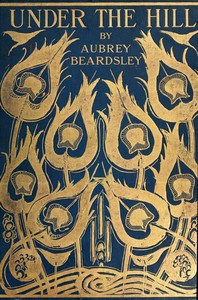
Aubrey Beardsley, best known for his sinuous black-and-white illustrations, here turns his hand to prose and verse with a style as mannered and deliberate as his drawings. The opening of 'Under the Hill' introduces the Abbé Fanfreluche, a character whose toilet is described with the same fastidious attention Beardsley gave to a decorative border: 'the drying and delicious frictions that a bather finds his chiefest joys.' The prose is thick with sensory detail—chocolate, muslin, buns, a unicorn named Adolphe—and a playful, almost camp formality that treats the fantastical with deadpan seriousness.
This collection, assembled posthumously, includes not only the unfinished 'Under the Hill' but also essays on painters like Claude and Corot, a biographical sketch of Saint Rose of Lima, and a comic ballet scenario. The publisher's note recalls Beardsley's role as art editor of The Yellow Book, and the volume preserves the arch, knowing tone of the 1890s aesthetic movement.
The Abbé's World: Decadence and Delicacy
In 'Under the Hill,' Beardsley constructs a mythological realm where the Abbé Fanfreluche moves through rituals of bathing, dressing, and breakfasting with a unicorn. The language is deliberately precious: Helen's pet unicorn is 'milk white all over, excepting his nose, mouth, and nostrils,' and its cage is 'a pretty palace of its own made of green foliage and golden bars.' The prose lingers on textures and surfaces—'sweet white muslin frock,' 'spicy buns,' 'ivory hoofs'—creating a world that is both sensuous and artificial. Beardsley's dialogue is clipped and theatrical; Helen's line 'Adolphe is so jealous' is delivered with the same brittle elegance as a Restoration comedy. The effect is a kind of literary rococo, where every gesture is stylized and every object is a prop in an elaborate performance.
Art Criticism as Aesthetic Manifesto
Beardsley's essay on Claude Lorrain reveals his critical voice: sharp, opinionated, and dismissive of rivals. He calls Turner 'the Wiertz of landscape-painting'—a comparison to the Belgian painter of grotesque fantasies that is clearly an insult. His praise of Corot is couched in a hierarchy: 'Corot is Claude's only worthy rival, but he does not eclipse or supplant the earlier master.' The metaphors are literary: a Corot painting is 'like an exquisite lyric poem, full of love and truth,' while a Claude 'recalls some noble eclogue glowing with rich concentrated thought.' This is not neutral art history but a manifesto for a particular kind of refined, classical beauty, one that values control and tradition over the sublime excesses of Turner.
Sacred Biography and Ironic Distance
The piece on Saint Rose of Lima adopts a tone of mock-piety that is hard to read as entirely sincere. Beardsley quotes Mother Ursula's biography with apparent reverence—'to chronicle the girlhood of this holy virgin makes as delicate a task as to trace the forms of some slim, sensitive plant'—but the effect is undercut by the dry aside that 'a cheap reprint of the biography has lately been brought out by Chaillot and Son.' The juxtaposition of the 'ineffable and miraculous' with commercial reprinting is a characteristically Beardsleyan irony. He also cites Dubonnet's remark about girls 'well confirmed in all the hateful practices of coquetry,' a sentence that seems designed to shock or amuse. The essay hovers between hagiography and parody, never quite committing to either.
Fragments and Forms: The Ballet Scenario
The collection includes a 'comedy ballet in one act' by Philippe Savarat and Titures de Schentefleur, described in a memoir excerpt. The curtain rises on 'a remote Arcadian valley, a delicious scrap of Tempe, gracious with cool woods and watered with a little river as fresh...' The fragment breaks off, but the tone is consistent with Beardsley's other work: a pastiche of classical pastoral that is both lush and knowingly artificial. The ballet scenario, like 'Under the Hill,' suggests that Beardsley thought in terms of staged tableaux. His literary fragments often feel like descriptions of pictures or performances, complete with props, costumes, and carefully arranged lighting. The unfinished state of many pieces leaves the reader with a sense of a mind that worked in vignettes rather than sustained narratives.
Beardsley's literary remains are best approached as extensions of his visual imagination. The prose is dense with color, texture, and theatrical gesture; the essays are as much about style as about their ostensible subjects. Readers familiar with his drawings will recognize the same blend of elegance and provocation, the same delight in artifice. These fragments do not cohere into a conventional book, but they offer a rare glimpse of a visual artist thinking in words.
That afternoon, rain drummed the windows while I wandered through Beardsley’s ornate, half-finished worlds—his brittle wit and lush sentences felt like velvet turned inside out. Later, idly shelving books, my hand caught an old volume, Letters on the Improvement of the Mind, Addressed to a Lady—a calmer, steadier voice, yet somehow the same intimate hush between pages. Letters on the Improvement of the Mind, Addressed to a Lady — Inside the Classic felt less like a departure than a quiet shift in weather.
Matthew Carter
1 week agoElijah Hernandez
1 month agoMadison Martin
1 week ago-
Heather Catherine Wise - 1 month ago
{'rating': 2, 'text': 'I struggled to get through this. The prose is overly ornate and the allusions are obscure, making the essays feel pretentious. While the author clearly has talent, the execution is not accessible. Only for those with a deep academic interest in the era.'} -
Rebecca Mullins - 3 weeks ago
{'rating': 3, 'text': "This book has its moments: the title essay is playful and clever, but some other essays feel too dense and meandering. The mix of prose and verse is interesting, but the balance isn't always perfect. Still, if you appreciate experimental literature, it's worth a look."} -
Sarah Walker - 1 week ago
{'rating': 4, 'text': "A delightful collection of essays that blend prose and verse with wit and imagination. The title piece 'Under the Hill' is a brilliant, irreverent take on mythology, while the other essays showcase the author's versatility. The language is rich and sometimes challenging, but it's worth the effort. A must-read for lovers of literary modernism."}
How will you remember this book?
Save your reaction, strongest insight, and memorable passage.
Henry Ramirez
3 weeks ago