1

The Wise and Ingenious Companion, French and English; or, A Collection of the Wit of the Illustrious Persons, Both Ancient and Modern — Reading Notes
(0 User reviews)
3247
Project Gutenberg
2017
Not confirmed
Wit and humor; Anecdotes
Readers of public-domain and historical texts
Project Gutenberg digital edition
en
Edition facts
Words
66,477
Reading time
290 min
Text sections
21
This digital edition of The Wise and Ingenious Companion, French and English; or, A Collection of the Wit of the Illustrious Persons, Both Ancient and Modern — Reading Notes is described by source-level measurements including 66,477 words, 4 hr 50 min estimated reading time, and 21 detected text sections.
The text analysis averages about 32.8 words per sentence, while the detected sections provide another way to judge how the source is divided.
Project Gutenberg metadata also associates the work with “Wit and humor,” connecting these edition facts with the source record’s subject description.
Source:
Project Gutenberg record #54498
Abel Boyer's 1700 bilingual collection of witty sayings, repartees, and stories from ancient and modern figures, presented in parallel French and English texts, with a prefatory introduction defending the moral and intellectual value of humor.
Editorial Edition Score
4.8/5
★★★★★
★★★★★
Calculated from edition completeness, EPUB availability, text structure and catalogue metadata. Not a user rating.
How this score is calculated
- Description quality20 pts
- Title & short description10 pts
- Source metadata20 pts
- Text length15 pts
- Chapters / structure15 pts
- EPUB file integrity20 pts
Total of 100 points, scaled to a 2.5-5.0 range. Editions with an empty description or a missing EPUB file are not scored.
Edition quality
Read the Text
e _Theopompus_ ètoit Roy de _Sparte_, quelqu’un dit en sa presence, que leurs Ville ètoit florissante, parce que leurs Rois avoient appris à gouverner, à quoi le Roy repondit fort sagement, _Que cela venoit plûtôt de ce que le Peuple avoit appris à obeïr_; donnant à entendre que les Villes où la Populace a du credit, se font beaucoup de tort par leurs Factions & leur desobeïssance, & qu’alors il est difficile, même aux meilleurs Magistrats de les bien gouverner.
_Dionysius_ the elder, Tyrant of _Syracuse_, reproving his Son, for that he had forcibly violated the Chastity of one of the Citizens Wives, asked him amongst other Things, if he had ever heard that any such thing had been done by him; _No_, said the Son, _but that was because you was not Son to a King_: _Neither_, said _Dionysius_, _will you ever be a Father to one, unless you give over such Pranks as these._ The event proved the truth of what he said; for when this young Man succeeded his Father, he was expelled the Kingdom of _Syracuse_ for his ill Behaviour and manner of Life.
_Denys_ le vieux, Tyran de _Syracuse_, grondant son Fils de ce qu’il avoit violé la Chasteté de la Femme d’un des Bourgeois, lui demanda entr’autres choses, s’il avoit jamais entendu dire, qu’il eut fait de pareilles Actions; _Non_, lui dit le Fils, _mais c’est parce que vous n’ètiez pas Fils de Roy_: _Tu n’en seras jamais Pere_, lui dit _Denys_, _si tu fais plus de ces Folies._ L’evenement justifia la verité de ce qu’il disoit; car ce jeune Homme ayant succedé à son Pere, il fut chassé du Royaume de _Syracuse_ à cause de sa méchante Conduite & de sa mauvaise Vie.
King _Antigonus_ came to visit _Antagoras_ a learned Man, whom he found in his Tent busied in the Cooking of Congers, _Do you think_, said _Antigonus_, _that_ Homer _at such time as he wrote the glorious Actions of_ Agamemnon _was boiling of Congers?_ _And do you think_, said the other, _that_ Agamemnon _when he did those great Actions, was wont to concern himself whether any Man in his Camp boiled Congers or not_,
Le Roy _Antigonus_ alla voir _Antagoras_, Homme savant, lequel il trouva dans sa Tente occupé à apprêter des Congres; _Croyez vous_, lui dit _Antigonus_, _qu’_Homere _fit bouillir des Congres lors qu’il écrivoit les glorieuses Actions d’_Agamemnon_?_ _Et pensez vous_, lui dit l’autre, _que lors qu’_Agamemnon _faisoit ces belles Actions, il se mît en peine si quelqu’un dans son Camp faisoit bouillir des Congres ou non?_
_Socrates_ was asked, why he endured his Wifes Brawling; says he, Why do you suffer your Geese to gaggle? _because_, answered one, _they lay us Eggs_; _and my Wife brings me Children_, said he.
On demanda à _Socrate_ pourquoy il enduroit les Criailleries de sa Femme, & vous, dit il, Pourquoy souffrez vous le bruit de vos Oyes? _Parce_, repondit quelqu’un, _qu’elles nous pondent des Oeufs_; _& bien_, dit il, _& ma Femme me fait des Enfans_.
_Apelles_ the famous Painter, drew the Picture of _Alexander_ the Great on Horse-back, and presented it to him; but _Alexander_ not praising it as so excellent a Piece deserved, _Apelles_ desired a living Horse might be brought, who seeing the Picture, fell to pawing and neighing, taking it to be a real one; whereupon _Apelles_ told him, _his Horse understood Painting better than himself_.
_Apelles_ le fameux Peintre, fit le Portrait d’_Alexandre_ le Grand à Cheval, & le lui presenta, mais comme _Alexandre_ ne loüoit pas assez un si excellent Ouvrage, _Apelles_ demanda qu’on fit venir un Cheval en Vie, lequel à la veuë du portrait se mit à trepigner des Pieds, & à hennir, le prenant pour une realité; surquoy _Apelles_, lui dit, _que son Cheval s’entendoit mieux en Peinture que lui_.
_Virgil_, the famous Poet, was much in favour thro’ his great Wit and Learning with _Augustus_, insomuch that he daily received his Bread from him; _Augustus_ one Day knowing his deep Discretion, ask’d him privately, _If he could guess what was his Father_; to which he replied, _Truly Sir, I do verily believe he was a Baker_, _a Baker, and why so?_ says _Augustus_; _because_ says _Virgil_, _you always reward me with Bread_, which Answer so well pleased the Emperour, that he rewarded him afterwards with Money.
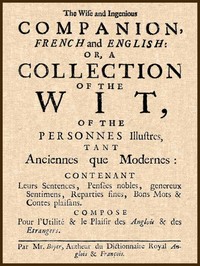
Abel Boyer's The Wise and Ingenious Companion, French and English (1700) presents itself as a dual-language treasury of wit, pairing French and English texts on facing pages. The title page promises wise sayings, noble sentiments, witty repartees, jests, and pleasant stories from illustrious persons both ancient and modern. Boyer, known for his Royal Dictionary, frames the collection as calculated for the improvement and pleasure of English and foreign readers alike.
The prefatory introduction argues that sentences, witty repartees, and jests have been esteemed by all civilized nations, citing Julius Caesar's collection of contemporary jests and Plutarch's recording of illustrious men's sayings. This defense of wit as both useful and delightful sets the tone for a work that blends instruction with entertainment.
Bilingual Structure and Reader Expectations
The most distinctive feature of this volume is its parallel presentation: each anecdote or saying appears first in English, then in French, or vice versa. The excerpt from a longer story—beginning with a mother telling her children a tale of love and slavery—shows the French text on the left and English on the right, with identical content in both languages. This layout suggests the book was designed for language learners as much as for connoisseurs of wit. Boyer's preface explicitly states the work is "calculated for the improvement and pleasure of the English and foreigners," indicating a pedagogical purpose. The bilingual format allows readers to compare phrasing and vocabulary across languages, making the collection a practical tool for studying French or English while enjoying the content.
The Prefatory Defense of Wit
Boyer opens with a learned introduction that traces the pedigree of wit-collecting from ancient Greece and Rome to modern authors. He mentions Julius Caesar's collection of jests, Plutarch's biographical anecdotes, and Diogenes Laertius's lives of philosophers, as well as moderns like Lord Bacon and Guichardin. This framing elevates the book beyond mere jest-book status, positioning it within a tradition of moral and intellectual improvement. The preface argues that witty sayings and repartees have been esteemed by all civilized nations, implying that the reader who engages with this collection is participating in a refined, cosmopolitan practice. Boyer's own authority as a lexicographer lends weight to this claim, as he presents himself as a curator of verbal excellence.
A Tale of Passion and Moral Ambiguity
The longest excerpt in the provided text is a first-person narrative of a woman's secret love for a slave named Glison. She describes her physical and emotional turmoil—"I could neither eat nor sleep"—and her eventual confession, which Glison accepts, saving her life. The story is framed by a mother addressing her children: "be merry whilst youth permits you; for the remembrance of past pleasures will be the only ones of your old age." This tale, with its frank depiction of desire and its morally ambiguous conclusion, stands in contrast to the book's advertised "wise sayings" and "noble sentiments." It suggests that the collection includes not only decorous wit but also more earthy, even transgressive, narratives, all presented without explicit moral judgment.
Readers approaching this work should attend to the interplay between its stated purpose—improvement through wit—and the actual content, which ranges from courtly repartee to intimate confession. The bilingual format rewards those who compare the two versions, as subtle differences in phrasing may reveal cultural assumptions about humor and decorum. Boyer's compilation offers a window into early modern attitudes toward language, learning, and the pleasures of a well-turned phrase.
I kept thinking about that old Boyer collection—how wit could feel like wisdom, and how laughter can be a gentle defense. It reminded me of something quieter in Goethe's literary essays — Themes and Context, where he treats art the way Boyer treats a joke: with deep fondness, never harshness. That linger stays with me, like a friend’s hand on my shoulder.
There are no reviews for this eBook.
There are no comments for this eBook.
Reader reflection
How will you remember this book?
Save your reaction, strongest insight, and memorable passage.
Your progress
0
/
10
2
How much did you enjoy the reading experience?
3
Would you pass this book on to a friend?
4
How easy was the book to follow?
5
Is this a title worth rereading?
6
How would you rate its originality?
7
Would you like to discuss this book with someone?
8
How would you describe its reading pace?
9
What changed or sharpened your thinking?
10