
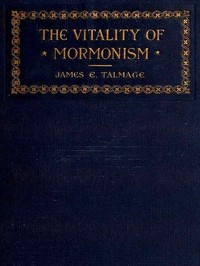
The Vitality of Mormonism: Brief Essays on Distinctive Doctrines of the Church of Jesus Christ of Latter-day Saints — Reading Notes

(2 User reviews)   483
Talmage, James E. (James Edward), 1862-1933 Project Gutenberg 2014 Not confirmed
Latter Day Saints; Latter Day Saint churches Readers of public-domain and historical texts
Project Gutenberg digital edition en

Edition facts

Words 104,183
Reading time 453 min
Text sections 14

The source record for The Vitality of Mormonism: Brief Essays on Distinctive Doctrines of the Church of Jesus Christ of Latter-day Saints — Reading Notes measures this digital text at 104,183 words, 7 hr 33 min estimated reading time, and 14 detected text sections.

The text analysis averages about 26.7 words per sentence, while the detected sections provide another way to judge how the source is divided.

Project Gutenberg metadata also associates the work with “Latter Day Saints,” connecting these edition facts with the source record’s subject description.

James E. Talmage, an LDS apostle, argues that Mormonism's doctrines are distinct and vital, using scriptural exegesis and modern revelation to address topics like the Godhead, atonement, and church-state relations. The book's preface outlines nine foundational premises, and excerpts show a legalistic, proof-texting style.
Share
Editorial Edition Score 4.8/5

Calculated from edition completeness, EPUB availability, text structure and catalogue metadata. Not a user rating.

How this score is calculated
  • Description quality20 pts
  • Title & short description10 pts
  • Source metadata20 pts
  • Text length15 pts
  • Chapters / structure15 pts
  • EPUB file integrity20 pts

Total of 100 points, scaled to a 2.5-5.0 range. Editions with an empty description or a missing EPUB file are not scored.

Edition quality

Read the Text

THE VITALITY OF MORMONISM

BRIEF ESSAYS ON DISTINCTIVE DOCTRINES OF THE CHURCH OF JESUS CHRIST OF LATTER-DAY SAINTS

One of the Twelve Apostles of the Church

The message of "Mormonism" is of summoning interest in the world today. People of serious mind are not satisfied with the unsupported generalization that it is naught but the outgrowth of delusion and error.

Fungi of fallacy, particularly in the field of modern religious systems, are of no such sturdy growth and wholesome fruitage as the Church of Jesus Christ of Latter-day Saints has progressively manifested.

"Mormonism," mis-named though it be, stands for the principles of eternal truth as enunciated by our Lord Jesus Christ, and by His duly commissioned Apostles and Prophets. The basis of "Mormonism" is fairly summarized in the following outline of facts and premises:

1. The eternal existence of a living personal God; and the preexistence and eternal duration of mankind as His literal offspring.

2. The placing of man upon the earth as an embodied spirit to undergo the experiences of an intermediate probation.

3. The transgression and fall of the first parents of the race, by which man became mortal, or in other words was doomed to suffer a separation of spirit and body through death.

4. The absolute need of a Redeemer, empowered to overcome death and thereby provide for a reunion of the spirits and bodies of mankind through a material resurrection from death to immortality.

5. The providing of a definite plan of salvation, by obedience to which man may obtain remission of his sins, and be enabled to advance by effort and righteous achievement throughout eternity.

6. The establishment of the Church of Jesus Christ in the "meridian of time," by the personal ministry and atoning death of the foreordained Redeemer and Savior of mankind, and the proclamation of His saving Gospel through the ministry of the Holy Priesthood during the apostolic period and for a season thereafter.

7. The general "falling away" from the Gospel of Jesus Christ, by which the world degenerated into a state of apostasy, and the Holy Priesthood ceased to be operative in the organization of sects and churches designed and effected by the authority of man.

8. The restoration of the Gospel in the current age, and the reestablishment of the Church of Jesus Christ by the bestowal of the Holy Priesthood through Divine revelation.

9. The appointed mission of the restored Church of Jesus Christ to preach the Gospel and administer in the ordinances thereof amongst all nations, in preparation for the near advent of our Savior Jesus Christ, who shall reign on earth as Lord and King.

The short essays following have been published at weekly intervals through two years; they number therefore one hundred and four. Concise rather than exhaustive treatment has been attempted. No apology is offered for reiteration of quotations or comment; repetition seemed preferable to the introduction of cross references.

Salt Lake City, Utah,

1. The Mustard Seed and the Tree--Development, not Growth Alone

2. What the "Mormons" Believe--Their Articles of Faith

3. What's in a Name?--Is "Mormonism" Misunderstood because of Its Unpopular Title?

4. "Mormonism"--A Distinctive Religious System

5. Direct and Sure--The Church Bold yet Tolerant

6. Wheat and Weeds--Successive Apostasies from the Gospel

7. A New Dispensation--Authority by Restoration not Through Succession

8 Divine Command and Human Agency--The Church a Democracy

9. The Holy Trinity--Unity of the Godhead

10. Original Sin--Are All to Suffer from it Eternally?

11. The Cooperative Plan of Salvation--Christ Alone Cannot Save You

12. The Need of a Redeemer--Man Cannot Exalt Himself

13. Christ's Unique Status--As Redeemer and Savior of the World

14. Philosophy of the Atonement--Its Two-fold Effect

15. How Does Christ Save?--His Plan Combines Justice and Mercy

16. Heaven and Hell--Graded Conditions in the Hereafter

17. In the Realm of the Dead--Paradise--What of the Spirits in Prison?

18. Why Are They Baptized for the Dead?--Elijah the Prophet on the American Continent

19. Obedience is Heaven's First Law--Conditions of Citizenship in the Kingdom of God

20. The Devils Believe and Tremble--Faith not Mere Belief

21. The Voice of John the Baptist Again Heard--Repent Ye, for the Kingdom of Heaven is at Hand!

22. Arise and Wash Away Thy Sins--The Only Way

23. Are Babes to be Damned?--A Horrible Misconception

24. The Watery Grave--And the New Birth

25. The Baptism of Fire--Power of the Spirit

26. In the Name of God, Amen!--Authority of the Holy Priesthood Again Operative on Earth

27. For Time Only or for Eternity--Human Institutions and Divine Authority

28. Apostles and Prophets Necessary--The Primitive Church and the Church of Latter Days

29. When Darkness Covered the Earth--The Long Night of Apostasy

30. The Morning Breaks, the Shadows Flee--Light of the Gospel Again Shines

31. The Beginning or the End--Ushering in of the Last Dispensation

32. A God of Miracles--Wonders Wrought by Devils

33. Is the Bible Sufficient?--Scriptures of Many Peoples

34. A Messenger--From the Presence of God

35. Scriptures of the American Continent--The Book of Mormon

36. By the Mouth of Witnesses--Shall the Truth be Established

37. Voices of the Dead--A Testimony from the Dust

38. A New Witness of the Christ--An Independent Scripture

39. When Christ Stood on American Soil--His Church Established Among the Ancient Americans

40. East and West in One Acclaim--That Jesus is the Christ

41. Sheep of Another Fold--Shepherds and Sheep-herders

42. From God to Man--Divine Communication in the Current Age

43. The Tragedy of Israel--A Nation Without a Country

44. The Gathering of the Tribes--Judah and Israel to Come into Their Own

45. America the Land of Zion--The Place of the New Jerusalem

46. The Coming of the Lord--The Consummation of the Ages

47. The Federation of the World--A Thousand Years of Peace

48. Thy Kingdom Come!--So Pray We Yet

49. Freedom to Worship God--Man's Divine Birthright

50. The Law of the Land--Should We Submit to It?

51. Church and State--Independent but Mutually Helpful

52. Religion of Daily Life--A Practical Test

53. America the Cradle of Liberty--No King to Rule in the Land

54. Democracy of American Origin--The Founding of an Ancient Republic

55. Perpetuity of American Nation--Assured by Prophecy

56. Law of the Tithe--The Lord's Revenue System

57. The United Order--No Longer Mine and Thine, but the Lord's and Ours

58. The Word of Wisdom--Sanctity of the Body

59. Unchastity the Dominant Evil--Infamy of a Double Standard of Virtue

60. Not Good for Man to be Alone--Companionship of the Sexes

61. Till Death Does You Part--Is there no Hope Beyond?

62. They Neither Marry--Nor Give in Marriage

63. Celestial Marriage--Eternal Relationship of the Sexes

64. There Was War in Heaven--Primeval Conflict over Satanic Autocracy

65. We Lived Before We Were Born--Our Primeval Childhood

66. Man is Eternal--Successive Stages of Existence

67. In the Lineage of Deity--Man's Divine Pedigree

68. Unending Advancement--Infinite Possibilities of Man's Estate

69. The Living and the Dead--Both to Hear the Gospel

70. God of the Living--All Live unto Him

71. Beyond the Grave--Repentance Possible even There

72. Opportunity Here and Hereafter--Free Agency and its Results

73. The Spirit World--Paradise and Hades

74. How Long Shall Hell Last?--The Duration of Punishment

75. Salvation and Exaltation--Advancement Worlds Without End

76. Deity as Exalted Humanity--Man is a God in Embryo

77. Be Ye Perfect--Is It Possible

78. The Glory of God is Intelligence--Knowledge is Power in Heaven as on Earth

79. When Ignorance is Sin--Opportunity Entails Accountability

80. Knowing and Doing--Knowledge May Help to Condemn or Save

81. Will Many or Few be Saved?--Our Place Beyond the Grave

82. The Graves Shall be Opened--And the Dead Shall Live

83. Resurrection of the Dead--When Shall it be?

84. Reaching After the Dead--"Lest We Forget"

85. The House of the Lord--Why do the Latter-day Saints Build Temples?

86. The Second Death--Spiritual Banishment Like unto the First

87. Antiquity of the Gospel--As Old as Adam

88. The Origin of Sacrifice--Coeval with the Race

89. Simplicity of the Gospel--None Need Err Therein

90. The Will or God--Though Opposed, Yet Eventually Supreme

91. God's Foreknowledge--Not a Determining Cause

92. Are Men Created Equal?--Individualism is Eternal

93. Ethics and Religion--A Distinction with a Difference

94. Religion Active and Passive--Effort Essential to Salvation

95. Remember the Sabbath Day--A Law unto Man from the Beginning

96. The Foolishness of God--And the Wisdom of Men

97. Freedom Through Obedience--Release from Autocracy of Sin

98. He Went and Washed--And Came Seeing

99. The Rod of Iron--A Dependable Support

100. Liar and Murderer--From the Beginning

101. On the Devil's Ground--Prisoners to Satan

102. What Doth It Profit a Man?--Worldly Gain--Eternal Loss

103. The Garden of God--And the Weeds of Human Culture

104. The Last Dispensation--Today is the Sum of all the Yesterdays

THE VITALITY OF MORMONISM

THE MUSTARD SEED AND THE TREE

Development, Not Growth Alone

WHY does "Mormonism" persist? The question is perennial, while the fact implied therein commands increasing interest and concern.

Determined attempts were made to stifle the system at its birth, to destroy the mustard seed at the planting; and, paradoxically, in proportion as the actuality of its survival has become generally evident, the assumed certainty of its imminent decline has been the more confidently proclaimed. The fall of the spreading tree, whose branches afford unfailing food and shelter, has been predicted time and again, but never realized.

On the sixth day of April, 1830, the Church of Jesus Christ of Latter-day Saints was organized as a body corporate at Fayette in the State of New York, with a membership of six persons. True, at that time a few times six had associated themselves more or less closely with the new religious movement; but, as the laws of the State specified six as the minimum required to form a religious corporation, only that number took part in the legal procedure. And they, save one, were relatively obscure.

The name of Joseph Smith had already been heard beyond his home district. He was at the time a subject of widening notoriety if not of enviable fame. The Book of Mormon, purporting to be a record of the aboriginal peoples of the Western Continent, had already been published. In reference to the title page of this work the appellation "Mormons" came to be fastened upon members of the Church.

Such a beginning as that of the Church of Jesus Christ of Latter-day Saints would seem to afford little ground of either hope or fear as to future developments. What was there to cause hostile concern over the voluntary association of six men and a few of their friends in an organization of openly expressed purpose, and that, the peaceful promulgation of what they verily believed to be the uplifting religion of life, the Gospel of Jesus Christ? Whatever may be the answer to the query, the fact that the Church met opposition, which for a long period was increasingly severe, is abundantly attested by history. [1]

Today the "Mormon" Church is known, by name at least, throughout the civilized world, as well as among most of the semi-cultured peoples in the remoter parts of the earth and on the islands of the sea. The six have increased to over half a million adherents.

The growth of the organization is apparent to even the poorly informed. But the Church has not only grown; it has developed. Between growth and development there is an essential difference; and not a few of the grave mistakes of men, even in every-day affairs--in business, in politics, in statesmanship--are traceable to our confusing and confounding the two. Growth alone is the result of accretion, the accumulation of material, the amassing of stuff. Development involves an extension of function, a gradation of efficiency, a passing from immaturity to maturity, from the seed to the fruiting tree.

Growth produces big things, and not only things of this sort but men. Between bigness and greatness, however, there is a distinction of kind. Growth is a measure of bulk, of quantity; it is specified as "so many" or "so much"; development is a gradation of quality; its terms are "so good" or "so bad." Our nation boasts a constantly increasing host of big men; the great men of the country may be more easily counted. And as with men so with institutions.

Dead things may grow, as witness the tiny salt crystal in its mother-brine--at first a microscopic cube, then a huge hexahedron limited only by the size of the container or other external conditions. Development, however, is the characteristic of life, to which mere growth is essentially secondary and subordinate.

The vital character of the Church of Jesus Christ of Latter-day Saints has been evident from the first. "Mormonism" lives because it is healthy, normal and undeformed. In general, a healthy organism is assured of life, barring destruction from external violence or deprivation of physical necessities; whereas one that is abnormal and sickly is doomed to decline. Opposition to the Church, the pitiless maltreatment to which its people have been subjected, particularly in the earlier decades of its history, comprising mobbings, drivings, spoliation, scourgings, and assassination, have operated to strengthen the Church, body and soul. True, the heat of persecution has scorched and withered a few of the sickly plants, such as had little depth of sincerity; but the general effect has been to promote a fuller growth, and to make richer and more fertile the Garden of the Lord.

The Church has never experienced a distinctive period of reduced membership. Always the present has been the time of its highest achievement. In spite of persecution, some of which sprang from misplaced sincerity and zeal while much was born of ignorance and fanaticism, the strength of the institution, measured in terms of loyalty, devotion and unswerving adherence to the principles of the restored Gospel, has steadily increased.

It is a notable fact that its members are imbued with the testimony of certitude as to the genuineness of the Gospel they have espoused and the perpetuity of the Church. This has been a distinguishing feature from the beginning.

Apostasy from the organization is so rare as to be negligible. Excommunicants, who are deprived of their membership through failure to live up to the high standard of morality and duty required by the revealed law of the Church, while not numerous exceed by many fold those who voluntarily withdraw and affiliate with other religious bodies.

"Mormonism" is definite and incisive in its claims. It speaks to the world in no uncertain tone. Its voice is virile; its activities are strong. It presents an unbroken front and is unafraid. Its attitude is not hostile, though strongly aggressive. Its methods are those of reason and persuasion, coupled with a fearless affirmation of testimony as to the surpassing importance of its message, which message it labors to convey to every nation, kindred, tongue and people.

It is not too much to affirm that the leaven of "Mormonism" is leavening the world and its theology. Every studious reader of recent commentaries on the Holy Scriptures, and of theological treatises in general, is aware of a surprising progressiveness in modern views of things spiritual, amounting in many instances to an abandonment of what were once regarded as the fundamentals of orthodoxy.

_In the new theology "Mormonism" has pioneered the way_.

In its early days the Church received the word of the Lord avouching the perpetuity of the organization. While no individual was promised that he should not fall away, and though the forfeiture of the Holy Spirit's companionship was specified as the sure and incalculable loss to all who wilfully persisted in sin, the blessed assurance was given that the Church of Jesus Christ was established for the last time, never to be destroyed, nor again driven from the earth through apostasy. Men may come and men may go, but the Church shall go on forever.

There has never been revision nor amendment in the fundamental law of the Church, and the only changes are those natural to development, expansion and adaptation to new conditions.

The world is full of sects and churches, and there is scarcely one that has not a counterpart in a revised or reformed or reorganized sect. _But the Church of Jesus Christ of Latter-day Saints is no sect; it is an original creation, established upon the earth in this age as a restoration_. There will never be a reformed or reorganized variant of this, the Church of Jesus Christ of Latter-day Saints.

The faith of the people is no whit weakened because of their fewness. This very condition was foretold. Nearly six centuries before the Savior's birth, a Hebrew prophet on the Western Continent predicted the establishment of this Church in the last days, and testified of it, as he had seen in vision, that its members would be found in all parts of the earth, but that their numbers would be relatively small. See Book of Mormon, 1 Nephi 14.

"_Strait is the gate, and narrow is the way, which leadeth unto life, and few there be that find it_." (Matt. 7:14, also Book of Mormon, 3 Nephi 14:14.)

The doors of the Church are open to all, rich and poor, learned and unlearned; and the pleading invitation to enter and become partakers of the blessings that pertain both to mortality and to the eternities beyond is freely extended--_to you and yours and to everybody, near and afar off, even as many as the Lord our God shall call_.

1. See the author's "Story and Philosophy of 'Mormonism'," 136 pp., _The Deseret News_, Salt Lake City, Utah.

WHAT THE "MORMONS" BELIEVE

Their Articles of Faith

WHILE it may be impossible for any religious body to set forth in a brief statement all the distinguishing features of its doctrines and practise, it has become usual for churches to embody the fundamentals of their belief in condensed form as creeds. When asked for a concise presentation of the principal doctrines accepted by his people, Joseph Smith, through whose instrumentality the Church of Jesus Christ of Latter-day Saints was established, responded with the Articles of Faith presented below. This was in the year 1841.

From the time of their first promulgation The Articles have been in force as an authorized statement of belief; and they were early adopted as such by the Church in general conference assembled.

The Articles of Faith

of the Church of Jesus Christ of Latter-day Saints

We believe in God, the Eternal Father, and in His Son Jesus Christ, and in the Holy Ghost.

We believe that men will be punished for their own sins, and not for Adam's transgression.

We believe that through the Atonement of Christ, all mankind may be saved, by obedience to the laws and ordinances of the Gospel.

We believe that the first principles and ordinances of the Gospel are:--(1) Faith in the Lord Jesus Christ; (2) Repentance; (3) Baptism by immersion for the remission of sins; (4) Laying on of hands for the Gift of the Holy Ghost.

We believe that a man must be called of God, by prophecy, and by the laying on of hands, by those who are in authority, to preach the Gospel and administer in the ordinances thereof.

We believe in the same organization that existed in the Primitive Church, viz.: apostles, prophets, pastors, teachers, evangelists, etc.

We believe in the gift of tongues, prophecy, revelation, visions, healing, interpretation of tongues, etc.

We believe the Bible to be the word of God, as far as it is translated correctly; we also believe the Book of Mormon to be the word of God.

We believe all that God has revealed, all that He does now reveal, and we believe that He will yet reveal many great and important things pertaining to the Kingdom of God.

We believe in the literal gathering of Israel and in the restoration of the Ten Tribes; that Zion will be built upon this [the American] continent; that Christ will reign personally upon the earth; and that the earth will be renewed and receive its paradisiacal glory.

We claim the privilege of worshiping Almighty God according to the dictates of our own conscience, and allow all men the same privilege, let them worship how, where, or what they may.

We believe in being subject to kings, presidents, rulers, and magistrates, in obeying, honoring, and sustaining the law.

We believe in being honest, true, chaste, benevolent, virtuous, and in doing good to all men; indeed, we may say that we follow the admonition of Paul, we believe all things, we hope all things, we have endured many things, and hope to be able to endure all things. If there is anything virtuous, lovely, or of good report or praiseworthy, we seek after these things.--_Joseph Smith_.

To most of these items many sects professing Christianity could confidently pledge allegiance; to many of them all Christian bodies subscribe. Belief in the existence and powers of the Holy Trinity, in Jesus Christ as the Savior and Redeemer of the human race, in man's individual accountability for his acts, in the acceptance of sacred writ as the Word of God, in the rights of worship according to the dictates of conscience, in the moral virtues--these professions and beliefs are a common creed in the realm of present-day Christendom. There is no peculiarly "Mormon" interpretation, in the light of which these principles of faith and practise are viewed by the Latter-day Saints, except, perhaps, in a certain simplicity and literalness of acceptance.

James E. Talmage, writing as an apostle of the Church of Jesus Christ of Latter-day Saints, opens with a preface that lists nine numbered premises—from the eternal existence of God to the imminent reign of Christ—as the basis of what he calls “Mormonism.” The book’s title and structure promise brief essays on distinctive doctrines, and the excerpts confirm a methodical, scripturally anchored approach. Talmage frequently cites both the Bible and modern revelations (e.g., Doctrine and Covenants 58:21–23) to support his arguments, treating them as equally authoritative. The tone is defensive yet confident, aiming to counter the charge that Mormonism is mere delusion.

A Doctrinal Blueprint in the Preface

The preface functions as a doctrinal table of contents, enumerating nine points that range from “the eternal existence of a living personal God” to “the restoration of the Gospel in the current age.” This list is not merely introductory; it shapes the entire work’s argumentative structure. Each essay likely expands on one or more of these premises. Notably, the preface frames Mormonism as a system of “eternal truth” opposed to “fungi of fallacy,” a botanical metaphor that underscores the author’s insistence on organic, healthy growth versus corrupt innovation. The numbered format gives the book a catechism-like clarity, even as the essays themselves may vary in depth.

Scripture as Legal Precedent

Talmage’s method is heavily forensic: he treats biblical passages and modern revelations as legal evidence. In the excerpt on church and state, he cites Matthew 17:25–27 (the temple tax coin), Matthew 22:15–21 (render unto Caesar), and Romans 13:1–7 (submission to authorities), then immediately quotes Doctrine and Covenants 58:21–23 as a modern parallel. The effect is to create a continuous chain of authority from the New Testament to 1831 revelation. The language is precise and juridical—words like “tribute,” “magistrates,” “ordinance,” and “damnation” recur. This approach suggests that for Talmage, doctrine is less about mystical experience than about correct interpretation of binding texts.

The Church and the State: A Twofold Loyalty

The essay “Church and State” explicitly argues for independence and mutual helpfulness between religious and secular governance. Talmage reproduces Section 134 of the Doctrine and Covenants, which states that governments are “instituted of God for the benefit of man” and that civil officers should “administer the law in equity and justice.” The excerpt emphasizes that Latter-day Saints must be “subject to the powers that be” while keeping church and state distinct. This is a pointed rebuttal to contemporary suspicions that Mormonism sought theocratic control. By embedding a full section of scripture into his essay, Talmage makes his case through authoritative citation rather than personal argument.

Readers should note that the excerpts represent only a fraction of the book’s fourteen sections, and the full work likely covers additional doctrines such as the nature of the Godhead, the atonement, and the plan of salvation. Talmage’s style is consistent: each essay probably follows a pattern of stating a doctrine, citing scripture (both ancient and modern), and defending it against implied criticism. The book is best approached as a series of apologetic lectures rather than a narrative or devotional text.

Reading Talmage’s careful proofs, I thought of my grandfather’s underlined gospel manuals, how he’d pencil notes in the margins like quiet prayers. That same patient weighing of evidence—the way The Diplomatic Correspondence of the American Revolution, Vol. 10 — Text and Context made me feel—two worlds insisting, gently, that their records matter. Neither book demands belief; they simply leave their ink beside you, waiting.

Carter Wright
1 month ago

Alexander Wilson
1 week ago

5
5 out of 5 (2 User reviews )

Add a Review

Your Rating *
There are no comments for this eBook.

Reader reflection

How will you remember this book?

Save your reaction, strongest insight, and memorable passage.

Your progress 0 / 10
1

How far have you progressed with this book?

2

What was your overall reaction to the book?

3

Would you recommend this book to another reader?

4

What was the reading difficulty like?

Related eBooks