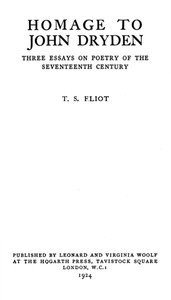
Homage to John Dryden: Three Essays on Poetry of the Seventeenth Century — Background and Themes

(1 User reviews)   228
Eliot, T. S. (Thomas Stearns), 1888-1965 Project Gutenberg 2020 Not confirmed
English poetry -- Early modern, 1500-1700 -- History and criticism; Great Britain -- Intellectual life -- 17th century Readers of public-domain and historical texts
Project Gutenberg digital edition en

Edition facts

Words 14,088
Reading time 62 min
Text sections 2

Homage to John Dryden: Three Essays on Poetry of the Seventeenth Century — Background and Themes can be approached with a clearer sense of reading commitment from its source measurements: 14,088 words, 1 hr 2 min estimated reading time, and 2 detected text sections.

The text analysis averages about 26.5 words per sentence, while the detected sections provide another way to judge how the source is divided.

Project Gutenberg metadata also associates the work with “English poetry -- Early modern, 1500-1700 -- History and criticism,” connecting these edition facts with the source record’s subject description.

T.S. Eliot's 1924 collection of three essays on Dryden, the Metaphysical poets, and Marvell, originally published in the Times Literary Supplement, argues for the elegance of 17th- and 18th-century verse against Romantic norms, using precise textual observations.
Share
Editorial Edition Score 4.5/5

Calculated from edition completeness, EPUB availability, text structure and catalogue metadata. Not a user rating.

How this score is calculated
  • Description quality20 pts
  • Title & short description10 pts
  • Source metadata20 pts
  • Text length15 pts
  • Chapters / structure15 pts
  • EPUB file integrity20 pts

Total of 100 points, scaled to a 2.5-5.0 range. Editions with an empty description or a missing EPUB file are not scored.

Edition quality

Read the Text

This was the morn, when issuing on the guard, Drawn up in rank and file they stood prepared Of seeming arms to make a short essay, Then hasten to be drunk, the business of the day.

Sometimes the wit appears as a delicate flavour to the magnificence, as in "Alexander's Feast":--

Sooth'd with the sound the king grew vain; Fought all his battles o'er again; And thrice he routed all his foes, and thrice he slew the slain.

The great advantage of Dryden over Milton is that while the former is always in control of his ascent, and can rise or fall at will (and how masterfully, like his own Timotheus, he directs the transitions!), the latter has elected a perch from which he cannot afford to fall, and from which he is in danger of slipping.

food alike those pure Intelligential substances require As doth your Rational; and both contain Within them every lower faculty Of sense, whereby they hear, see, smell, touch, taste, Tasting concoct, digest, assimilate, And corporeal to incorporeal turn.

Dryden might have made poetry out of that; his translation from Lucretius is poetry. But we have an ingenious example, on which to test our contrast of Dryden and Milton: it is Dryden's "Opera," called _The State of Innocence and Fall of Man_, of which Nathaniel Lee neatly says in his preface:--

Milton did the wealthy mine disclose, And rudely cast what you could well dispose: He roughly drew, on an old-fashioned ground, A chaos, for no perfect world were found, Till through the heap, your mighty genius shined.

In the author's preface Dryden acknowledges his debt generously enough:--

"The original being undoubtedly, one of the greatest, most noble, and most sublime poems, which either this age or nation has produced."

The poem begins auspiciously:--

_Lucifer_: Is this the seat our conqueror has given? And this the climate we must change for Heaven? These regions and this realm my wars have got; This mournful empire is the loser's lot: In liquid burnings, or on dry to dwell, Is all the sad variety of hell.

It is an early work; it is on the whole a feeble work; it is not deserving of sustained comparison with "Paradise Lost." But "all the sad variety of hell"! Dryden is already stirring; he has assimilated what he could from Milton; and he has shown himself capable of producing as splendid verse.

The capacity for assimilation, and the consequent extent of range, are conspicuous qualities of Dryden. He advanced and exhibited his variety by constant translation; and his translations of Horace, of Ovid, of Lucretius, are admirable. His gravest defects are supposed to be displayed in his dramas, but if these were more read they might be more praised. From the point of view of either the Elizabethan or the French drama they are obviously inferior; but the charge of inferiority loses part of its force if we admit that Dryden was not quite trying to compete with either, but was pursuing a direction of his own. He created no character; and although his arrangements of plot manifest exceptional ingenuity, it is the pure magnificence of diction, of poetic diction, that keeps his plays alive:--

How I loved Witness ye days and nights, and all ye hours, That danced away with down upon your feet, As all your business were to count my passion. One day passed by, and nothing saw but love;-- Another came, and still 'twas only love: The suns were wearied out with looking on, And I untired with loving. I saw you every day and all the day; And every day was still but as the first: So eager was I still to see you more . . .

While within your arms I lay, The world fell mould'ring from my hands each hour.

Such language is pure Dryden: it sounds, in Mr. van Doren's phrase, "like a gong." _All for Love_, from which the lines are taken, is Dryden's best play, and this is perhaps the highest reach. In general, he is best in his plays when dealing with situations which do not demand great emotional concentration; when his situation is more trivial, and he can practise his art of making the small great. The back-talk between the Emperor and his Empress Nourmahal, in _Aurungzebe_ is admirable purple comedy:--

_Emperor_: Such virtue is the plague of human life: A virtuous woman, but a cursed wife. In vain of pompous chastity y'are proud: Virtue's adultery of the tongue, when loud. I, with less pain, a prostitute could bear, Than the shrill sound of virtue, virtue hear. In unchaste wives-- There's yet a kind of recompensing ease: Vice keeps 'em humble, gives 'em care to please: But against clamourous virtue, what defence? It stops our mouths, and gives your noise pretence. . .

What can be sweeter than our native home? Thither for ease, and soft repose, we come; Home is the sacred refuge of our life: Secure from all approaches but a wife. If thence we fly, the cause admits no doubt: None but an inmate foe could force us out. Clamours, our privacies uneasy make: Birds leave their nests disturbed, and beasts their haunts forsake.

But drama is a mixed form; pure magnificence will not carry it through. The poet who attempts to achieve a play by the single force of the word provokes comparison, however strictly he confine himself to his capacity, with poets of other gifts. Corneille and Racine do not attain their triumphs by magnificence of this sort; they have concentration also, and, in the midst of their phrases, an undisturbed attention to the human soul as they knew it.

Nor is Dryden unchallenged in his supreme ability to make the ridiculous, or the trivial, great.

Avez-vous observé que maints cercueils de vieilles Sont presque aussi petits que celui d'un enfant?

Those lines are the work of a man whose verse is as magnificent as Dryden's, and who could see profounder possibilities in wit, and in violently joined images, than ever were in Dryden's mind. For Dryden, with all his intellect, had a commonplace mind. His powers were, we believe, wider, but no greater, than Milton's; he was confined by boundaries as impassable, though less strait. He bears a curious antithetical resemblance to Swinburne. Swinburne was also a master of words, but Swinburne's words are all suggestions and no denotation; if they suggest nothing, it is because they suggest too much. Dryden's words, on the other hand, are precise, they state immensely, but their suggestiveness is almost nothing.

That short dark passage to a future state; That melancholy riddle of a breath, That something, or that nothing, after death.

is a riddle, but not melancholy enough, in Dryden's splendid verse. The question, which has certainly been waiting, may justly be asked: whether, without this which Dryden lacks, verse can be poetry? What is man to decide what poetry is? Dryden's use of language is not, like that of Swinburne, weakening and demoralizing. Let us take as a final test his elegy upon Oldham, which deserves not to be mutilated:--

Farewell, too little and too lately known, Whom I began to think and call my own; For sure our souls were near allied, and thine Cast in the same poetic mould with mine. One common note on either lyre did strike, And knaves and fools we both abhorred alike. To the same goal did both our studies drive; The last set out the soonest did arrive. Thus Nisus fell upon the slippery place, Whilst his young friend performed and won the race. O early ripe! to thy abundant store What could advancing age have added more? It might (what nature never gives the young) Have taught the numbers of thy native tongue. But satire needs not those, and wit will shine Through the harsh cadence of a rugged line. A noble error, and but seldom made, When poets are by too much force betrayed. Thy generous fruits, though gathered ere their prime, Still showed a quickness; and maturing time But mellows what we write to the dull sweets of rhyme. Once more, hail, and farewell; farewell, thou young, But ah! too short, Marcellus of our tongue! Thy brows with ivy and with laurels bound; But fate and gloomy night encompass thee around.

From the perfection of such an elegy we cannot detract; the lack of nebula is compensated by the satisfying completeness of the statement. Dryden lacked what his master Jonson possessed, a large and unique view of life; he lacked insight, he lacked profundity. But where Dryden fails to satisfy, the nineteenth-century does not satisfy us either; and where that century has condemned him, it is itself condemned. In the next revolution of taste it is possible that poets may turn to the study of Dryden. He remains one of those who have set standards for English verse which, it is desperate to ignore.

[Footnote 1: "John Dryden," by Mark van Doren (New York: Harcourt, Brace and Howe).]

II. THE METAPHYSICAL POETS

By collecting these poems[2] from the work of a generation more often named than read, and more often read than profitably studied, Professor Grierson has rendered a service of some importance. Certainly the reader will meet with many poems already preserved in other anthologies, at the same time that he discovers poems such as those of Aurelian Townshend or Lord Herbert of Cherbury here included. But the function of such an anthology as this is neither that of Professor Saintsbury's admirable edition of Caroline poets nor that of the "Oxford Book of English Verse." Mr. Grierson's book is in itself a piece of criticism, and a provocation of criticism; and we think that he was right in including so many poems of Donne, elsewhere (though not in many editions) accessible, as documents in the case of "metaphysical poetry." The phrase has long done duty as a term of abuse, or as the label of a quaint and pleasant taste. The question is to what extent the so-called metaphysicals formed a school (in our own time we should say a "movement"), and how far this so-called school or movement is a digression from the main current.

Not only is it extremely difficult to define metaphysical poetry, but difficult to decide what poets practise it and in which of their verses. The poetry of Donne (to whom Marvell and Bishop King are sometimes nearer than any of the other authors) is late Elizabethan, its feeling often very close to that of Chapman. The "courtly" poetry is derivative from Jonson, who borrowed liberally from the Latin; it expires in the next century with the sentiment and witticism of Prior. There is finally the devotional verse of Herbert, Vaughan, and Crashaw (echoed long after by Christina Rossetti and Francis Thompson); Crashaw, sometimes more profound and less sectarian than the others, has a quality which returns through the Elizabethan period to the early Italians. It is difficult to find any precise use of metaphor, simile, or other conceit, which is common to all the poets and at the same time important enough as an element of style to isolate these poets as a group. Donne, and often Cowley, employ a device which is sometimes considered characteristically "metaphysical"; the elaboration (contrasted with the condensation) of a figure of speech to the farthest stage to which ingenuity can carry it. Thus Cowley develops the commonplace comparison of the world to a chess-board through long stanzas ("To Destiny"), and Donne, with more grace, in "A Valediction," the comparison of two lovers to a pair of compasses. But elsewhere we find, instead of the mere explication of the content of a comparison, a development by rapid association of thought which requires considerable agility on the part of the reader.

On a round ball A workeman that hath copies by, can lay An Europe, Afrique, and an Asia, And quickly make that, which was nothing, _All_, So doth each teare, Which thee doth weare, A globe, yea world by that impression grow, Till thy tears mixt with mine doe overflow This world, by waters sent from thee, my heaven dissolved so.

Here we find at least two connexions which are not implicit in the first figure, but are forced upon it by the poet: from the geographer's globe to the tear, and the tear to the deluge. On the other hand, some of Donne's most successful and characteristic effects are secured by brief words and sudden contrasts--

A bracelet of bright hair about the bone,

where the most powerful effect is produced by the sudden contrast of associations of "bright hair" and of "bone." This telescoping of images and multiplied association is characteristic of the phrase of some of the dramatists of the period which Donne knew: not to mention Shakespeare, it is frequent in Middleton, Webster, and Tourneur, and is one of the sources of the vitality of their language.

Johnson, who employed the term "metaphysical poets," apparently having Donne, Cleveland, and Cowley chiefly in mind, remarks of them that "the most heterogeneous ideas are yoked by violence together." The force of this impeachment lies in the failure of the conjunction, the fact that often the ideas are yoked but not united; and if we are to judge of styles of poetry by their abuse, enough examples may be found in Cleveland to justify Johnson's condemnation. But a degree of heterogeneity of material compelled into unity by the operation of the poet's mind is omnipresent in poetry. We need not select for illustration such a line as--

Notre âme est un trois-mâts cherchant son Icarie;

we may find it in some of the best lines of Johnson himself ("The Vanity of Human Wishes"):--

His fate was destined to a barren strand, A petty fortress, and a dubious hand; He left a name at which the world grew pale, To point a moral, or adorn a tale,

where the effect is due to a contrast of ideas, different in degree but the same in principle, as that which Johnson mildly reprehended. And in one of the finest poems of the age (a poem which could not have been written in any other age), the "Exequy" of Bishop King, the extended comparison is used with perfect success: the idea and the simile become one, in the passage in which the Bishop illustrates his impatience to see his dead wife, under the figure of a journey:--

Stay for me there; I will not faile To meet thee in that hollow Vale. And think not much of my delay; I am already on the way, And follow thee with all the speed Desire can make, or sorrows breed. Each minute is a short degree, And ev'ry houre a step towards thee. At night when I betake to rest, Next morn I rise nearer my West Of life, almost by eight houres sail, Than when sleep breath'd his drowsy gale. . . . But heark! My Pulse, like a soft Drum Beats my approach, tells _Thee_ I come; And slow howere my marches be, I shall at last sit down by _Thee._

(In the last few lines there is that effect of terror which is several times attained by one of Bishop King's admirers, Edgar Poe.) Again, we may justly take these quatrains from Lord Herbert's Ode, stanzas which would, we think, be immediately pronounced to be of the metaphysical school:--

So when from hence we shall be gone, And be no more, nor you, nor I, As one another's mystery, Each shall be both, yet both but one.

This said, in her up-lifted face, Her eyes, which did that beauty crown, Were like two starrs, that having faln down, Look up again to find their place:

While such a moveless silent peace Did seize on their becalmed sense, One would have thought some influence Their ravished spirits did possess.

There is nothing in these lines (with the possible exception of the stars, a simile not at once grasped, but lovely and justified) which fits Johnson's general observations on the metaphysical poets in his essay on Cowley. A good deal resides in the richness of association which is at the same time borrowed from and given to the word "becalmed"; but the meaning is clear, the language simple and elegant. It is to be observed that the language of these poets is as a rule simple and pure; in the verse of George Herbert this simplicity is carried as far as it can go--a simplicity emulated without success by numerous modern poets. The _structure_ of the sentences, on the other hand, is sometimes far from simple, but this is not a vice; it is a fidelity to thought and feeling. The effect, at its best, is far less artificial than that of an ode by Gray. And as this fidelity induces variety of thought and feeling, so it induces variety of music. We doubt whether, in the eighteenth century, could be found two poems in nominally the same metre, so dissimilar as Marvell's "Coy Mistress" and Crashaw's "Saint Teresa"; the one producing an effect of great speed by the use of short syllables, and the other an ecclesiastical solemnity by the use of long ones:--

Love, thou art absolute sole lord Of life and death.

If so shrewd and sensitive (though so limited) a critic as Johnson failed to define metaphysical poetry by its faults, it is worth while to inquire whether we may not have more success by adopting the opposite method: by assuming that the poets of the seventeenth century (up to the Revolution) were the direct and normal development of the precedent age; and, without prejudicing their case by the adjective "metaphysical," consider whether their virtue was not something permanently valuable, which subsequently disappeared, but ought not to have disappeared. Johnson has hit, perhaps by accident, on one of their peculiarities, when he observes that "their attempts were always analytic"; he would not agree that, after the dissociation, they put the material together again in a new unity.

It is certain that the dramatic verse of the later Elizabethan and early Jacobean poets expresses a degree of development of sensibility which is not found in any of the prose, good as it often is. If we except Marlowe, a man of prodigious intelligence, these dramatists were directly or indirectly (it is at least a tenable theory) affected by Montaigne. Even if we except also Jonson and Chapman, these two were notably erudite, and were notably men who incorporated their erudition into their sensibility: their mode of feeling was directly and freshly altered by their reading and thought. In Chapman especially there is a direct sensuous apprehension of thought, or a recreation of thought into feeling, which is exactly what we find in Donne:--

in this one thing, all the discipline Of manners and of manhood is contained; A man to join himself with th' Universe In his main sway, and make in all things fit One with that All, and go on, round as it; Not plucking from the whole his wretched part, And into straits, or into nought revert, Wishing the complete Universe might be Subject to such a rag of it as he; But to consider great Necessity.

We compare this with some modern passage:--

No, when the fight begins within himself, A man's worth something. God stoops o'er his head, Satan looks up between his feet--both tug-- He's left, himself, i' the middle; the soul wakes And grows. Prolong that battle through his life!

It is perhaps somewhat less fair, though very tempting (as both poets are concerned with the perpetuation of love by offspring), to compare with the stanzas already quoted from Lord Herbert's Ode the following from Tennyson:--

One walked between his wife and child, With measured footfall firm and mild, And now and then he gravely smiled. The prudent partner of his blood Leaned on him, faithful, gentle, good, Wearing the rose of womanhood. And in their double love secure. The little maiden walked demure, Pacing with downward eyelids pure. These three made unity so sweet, My frozen heart began to beat, Remembering its ancient heat.

Eliot opens his preface by confessing that these three essays, written years earlier for the Times Literary Supplement, need “still more justification in a book.” He had planned a series on seventeenth- and eighteenth-century poetry from Chapman to Johnson, but abandoned it due to “dissipation” and “infirmities of age.” The essays, he says, preserve “in cryptogram certain notions” too controversial to state directly. This defensive, almost apologetic tone sets the stage for a work that is both a homage and a polemic.

The Opening Gambit: Dryden and the Nineteenth-Century Reader

Eliot begins the first essay by confronting a problem: most living readers, he claims, are genuinely insensible to Dryden’s genius. He attributes this to a taste “formed entirely upon the English poetry of the nineteenth-century.” The twentieth century, he adds wryly, “is still the nineteenth.” Rather than praising Dryden directly, Eliot proposes to show that this insensibility “does not merely signify indifference to satire and wit” but a deeper lack of perception. He thus frames the essay as a corrective, not a celebration. The reader should note how Eliot uses the negative—what readers fail to see—as his primary argumentative strategy.

The Metaphysical Poets: A Revaluation Through Johnson

In the second essay, Eliot engages directly with Samuel Johnson’s criticism of the Metaphysical poets. He warns that we must not reject Johnson’s judgment “without having mastered it.” Johnson’s concept of wit, Eliot insists, was “something more serious than we usually mean to-day.” He also notes the narrow discipline of Johnson’s training. Eliot’s method here is to acknowledge the authority of the critic he partly opposes, then to qualify it. He suggests that a “fruitful work” would break up Johnson’s classification and exhibit the poets “in all their difference of kind and of degree.” The essay thus becomes a dialogue with the critical tradition.

Marvell and the Quality of a Civilization

The third essay turns to Andrew Marvell, whose tercentenary Eliot marks with “serious reflection.” He distinguishes this from “the resurrection of a deceased reputation,” noting that Marvell’s best poems are already well known. The critic’s task, Eliot says, is “to squeeze the drops of the essence of two or three poems.” He identifies the valuable quality in Marvell as “a quality of a civilization, of a traditional habit of life” rather than a personal one. This claim is striking: it ties poetic merit to cultural context, not individual genius. The reader should watch how Eliot uses Marvell to exemplify a broader argument about seventeenth-century verse.

Eliot’s Comparative Method: Diction and the Soul

Across the essays, Eliot repeatedly compares English poets to French ones. He calls Racine “the great master of the seventeenth century” and Baudelaire “the great master of the nineteenth,” noting they are “more like each other than they are like anyone else.” He then contrasts them with Milton and Dryden, who “triumph with a dazzling disregard of the soul.” This comparison is central to Eliot’s critical stance: he values psychological depth and diction together. He even urges poets to look “into the cerebral cortex, the nervous system, and the digestive tracts” rather than merely the heart. These passages reveal Eliot’s ambition to redefine the standards of poetic excellence.

These three essays, though brief, offer a concentrated argument about the trajectory of English poetry. Eliot’s method is to use specific poets as case studies for larger claims about tradition, sensibility, and critical judgment. Readers will benefit from attending to his comparative references—especially to French poets—and to his careful engagement with earlier critics like Johnson. The essays reward rereading, as Eliot’s own cryptic hints often become clearer on a second pass.

Reading Eliot’s praise for Dryden’s disciplined elegance, I found myself drifting to the quieter dignity of The Diplomatic Correspondence of the American Revolution, Vol. 10 — Text and Context. Both feel like conversations overheard from another room – precise, unhurried, full of faith in what words can carry. There’s a shared belief that grace lives in restraint, not ornament. Strange how one century’s letters reminded me of another’s verse.

Matthew Brown
1 month ago

4
4 out of 5 (1 User reviews )

Add a Review

Your Rating *
  • ...
    Daniel Mayo - 4 weeks ago
    Homage to John Dryden is a brilliant collection of three essays that delve into the poetry of the seventeenth century. T.S. Eliot's critical acumen shines as he examines Dryden's place in literary history, his mastery of verse, and his influence on later poets. The essays are dense but rewarding, offering deep insights into the period's poetry. A must-read for serious students of literature and Eliot fans alike.

  • ...
    Krystal Johnson - 4 weeks ago
    Eliot's Homage to John Dryden is an insightful read for those interested in literary criticism. The essays provide a solid analysis of Dryden's contributions and the broader poetic landscape of the era. However, the prose is occasionally dense and assumes a high level of familiarity with the subject, which might challenge casual readers. Still, it's a respected work in the field.

  • ...
    Xavier Gonzalez - 3 weeks ago
    Homage to John Dryden is a challenging read, not for the faint-hearted. Eliot's essays are erudite but often convoluted, making the book inaccessible to general readers. The focus is narrow, and the writing style is academic to a fault. Unless you're a specialist in seventeenth-century poetry, this book may leave you frustrated rather than enlightened.


Reader reflection

Your personal reading reflection

Build a private reading journal entry for this title.

Your progress 0 / 10
1

Where are you in your reading?

2

Did this book hold your interest?

3

Would you encourage someone else to read it?

4

What was the reading difficulty like?

Related eBooks