1

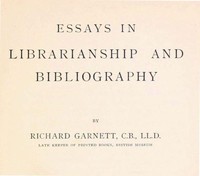
Essays in Librarianship and Bibliography — Themes and Context
(0 User reviews)
1712
Project Gutenberg
2016
Not confirmed
Library science; British Museum; Bibliography -- Methodology
Readers of public-domain and historical texts
Project Gutenberg digital edition
en
Edition facts
Words
89,368
Reading time
389 min
Text sections
32
The source record for Essays in Librarianship and Bibliography — Themes and Context measures this digital text at 89,368 words, 6 hr 29 min estimated reading time, and 32 detected text sections.
The text analysis averages about 28.3 words per sentence, while the detected sections provide another way to judge how the source is divided.
Project Gutenberg metadata also associates the work with “Library science,” connecting these edition facts with the source record’s subject description.
Source:
Project Gutenberg record #53163
Richard Garnett's 1899 collection of essays argues for scientific processes in library management, drawing on his experience at the British Museum. The pieces range from the history of catalog printing to anecdotes about book-collecting in seventeenth-century Rome, revealing tensions between tradition and innovation in librarianship.
Editorial Edition Score
4.9/5
★★★★★
★★★★★
Calculated from edition completeness, EPUB availability, text structure and catalogue metadata. Not a user rating.
How this score is calculated
- Description quality20 pts
- Title & short description10 pts
- Source metadata20 pts
- Text length15 pts
- Chapters / structure15 pts
- EPUB file integrity20 pts
Total of 100 points, scaled to a 2.5-5.0 range. Editions with an empty description or a missing EPUB file are not scored.
Edition quality
Read the Text
Mr. Axon, who dwelt especially on two points in which provincial culture could be promoted by the Museum—the distribution of duplicates and the printing of the catalogue. On both these I am enabled to announce the most satisfactory progress since they were ventilated in 1877. As regards the distribution of duplicates, indeed, further progress is impossible, for we have distributed all we can spare. The subject was energetically taken up by the present Principal Librarian, Mr. Maunde Thompson, shortly after his accession to office, and the result has been that almost all the principal libraries throughout the country have received important benefactions from the Museum. Libraries of the rank of the Bodleian and the Guildhall have, of course, received the first consideration; but nearly all have had some accession, and in some instances provision has been made for a regular supply of duplicate parliamentary papers. Since the distribution of these duplicates the opportunity has further presented itself, through the extensive purchases made at the sale of the Hailstone Library, for enriching Yorkshire libraries with duplicate tracts relating to that county, and I am sure that the trustees will readily avail themselves of any subsequent occasions. I am aware that some think that distribution might be carried even further, but I am certain that this is not the case. We are bound in honour not to give any presented books; valuable presented books must be protected by second copies; copyright books cannot be parted with because receipts have been given for them which, if the books disappeared, there would be nothing to justify, while the books and the stamp showing the date of reception may be required for legal purposes; finally, the international copyright which used to provide the Museum with so many duplicates of foreign books has now become utterly extinct in consequence of the Berne Convention. The progress made in the far more important department of the printing of the catalogue is already well known to you. I have been able to give the Association a satisfactory report of progress on two occasions, and I am now able to state that we have entered into letter P. Some important gaps remain to be filled up, but on the other hand the latter part of the catalogue is printed and published from U to the end. If the Treasury continues its aid, I have little doubt that the whole will be published some time before the end of the century. Mr. Axon certainly did not exaggerate the value which such a publication would possess for general culture, and I am only sorry that it is not as yet properly recognised. Every large town ought to have a copy of the Museum Catalogue, and the supply of the accession parts ought to be regularly kept up. It is too late now to do what might have been done if the importance of the undertaking had been recognised from the first: but the oversight can soon be repaired if the catalogue is reprinted as soon as completed, with the inclusion of all the additional titles that have since grown up. The edition can then be made as large as is necessary to accommodate every important town in the United Kingdom. But this will not be done without the application of considerable pressure to the Government, and this will not come without a much more general interest on the part of the public than there is any reason to suppose exists at present. This might, however, be created by judicious stimulus, which must come in the first instance from librarians, who, though not collectively a highly influential body, have many means of privately influencing persons of weight, and making themselves directly and indirectly heard in the public press.
Richard Garnett, late Keeper of Printed Books at the British Museum, opens this 1899 collection by describing his essays as 'occasional and desultory,' yet united by a 'pervading idea': the importance of scientific processes in library management. The preface immediately establishes a central tension—typography, a technology so familiar it seems 'preposterous' to call it scientific, is still resisted in many European libraries when applied to catalogues. Garnett notes that at the British Museum, print has reigned for nearly twenty years, making the debate there 'historical,' but he insists the subject retains value. This framing positions the reader at a hinge point between old manuscript habits and modern mechanical efficiency.
Typography versus Tradition in the Catalogue
Garnett’s preface identifies a paradox: printing, which revolutionized book production, remains controversial when applied to the catalogue—'the book of books.' He observes that few great European libraries have printed catalogues, and in many, 'the introduction of print is as yet resisted, or beset with impediments.' The British Museum’s adoption of typography for its catalogue is presented as a settled victory, but the essayist’s tone suggests the battle was hard-won. The tension between the efficiency of print and the inertia of established practice recurs throughout the volume. Garnett does not merely celebrate progress; he acknowledges the 'historical interest' of the struggle, implying that the resistance itself reveals something about the nature of library work. The reader is invited to consider how a tool as basic as type could become a site of institutional conflict.
Anecdote as Evidence: The Monkey, the Ink, and the Blotter
In a paper on Nicius Erythræus, Garnett recounts a bibliographic mishap: Cardinal Peranda’s pet monkey seized an ink-soaked cotton stopper and applied it to 'the most precious book in his whole library.' This anecdote, Garnett notes, describes 'an enemy of books which has escaped the attention of Mr. Blades.' The story serves a dual purpose—it entertains while illustrating a gap in existing scholarship. Similarly, the tale of Muzio Oddi, who wrote mathematical treatises on blotting-paper with charcoal ink while imprisoned, is used to document the early use of blotting-paper in Italy. Garnett cross-references Sir Edward Thompson’s evidence that blotting-paper was known in fifteenth-century England, yet notes that sand was still used in the British Museum Reading Room as late as 1838, discontinued only when Panizzi objected that it 'got into the books.' These details build a picture of library history as a patchwork of forgotten innovations and persistent old habits.
The Seventeenth-Century Librarian as a Phantom Profession
Garnett’s essay on librarianship in the seventeenth century opens with a provocative claim: the 'dark ages' were not entirely dark, but librarians know better—'there can have been no librarians where there were no libraries.' He argues that early medieval manuscript collections were too small to require a professional custodian; the librarian’s role was likely 'one of the numerous offices discharged cumulatively by a single monk, upon whom it may sometimes have been imposed by way of penance.' This wry observation sets up a contrast with the classical world, where libraries were larger and more organized. The essay then moves to the seventeenth century, a period when libraries grew but the profession remained ill-defined. Garnett’s tone is both scholarly and amused, treating the absence of a formal librarian class as a kind of professional origin story. The reader is left to ponder how the identity of the librarian emerged from conditions that actively discouraged specialization.
Garnett’s essays reward a reader interested in the granular details of library history—the adoption of blotting-paper, the resistance to printed catalogues, the misadventures of book-collecting cardinals. The collection does not offer a unified argument so much as a series of case studies in the slow, uneven adoption of efficiency. Readers should approach each essay as a self-contained investigation, noting how Garnett uses anecdote to illuminate broader institutional patterns. The volume is best read with an eye for the specific, the quirky, and the practical, rather than for sweeping theoretical claims.
There’s something steadying about how Garnett treats the library like a living thing—catalogues as breathing systems, old books still whispering to new hands. It reminded me of another quiet voice, one that sees purpose woven through ordinary moments. I kept thinking of The Incarnate Purpose: Essays on the Spiritual Unity of Life — Key Ideas to Explore, and how both circle the same hush—that order and meaning aren’t opposed, only resting closer than we expect.
There are no reviews for this eBook.
There are no comments for this eBook.
Reader reflection
What did you think of this book?
Answer a few questions and save a private reflection on this device.
Your progress
0
/
10
2
What was your overall reaction to the book?
3
Is this a title you would suggest to others?
4
How much effort did this book require?
5
Did it raise ideas you would like to talk about?
6
How useful did the reading feel?
7
How understandable was the text?
8
What did you think about the pace?
9
Which lesson or insight stayed with you?
10