
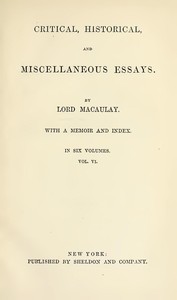
Critical, Historical, and Miscellaneous Essays; Vol. 6 With a Memoir and Index — Themes and Context

(1 User reviews)   350
Macaulay, Thomas Babington Macaulay, Baron, 1800-1859, Whipple, Edwin Percy, 1819-1886 [Editor] Project Gutenberg 2017 Not confirmed
Great Britain -- History; English literature -- History and criticism Readers of public-domain and historical texts
Project Gutenberg digital edition en

Edition facts

Words 171,329
Reading time 745 min
Text sections 32

Critical, Historical, and Miscellaneous Essays; Vol. 6 With a Memoir and Index — Themes and Context can be approached with a clearer sense of reading commitment from its source measurements: 171,329 words, 12 hr 25 min estimated reading time, and 32 detected text sections.

The text analysis averages about 24.6 words per sentence, while the detected sections provide another way to judge how the source is divided.

Project Gutenberg metadata also associates the work with “Great Britain -- History,” connecting these edition facts with the source record’s subject description.

This volume collects Macaulay's essays on Chatham, Atterbury, Bunyan, Goldsmith, Johnson, and Pitt, with a memoir and index. The excerpts show his characteristic blend of biographical narrative, political analysis, and moral judgment, particularly in the detailed account of Pitt's final illness and funeral.
Share
Editorial Edition Score 4.9/5

Calculated from edition completeness, EPUB availability, text structure and catalogue metadata. Not a user rating.

How this score is calculated
  • Description quality20 pts
  • Title & short description10 pts
  • Source metadata20 pts
  • Text length15 pts
  • Chapters / structure15 pts
  • EPUB file integrity20 pts

Total of 100 points, scaled to a 2.5-5.0 range. Editions with an empty description or a missing EPUB file are not scored.

Edition quality

Read the Text

was a reformer, and indeed an intemperate and indiscreet reformer, while the Whig; was conservative even to bigotry. We have ourselves, seen similar effects produced in a neighbouring country by similar causes. Who would have believed, fifteen years ago, that M. Guizot and M. Villemain would have to defend property and social order against the attacks of such enemies as M. Genoude and M. de La Roche Jaquelin?

Thus the successors of the old Cavaliers had turned demagogues; the successors of the old Roundheads had turned courtiers. Yet was it long before their mutual animosity began to abate; for it is the nature of parties to retain their original enmities far more firmly than their original principles. During many years, a generation of Whigs, whom Sidney would have spurned as slaves, continued to wage deadly war with a generation of Tories whom Jeffreys would have hanged for Republicans.

Through the whole reign of George the First, and through nearly half of the reign of George the Second, a Tory was regarded as an enemy of the reigning house, and was excluded from all the favours of the crown. Though most of the country gentlemen were Tories, none but Whigs were created peers and baronets. {5}Though most of the clergy were Tories, none but Whigs were appointed deans and bishops. In every county, opulent and well descended Tory squires complained that their names were left out of the commission of the peace, while men of small estate and mean birth, who were for toleration and excise, septennial parliaments and standing armies, presided at quarter sessions, and became deputy lieutenants.

By degrees some approaches were made towards a reconciliation. While Walpole was at the head of affairs, enmity to his power induced a large and powerful body of Whigs, headed by the heir apparent of the throne, to make an alliance with the Tories, and a truce even with the Jacobites. After Sir Robert’s fall, the ban which lay on the Tory party was taken off. The chief places in the administration continued to be filled by Whigs, and, indeed, could scarcely have been filled otherwise; for the Tory nobility and gentry, though strong in numbers and in property, had among them scarcely a single man distinguished by talents, either for business or for debate. A few of them, however, were admitted to subordinate offices; and this indulgence produced a softening effect on the temper of the whole body. The first levee of George the Second after Walpole’s resignation was a remarkable spectacle. Mingled with the constant supporters of the House of Brunswick, with the Russells, the Cavendishes, and the Pelhams, appeared a crowd of faces utterly unknown to the pages and gentlemen ushers, lords of rural manors, whose ale and fox-hounds were renowned in the neighbourhood of the Mendip hills, or round the Wrekin, but who had never crossed the threshold of the palace since the days when Oxford, with the white staff in his hand, stood behind Queen Anne. {6}During the eighteen years which followed this day, both factions were gradually sinking deeper and deeper into repose. The apathy of the public mind is partly to be ascribed to the unjust violence with which the administration of Walpole had been assailed. In the body politic, as in the natural body, morbid languor generally succeeds morbid excitement. The people had been maddened by sophistry, by calumny, by rhetoric, by stimulants applied to the national pride. In the fulness of bread, they had raved as if famine had been in the land. While enjoying such a measure of civil and religious freedom as, till then, no great society had ever known, they had cried out for a Timoleon or a Brutus to stab their oppressor to the heart. They were in this frame of mind when the change of administration took place; and they soon found that there was to be no change whatever in the system of government. The natural consequences followed. To frantic zeal succeeded sullen indifference. The cant of patriotism had not merely ceased to charm the public ear, but had become as nauseous as the cant of Puritanism after the downfall of the Rump. The hot fit was over: the cold fit had begun: and it was long before seditious arts, or even real grievances, could bring back the fiery paroxysm which had run its course and reached its termination.

Two attempts were made to disturb this tranquillity. The banished heir of the House of Stewart headed a rebellion; the discontented heir of the House of Brunswick headed an opposition. Both the rebellion and the opposition came to nothing. The battle of Culloden annihilated the Jacobite party. The death of Prince Frederic dissolved the faction which, under his guidance, had feebly striven to annoy his father’s government. {7}His chief followers hastened to make their peace with the ministry; and the political torpor became complete.

Five years after the death of Prince Frederic, the public mind was for a time violently excited. But this excitement had nothing to do with the old disputes between Whigs and Tories. England was at war with France. The war had been feebly conducted. Minorca had been torn from us. Our fleet had retired before the white flag of the House of Bourbon. A bitter sense of humiliation, new to the proudest and bravest of nations, superseded every other feeling. The cry of all the counties and great towns of the realm was for a government which would retrieve the honour of the English arms. The two most powerful men in the country were the Duke of Newcastle and Pitt. Alternate victories and defeats had made them sensible that neither of them could stand alone. The interest of the state, and the interest of their own ambition, impelled them to coalesce. By their coalition was formed the ministry which was in power when George the Third ascended the throne.

The more carefully the structure of this celebrated ministry is examined, the more shall we see reason to marvel at the skill or the luck which had combined in one harmonious whole such various and, as it seemed, incompatible elements of force. The influence which is derived from stainless integrity, the influence which is derived from the vilest arts of corruption, the strength of aristocratical connection, the strength of democratical enthusiasm, all these things were for the first time found together. Newcastle brought to the coalition a vast mass of power, which had descended to him from Walpole and Pelham. The public offices, the church, {8}the courts of law, the army, the navy, the diplomatic service, swarmed with his creatures. The boroughs, which long afterwards made up the memorable schedules A and B, were represented by his nominees. The great Whig families, which, during several generations, had been trained in the discipline of party warfare, and were accustomed to stand together in a firm phalanx, acknowledged him as their captain. Pitt, on the other hand, had what Newcastle wanted, an eloquence which stirred the passions and charmed the imagination, a high reputation for purity, and the confidence and ardent love of millions.

The partition which the two ministers made of the powers of government was singularly happy. Each occupied a province for which he was well qualified; and neither had any inclination to intrude himself into the province of the other. Newcastle took the treasury, the civil and ecclesiastical patronage, and the disposal of that part of the secret service money which was then employed in bribing members of Parliament. Pitt was Secretary of State, with the direction of the war and of foreign affairs. Thus the filth of all the noisome and pestilential sewers of government was poured into one channel. Through the other passed only what was bright and stainless. Mean and selfish politicians, pining for commissionerships, gold sticks, and ribands, flocked to the great house at the corner of Lincoln’s Inn Fields. There, at every levee, appeared eighteen or twenty pair of lawn sleeves; for there was not, it was said, a single Prelate who had not owed either his first elevation or some subsequent translation to Newcastle. There appeared those members of the House of Commons in whose silent votes the main strength of the government lay. One wanted a {9}place in the excise for his butler. Another came about a prebend for his son. A third whispered that he had always stood by his Grace and the Protestant succession; that his last election had been very expensive; that potwallopers had now no conscience; that he had been forced to take up money on mortgage; and that he hardly knew where to turn for five hundred pounds. The Duke pressed all their hands, passed his arms round all their shoulders, patted all their backs, and sent away some with wages, and some with promises. From this traffic Pitt stood haughtily aloof. Not only was he himself incorruptible, but he shrank from the loathsome drudgery of corrupting others. He had not, however, been twenty years in Parliament, and ten in office, without discovering how the government was carried on. He was perfectly aware that bribery was practised on a large scale by his colleagues. Hating the practice, yet despairing of putting it down, and doubting whether, in those times, any ministry could stand without it, he determined to be blind to it. He would see nothing, know nothing, believe nothing. People who came to talk to him about shares in lucrative contracts, or about the means of securing a Cornish corporation, were soon put out of countenance by his arrogant humility. They did him too much honour. Such matters were beyond his capacity. It was true that his poor advice about expeditions and treaties was listened to with indulgence by a gracious sovereign. If the question were, who should command in North America, or who should be ambassador at Berlin, his colleagues would probably condescend to take his opinion. But he had not the smallest influence with the Secretary of the Treasury, and could not venture to ask even for a tidewaiter’s place. {10}It may be doubted whether he did not owe as much of his popularity to his ostentatious purity as to his eloquence, or to his talents for the administration of war. It was every where said with delight and admiration that the great Commoner, without any advantages of birth or fortune, had, in spite of the dislike of the Court and of the aristocracy, made himself the first, man in England, and made England the first country in the world; that his name was mentioned with awe in every palace from Lisbon to Moscow; that his trophies were in all the four quarters of the globe; yet that he was still plain William Pitt, without title or riband, without pension or sinecure place. Whenever he should retire, after saving the state, he must sell his coach horses and his silver candlesticks. Widely as the taint of corruption had spread, his hands were clean. They had never received, they had never given, the price of infamy. Thus the coalition gathered to itself support from all the high and all the low parts of human nature, and was strong with the whole united strength of virtue and of Mammon.

Pitt and Newcastle were co-ordinate chief ministers. The subordinate places had been filled on the principle of including in the government every party and shade of party, the avowed Jacobites alone excepted, nay, every public man who, from his abilities or from his situation, seemed likely to be either useful in office or formidable in opposition.

The Whigs, according to what was then considered as their prescriptive right, held by far the largest share of power. The main support of the administration was what may be called the great Whig connection, a connection which, during near half a century, had {11}generally had the chief sway in the country, and which derived an immense authority from rank, wealth, borough interest, and firm union. To this connection, of which Newcastle was the head, belonged the houses of Cavendish, Lennox, Fitzroy, Bentinck, Manners, Conway, Wentworth, and many others of high note.

There were two other powerful Whig connections, either of which might have been a nucleus for a strong opposition. But room had been found in the government for both. They were known as the Grenvilles and the Bedfords.

The head of the Grenvilles was Richard Earl Temple. His talents for administration and debate were of no high order. But his great possessions, his turbulent and unscrupulous character, his restless activity, and his skill in the most ignoble tactics of faction, made him one of the most formidable enemies that a ministry could have. He was keeper of the privy seal. His brother George was treasurer of the navy. They were supposed to be on terms of close friendship with Pitt, who had married their sister, and was the most uxorious of husbands.

The Bedfords, or, as they were called by their enemies, the Bloomsbury gang, professed to be led by John Duke of Bedford, but in truth led him wherever they chose, and very often led him where he never would have gone of his own accord. He had many good qualities of head and heart, and would have been certainly a respectable, and possibly a distinguished man, if he had been less under the influence of his friends, or more fortunate in choosing them. Some of them were indeed, to do them justice, men of parts. But here, we are afraid, eulogy must end. {12}Sandwich and Rigby were able debaters, pleasant boon companions, dexterous intriguers, masters of all the arts of jobbing and electioneering, and both in public and private life, shamelessly immoral. Weymouth had a natural eloquence, which sometimes astonished those who knew how little he owed to study. But he was indolent and dissolute, and had early impaired a fine estate with the dice box, and a fine constitution with the bottle. The wealth and power of the Duke, and the talents and audacity of some of his retainers, might have seriously annoyed the strongest ministry. But his assistance had been secured. He was Lord Lieutenant of Ireland; Rigby was his secretary; and the whole party dutifully supported the measures of the Government.

Two men had, a short time before, been thought likely to contest with Pitt the lead of the House of Commons, William Murray and Henry Fox. But Murray had been removed to the Lords, and was Chief Justice of the Kings Bench. Fox was indeed still in the Commons: but means had been found to secure, if not his strenuous support, at least his silent acquiescence. He was a poor man; he was a doting father. The office of Paymaster-General during an expensive war was, in that age, perhaps the most lucrative situation in the gift of the government. This office was bestowed on Fox. The prospect of making a noble fortune in a few years, and of providing amply for his darling boy Charles, was irresistibly tempting. To hold a subordinate place, however profitable, after having led the House of Commons, and having been intrusted with the business of forming a ministry, was indeed a great descent. But a punctilious sense of personal dignity was no part of the character of Henry Fox. {13}We have not time to enumerate all the other men of weight who were, by some tie or other, attached to the government. We may mention Hardwicke, reputed the first lawyer of the age; Legge, reputed the first financier of the age; the acute and ready Oswald; the bold and humorous Nugent; Charles Townshend, the most brilliant and versatile of mankind; Elliot, Barrington, North, Pratt. Indeed, as far as we recollect, there were in the whole House of Commons only two men of distinguished abilities who were not connected with the government; and those two men stood so low in public estimation, that the only service which they could have rendered to any government would have been to oppose it. We speak of Lord George Sackville and Bubb Dodington.

Though most of the official men, and all the members of the cabinet, were reputed Whigs, the Tories were by no means excluded from employment. Pitt had gratified many of them with commands in the militia, which increased both their income and their importance in their own counties; and they were therefore in better humour than at any time since the death of Anne. Some of the party still continued to grumble over their punch at the Cocoa Tree; but in the House of Commons not a single one of the malecontents durst lift his eyes above the buckle of Pitt’s shoe.

Thus there was absolutely no opposition. Nay, there was no sign from which it could be guessed in what quarter opposition was likely to arise. Several years passed during which Parliament seemed to have abdicated its chief functions. The Journals of the House of Commons, during four sessions, contain no trace of a division on a party question. The supplies, {14}though beyond precedent great, were voted without discussion. The most animated debates of that period were on road bills and inclosure bills.

The old King was content; and it mattered little whether he were content or not. It would have been impossible for him to emancipate himself from a ministry so powerful, even if he had been inclined to do so. But he had no such inclination. He had once, indeed, been strongly prejudiced against Pitt, and had repeatedly been ill used by Newcastle; but the vigour and success with which the war had been waged in Germany, and the smoothness with which all public business was carried on, had produced a favourable change in the royal mind.

Macaulay's essay on William Pitt the Younger, included in this volume, opens with a striking admission of delay: the author had begun a sketch of Lord Chatham more than ten years earlier and now returns to it, noting that materials available in 1834 were 'scanty and unsatisfactory' compared to those at hand in 1844. This self-consciousness about sources recurs throughout the volume, which also contains essays on Francis Atterbury, John Bunyan, Oliver Goldsmith, Samuel Johnson, and a second Pitt essay. The excerpts reveal a writer who treats historical figures as subjects for moral portraiture, blending political narrative with personal anecdote.

A Deathbed Scene Without Sentiment

The account of Pitt's final days is notably unsentimental. Macaulay reports that stories of 'devout sentiments fervently uttered by the dying man' found 'no credit with anybody who knew him,' and he quotes Wilberforce's judgment that Pitt 'always said less than he thought on such topics.' The famous last words 'Oh my country!' are dismissed as 'a fable.' Instead, the dying man's actual utterances were 'broken exclamations about the alarming state of public affairs.' This refusal to embellish a deathbed scene is characteristic of Macaulay's approach: he values factual accuracy over hagiography, even when the subject is a towering political figure.

The Rhetoric of Political Opposition

Macaulay's essay on Pitt also contains a revealing passage about Fox's speech opposing a public funeral and monument for Pitt. He describes the speech as 'a model of good taste and good feeling,' noting that Fox performed 'the most invidious that ever an orator undertook' with 'humanity and delicacy.' This moment of cross-party respect is framed within a larger narrative of political rivalry. Earlier in the volume, Macaulay characterizes the Whig and Tory as representing 'a great principle, essential to the welfare of nations'—one the 'guardian of liberty,' the other of 'order.' Such abstract formulations sit alongside concrete details of parliamentary maneuvering.

The Material Culture of State Funerals

The description of Pitt's funeral is rich in physical detail: the corpse lay 'in state during two days in the Painted Chamber,' then was borne 'with great pomp to the northern transept of the Abbey.' The grave was placed 'near to the spot where his great father lay, near also to the spot where his great rival was soon to be.' Wilberforce, who 'carried the banner before the hearse,' reported that 'the eagle face of Chatham from above seemed to look down with consternation into the dark house.' Macaulay uses these concrete images to underscore the pathos of a minister who 'died of sorrows and anxieties of which none of the survivors could be altogether without a share.'

Readers approaching this volume should expect essays that are as much about character as about policy. Macaulay's method is to anchor broad historical arguments in specific, often vivid, human details—a dying man's last words, a rival's generous speech, the placement of a grave. The memoir and index that frame the collection suggest an editorial intention to present these pieces as a coherent body of work, though the excerpts alone cannot confirm how the volume's structure shapes the reader's experience.

Reading Macaulay on Pitt’s long decline, I found myself thinking how these heavy volumes carry their own quiet weight, much like my old copy of The Free Press — Text and Context rests unopened but familiar. Both feel less like books than companions whose pages have absorbed a little of my own dwelling. A modest shelf, a lingering glance—that’s enough.

Ava Miller
3 weeks ago

5
5 out of 5 (1 User reviews )

Add a Review

Your Rating *
There are no comments for this eBook.

Reader reflection

Your personal reading reflection

Build a private reading journal entry for this title.

Your progress 0 / 10
1

Have you finished this book?

2

What was your overall reaction to the book?

3

Would you encourage someone else to read it?

4

What was the reading difficulty like?

Related eBooks