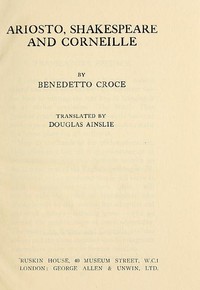
Ariosto, Shakespeare and Corneille — Key Ideas to Explore

(5 User reviews)   1140
Croce, Benedetto, 1866-1952, Ainslie, Douglas, 1865-1948 [Translator] Project Gutenberg 2017 Not confirmed
Shakespeare, William, 1564-1616 -- Criticism and interpretation; Ariosto, Lodovico, 1474-1533; Corneille, Pierre, 1606-1684 Readers of public-domain and historical texts
Project Gutenberg digital edition en

Edition facts

Words 90,872
Reading time 396 min
Text sections 12

Ariosto, Shakespeare and Corneille — Key Ideas to Explore can be approached with a clearer sense of reading commitment from its source measurements: 90,872 words, 6 hr 36 min estimated reading time, and 12 detected text sections.

The text analysis averages about 37.3 words per sentence, while the detected sections provide another way to judge how the source is divided.

Project Gutenberg metadata also associates the work with “Shakespeare, William, 1564-1616 -- Criticism and interpretation,” connecting these edition facts with the source record’s subject description.

Benedetto Croce's literary criticism applies his theory of art as intuition-expression to three major playwrights, analyzing structure and recurring images in Macbeth and King Lear without summarizing plots.
Share
Editorial Edition Score 4.8/5

Calculated from edition completeness, EPUB availability, text structure and catalogue metadata. Not a user rating.

How this score is calculated
  • Description quality20 pts
  • Title & short description10 pts
  • Source metadata20 pts
  • Text length15 pts
  • Chapters / structure15 pts
  • EPUB file integrity20 pts

Total of 100 points, scaled to a 2.5-5.0 range. Editions with an empty description or a missing EPUB file are not scored.

Edition quality

Read the Text

riosto had ordinary emotional experiences in life, and this has been shown to be true, not so much through the biographies of his contemporaries and documents which have later come to light, as through his own words, because he took great pleasure, if not exactly in confessing himself, at any rate in giving vent to his feelings. It is well known that he was without profound intellectual passions, religious or political, free from longing for riches and honours, simple and frugal in his mode of life, seeking above all things peace and tranquillity and freedom to follow his own imagination, to give himself over to the studies that he loved. Rarely or only for brief spaces of time was it given to him to live in his own way, owing to the necessity, always on his shoulders, for providing for his younger brothers and sisters and for his mother, and also the necessity of obtaining bread for himself. All these circumstances together constrained him to undertake the hard work and the annoyances of a court life. He was admirable in the fulfilment of family duties, perfectly honest and reliable on every occasion, full of good, just and generous sentiments, and therefore the recipient of universal esteem and confidence. Owing to reasons connected with his office, he was obliged to associate with greedy, violent, unscrupulous men, but he did not allow himself to be stained by their contact, preserving the attitude of an honest employee towards his patrons, attentive to the formal duties with which he was charged. He is discreet, but pure and dignified, refraining from taking part whatever in the secret plots and machinations of those whose orders he obeys. He was thus enabled to carry out the instructions of his superiors, whom he regarded solely as filling a certain lofty rank, idealising them in conformity with their rank, praising them, that is to say, for their attainments, their ability and their noble undertakings, either because they really possessed them and really accomplished the things for which he praised them, or because they should have possessed them and accomplished the feats in question, as attributes inherent to their social station.

Among these duties and labours one single passion ran like an ever warm stream through his brain: love, or rather the need of woman's society, to have with him a beloved woman, to enjoy her beauty, her laughter, her speech: and although he frequently alludes to this passion, it is as one ashamed of a weakness, but aware that he can by no means dispense with the sweetness that it procures for him and which is a vital element of his being. But even his love for woman, however strong it may have been, found its correct framework in his idyllic ideal and in his reflective and temperate spirit: it contained nothing of the fantastic, the adventurous, the Donjuanesque; and after the customary evil and evanescent adventures of youth, he took refuge in her "for whom he trembled with amorous zeal" and (as his friend Hercules Bentivoglio tells us in verse): in that Alexandra, who was his friend for twenty years, and finally his more or less legal wife. United to his desire for quietude, there was thus a potent stimulus not to remove himself at all, or if at all, then as little as possible, from her who was warmth and comfort for him, and to whom he clung like a child to the bosom of its mother. His latter years, in which, recalled from his severe sojourn at Garfagnana, he occupied himself with correcting his poems at Ferrara, with the woman he loved at his side, were perhaps the happiest he knew; and he passed away in that peace for which he had sighed, ere attaining to old age.

Such tendencies of soul and the life which resulted from them, have sometimes been admired and envied, as for instance by the sixteenth century English translator of the _Furioso,_ Harrington. After having described them, and having disclaimed certain sins, indeed as he said, the single _pecadillo of love,_ he concludes with a sigh: "_Sic me contingat vivere, Sicque mori._" Sometimes too they have been looked upon from above and almost with compassion, as by De Sanctis and others, who have insisted upon the negative aspects of the character of Ariosto. These negative aspects are however nothing but the limits, which are found in everyone, for we are not all capable of everything; and really Italian critics, especially in the period of the Risorgimento, were often wrong in laying down as a single measure for everyone, civil, political, patriotic, religious, excellence, forgetful that judgment of an individual's character should depend upon his natural disposition, his temperament. Certainly, the life of Ariosto was not rich and intense, nor does it present important problems in respect of social and moral history; and the industry of the learned, although it has been able to increase its collections and conjectures as to his economic and family conditions, as to his official duties as courtier, as ambassador and administrator for the Duke of Ferrara, as to his loves and as to the names and persons of the women whom he loved, as to the house which he built and inhabited, and other similar particulars, anecdotes and curiosities concerning him (the collection of which shows with how much religion or superstition a great man is surrounded, and also sometimes the futility of the searcher), has not added anything substantial to what the poet tells us himself, far less has been able to furnish materials for a really new biography, which should be at once profound and dramatic.

Nevertheless, such as it was, the life of a good and of a poor man, of one tenaciously devoted to love and poetry, it found literary expression in the minor works of the author: in the Latin songs, in the Italian verses, and in the satires.

In saying this, we shall set aside the comedies, which seem to be the most important of those minor works and are notwithstanding the least significant, so that they might be almost excluded from the history of his poetical development, connected rather with his doings as a courtier, as an arranger of spectacles and plays, for which purpose he decided to imitate the Latin comedy, for he did not believe there was anything new to be done in that field, since the Latins had already imitated the Greeks. No doubt Ariosto's comedies stand for an important date in the history of the Italian theatre and of the Latin imitation which prevailed there, that is to say, the history of culture, but not in that of poetry. There they are mute. They are works of adaptation and combination, and therefore executed with effort; there is nothing new, even about their form, and a proof of this is that Ariosto, after he had made a first attempt to write them in prose, finally put them into monotonous and tiresome ante-penultimate hendecasyllabics, which have never pleased anyone's ear, because they were not born, but constructed according to design, with evident artifice and with a view to giving to Italy the metre of comedy, analogous to the Roman iambic. Whoever (to cite an instance from the same period and "style") calls to memory the _Mandragola_ of Machiavelli, instinct with the energetic spirit, the bitter disdain of the great thinker, or even the sketches thrown upon paper anyhow by the ne'er-do-well Pietro Aretino, is at once sensible of the difference between dead ability and living force, or at any rate careless vigour. Nor does the dead material come alive, as some easily contented critics maintain, from the fact that Ariosto introduced, especially into the later of those comedies, allusions to persons, places and customs of Ferrara, or satirical gibes at the vices of the time; all these things are light as straws and quite indifferent when original inspiration lacks, as in the present case.

On the other hand, there are many pure and spontaneous parts in the minor works: even the imitations of Horace, of Catullus, of Tibullus in the Latin poems, do not produce a sense of coldness, because we feel that they are inspired with devotion of the humanists for the Latins, for "my Latins," as he affectionately called them; and the heart of the poet often beats with theirs, whether he be lamenting the death of a friend and companion, or drawing the portrait of some fair lady, or describing the delights of the country, or inveighing against some treacherous and venal woman. In like manner, we observe some fine traits of lofty emotion among the Italian poems, such as the two songs for Philiberta of Savoy; and the true accents of his love find their way to utterance among the Petrarchan, the madrigalesque and the courtly qualities of others. Such is the song celebrating their first meeting, in which he records the Florentine _festa,_ where he saw her who was to become his mistress, and who immediately occupied a place above all other women in his eyes, her whose fair, dense hair, as it shaded her cheeks and neck and fell upon her shoulders, whose rich silken robe adorned with scarlet and gold, became part of his soul; and the elegy which is an outburst of joy upon having attained the desired felicity; and that other which records the lovers' meeting at night; then too the chapter upon the visit to Florence, where all the attractions of the sweet city failed to secure fer him a moment's respite, eager as he was to return to the longed-for presence of the loved one, whom he describes poetically in her absence as a fair magician:

"Oltra acque, monti, a ripa l'onda vaga Del re de' fiumi, in bianca e pura stola, Cantando ferma il sol la bella maga, Che con sua vista può sanarmi sola."

and in the sonnet which ends:

"Ma benigne accoglienze, ma complessi Licenziosi, ma parole sciolte D'ogni freno, ma risi, vezzi e giuochi."

They are often echoes of the erotic Latin poets, refreshed by the true condition of his own spirit which, in the passion of love, never went beyond a tender and somewhat slight degree of sensuality. It would be vain to seek in him what he does not possess--that suave imagining, those cosmical analogies, those moral finesses and lofty thoughts, which are to be found in other poets of love.

For this reason, reflections upon himself and upon the society in which it was his fate to live, confidences about his own various ways of feeling and the recital of his adventures, follow and accompany the brief lyrical effusions of this eroticism. When Ariosto limits himself to the thoughts and happenings of his daily life, it is rather a question of narrating than creating, and the culmination of the minor works are known as the _Satires,_ which must not be limited to the seven which bear this title in the printed editions, but should be extended to include other compositions of like tone and content, to be found among the elegies and the capitals, and even among the odes, such as the elegy _De diversis amoribus._ In all of these, Ariosto is writing his autobiography in fragments, or rather as a series of confidential letters to his friends, such as he did not write in prose, at least none are to be found among those of his that remain. These are all connected with business, dry, summary, and written in haste, only here and there revealing the personality of the writer; whereas, when he expressed himself in verse, he made his own soul the subject, paying attention to the vivacity of the representation and the precise accuracy of what he said. This is a most pleasing versified correspondence, where we hear him lamenting, losing patience, telling us what he wants, forming projects, refusing, begging a favour, candidly laying bare for us his true disposition, his lack of docility, his volubility and his caprices, discussing life and the world, smiling at others and at himself; we converse with an Ariosto in his dressing-gown, who experiences great pleasure and has no compunction about showing us himself as he is, and we know how he abhorred any sort of restraint. But these letters in verse, although perfect in quality, vivacious and eloquent as only the writings of a man who speaks of things that concern himself can be, yet are letters, confessions, autobiography: they are not pure poetry; their metrical form is to them something of a delicate pleasing whim, in harmony with such a definition of the soul. In saying this, we do not wish to detract in any way from their value, which is great, but only to prevent their true character from escaping us.

It is no marvel then if a connection, such as prevails between hills and valleys, seems to run between these lesser works, the odes, the verses of the satires, and the _Furioso._ It is sufficient to read an octave or two of the poem to discover at once the difference in altitude separating it from the most delicious of the love-songs, from the most nimble and picturesque of the satires, which express the feelings of the author far more directly than does the _Furioso._ It is further to be noted that Ariosto never wished to publish, and certainly never would have had published a great number of them, with the exception of the comedies, even after his death, except perhaps the satires; but since the minor works are nevertheless the expression of his feelings in real and ordinary life, it follows that if we wish to discover the inspiration of the _Furioso,_ the passion which informed and gave to it its proper content, we must seek for this beyond his ordinary life, not in the heart which we know as that of a son, a brother, a poor man, a lover: it is something hidden yet more deeply within him, the heart of his heart.

That there really was a hidden affection; that Ariosto really had a heart of his heart shut up within himself; that beyond and above the beloved woman he worshipped another woman or goddess, with whom he daily held religious converse, is apparent from his whole habit of life. Why had he so lofty a disdain for practical ambitions, why was life at court and business so wearisome to him, why did he renounce so much, sigh so often and so often pray for leisure and rest and freedom, save to celebrate that cult, to give himself over to that converse, to work upon the _Furioso,_ which was its altar, or the statue which he had sculptured for it and was perfecting with his chisel? What was the origin of his well-known "distraction," that mind of his so aloof from his surroundings, ever dwelling upon something else, which his contemporaries observe and about which curious anecdotes are preserved? His need of love and of feminine caresses did not present itself to him as a supreme end, as with people desirous of ease and pleasure, but seemed to him to be rather a means to an end: as though it were the surrounding of serene joy, of tumult appeased, which he prepared for himself and for that other more lofty love. Carducci has successfully defined this psychological situation in his sonnet on the portrait of Ariosto, where he says that the only longed for and accepted "prize for his poems" was for the great dreamer "a lovely mouth--which should appease the burning of his Apollonian brow--with kisses ..."

The proof of the scrupulous attention which he devoted to the _Furioso,_ is to be found in the twelve years, during which he worked upon it in the flower of his age, "with long vigils and labours," as he wrote to the Doge of Venice, when requesting the privilege of printing the first edition of 1516; and in his having always returned to it, to chisel smooth and to soften it in innumerable delicate details, or to amplify it, or in the throwing away of five cantos, which he had written by way of amplification, but which did not go well with the general design, and finally failed to content him. For these he substituted as many more, and personally superintended the edition of 1532, which also failed to content him altogether, so that he began to work upon it again during the few months which separated him from death. His son Virginio attests that he "was never satisfied with his verses, that he kept changing them again and again, and for this reason never remembered any of them ..."; and contemporaries never cease marvelling at his diligence as a corrector and a maker of perfect things: Giraldi Cinzio, to mention but one witness, says that after the first edition, "not a single day passed," during sixteen years, "that he was not occupied upon it with pen and with thought," and that he was also desirous of obtaining the opinions and impressions of the greatest men of letters and humanists in Italy as to every part of it, men such as Bembo, Molza, Navagero; and as Apelles with his paintings, Ariosto kept his work for two years "in the hall of his house, leaving it there that it might be criticised by everyone"; and he particularly said that he wished his critics merely to mark with a stroke of the pen those parts which did not please them, without giving any reason for so doing, that he might find it out for himself, and then discuss it with them, and so arrive at a decision and a solution in his own way. He pushed his minute delicacy of taste so far as to be preoccupied about the choice of modes of spelling, refusing, for instance, to remove the "h" from those words which possessed it by tradition, thus opposing the suggestion of Tolomei and the new fashion of the illiterate crowd, by jocosely replying that "He who removes the _h_ from _Huomo,_ does not know _Huomo_ (man), and he who removes it from _Honore,_ is not worthy of honour."

What then was the passion which he thus expressed, who was the goddess, for whom, since he could not raise a temple and a marble statue in the little house which he longed for and built in the Via Mirasole, he constructed the architecture, the forms and the poetical adornments of the _Furioso? _ He never uttered her name, because none of the other great Italian poets was so little a theorist or critic as Ariosto. He never discussed his art or art in general, limiting himself to saying very simply, and indeed very inadequately, that what he meant by art was "A work containing pleasing and delightful things"; nor, as we have seen, have the critics told us who she was, since they have at the most indicated vaguely and indirectly in their illogical formula that "his Goddess was Art."

THE HIGHEST LOVE: HARMONY

But we on the other hand shall name her, and we shall call her Harmony, and we shall prove that those who assign a simple aim to Ariosto in the _Furioso,_ Art or Pure Form, were gazing at her and seeing her as it were through a veil of clouds. In doing this, we shall at the same time define the concept of Harmony. We cannot avoid entering upon certain theoretical explanations in relation to this matter; but it would be wrong to look upon them as digressions, since it is only by their means that the way can be cleared to the understanding of the spirit which animates the _Furioso._ There is something comic or at least ironic in this necessity in which we find ourselves, of weighting with philosophy a discourse relating to so transparent a poet as Ariosto; but we have already warned the reader at the beginning that it is one thing to read and let sing to him the verses of a poet, and another to understand him, and that what is easy to learn may sometimes be very difficult to understand.

Benedetto Croce's Ariosto, Shakespeare and Corneille (1920) applies his aesthetic theory—art as lyrical intuition—to three canonical dramatists. The volume opens with a translator's preface by Douglas Ainslie that situates Croce's work as a philosophical corrective to earlier critics like Sainte-Beuve and Taine. Croce's method is not biographical or historical but structural: he examines how each playwright's work embodies a distinct poetic form. The excerpts from the Shakespeare section reveal a critic who reads closely, tracing internal conflicts through recurring images of sleep, blood, and moral paralysis.

The Structure of Moral Conflict in Macbeth

Croce's analysis of Macbeth centers on the protagonist's internal discord, which he describes as a conflict that never resolves. He notes that Macbeth's tragedy lies in his 'incapacity to hold himself right or wrong.' The critic traces this through the play's structure: Macbeth's crimes increase alongside his torment, with no salvation or complete damnation. Croce highlights the recurring image of sleep—Macbeth envies Duncan's 'great final, dissolving sleep'—and the tactile horror of Lady Macbeth's bloody hands. The essay argues that the good appears only as revenge or remorse, never personified, a structural choice that deepens the tragedy.

Cordelia as a Single Star in King Lear

In King Lear, Croce identifies a different structural principle: goodness is 'impersonated and takes the name of Cordelia.' He compares her to a single star shining in a dark sky, a striking image that contrasts with the sequence of betrayals and torments. The critic notes that the play inspires 'tremendous doubt as to the non-existence of goodness,' a doubt generated by the moral deceit that mimics rectitude. Croce's reading focuses on how the play's structure—a tempest of cruelty—allows one figure to embody virtue without sentimentality. He also cites the boy's logical wonderment that good does not choke evil, a detail that underscores the play's philosophical unease.

Recurring Images and Their Thematic Weight

Croce's criticism is notable for its attention to recurring images that carry thematic weight. In Macbeth, he emphasizes the 'nauseating odour of blood' that clings to Lady Macbeth's hands, a sensory detail that recurs in her sleepwalking. The image of sleep—as a 'suavity of desire' and a final dissolution—appears multiple times, linking Macbeth's longing for peace to his moral paralysis. Croce also notes the structural parallel between Macbeth and his wife: both 'consume themselves' but in different ways, he through an implacable call, she through sensible images. These observations ground his philosophical claims in the text's concrete language.

Movement Between Scenes and Character Dynamics

Croce's analysis pays close attention to how characters move between scenes and how their dynamics shift. In Macbeth, he observes that Duncan 'glides along on the outside of things, unsuspectful of betrayals,' a movement that contrasts with Macbeth's internal turmoil. Lady Macduff and her son are 'innocent victims, who flee the knife of the murderers in vain,' their flight a structural counterpoint to Macbeth's aggression. Croce also notes the moment when Macbeth receives news of his wife's death with 'desolate coldness,' a shift that marks his renunciation of affection. These movements—from suspicion to flight, from love to coldness—structure the tragedy's emotional arc.

Croce's essays reward readers who attend to his precise observations of structure and image. Rather than offering a general theory, he demonstrates how each play's form generates its meaning. The excerpts suggest a critic who reads with philosophical rigor but never loses sight of the text's concrete details. Readers interested in Croce's aesthetic theory will find its application here, but the essays also stand as independent critical performances.

That rainy afternoon, Croce’s insistence on art as pure intuition kept tugging at me—his Corneille felt less like a playwright, more like a shaped sigh. The book slipped shut, and I wandered to a shelf where an older, calmer voice waited. That Macaulay collection, Critical, Historical, and Miscellaneous Essays; Vol. 3 With a Memoir and Index — A Reader’s Guide, felt like sitting down beside the same quiet idea, only told in the margins of history itself.

Sebastian Jackson
2 weeks ago

John Torres
3 weeks ago

Sebastian Walker
3 weeks ago

Dylan Brown
1 month ago

Evelyn Gonzalez
2 weeks ago

5
5 out of 5 (5 User reviews )

Add a Review

Your Rating *
There are no comments for this eBook.

Reader reflection

Your personal reading reflection

Build a private reading journal entry for this title.

Your progress 0 / 10
1

Where are you in your reading?

2

Did this book hold your interest?

3

Would you pass this book on to a friend?

4

What was the reading difficulty like?

Related eBooks