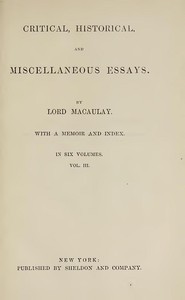
Critical, Historical, and Miscellaneous Essays; Vol. 3 With a Memoir and Index — A Reader’s Guide
Edition facts
For Critical, Historical, and Miscellaneous Essays; Vol. 3 With a Memoir and Index — A Reader’s Guide, the stored edition analysis reports 177,041 words, 12 hr 50 min estimated reading time, and 33 detected text sections.
The text analysis averages about 23.9 words per sentence, while the detected sections provide another way to judge how the source is divided.
Project Gutenberg metadata also associates the work with “Great Britain -- History,” connecting these edition facts with the source record’s subject description.
Calculated from edition completeness, EPUB availability, text structure and catalogue metadata. Not a user rating.
How this score is calculated
- Description quality20 pts
- Title & short description10 pts
- Source metadata20 pts
- Text length15 pts
- Chapters / structure15 pts
- EPUB file integrity20 pts
Total of 100 points, scaled to a 2.5-5.0 range. Editions with an empty description or a missing EPUB file are not scored.
Read the Text
lace. Cecil, therefore, according to his own account, excused himself from signing as a party, but consented to sign as a witness. It is not easy to describe his dexterous conduct at this most perplexing crisis, in language more appropriate than that which is employed by old Fuller. “His hand wrote it as secretary of state,” says that quaint writer; “but his heart consented not thereto. Yea, he openly opposed it; though at last yielding to the greatness of Northumberland, in an age when it was present drowning not to swim with the stream. But as the philosopher tells us, that, though the planets be whirled about daily from east to west, by the motion of the _primum mobile_, yet have they also a contrary proper motion of their own from west to east, which they slowly, though surely, move at their leisure; so Cecil had secret counter-endeavours against the strain of the court herein, and privately advanced his rightful intentions against the foresaid duke’s ambition.” {6}This was undoubtedly the most perilous conjuncture of Cecil’s life. Wherever there was a safe course, he was safe. But here every course was full of danger. His situation rendered it impossible for him to be neutral. If he acted on either side, if he refused to act at all, he ran a fearful risk. He saw all the difficulties of his position. He sent his money and plate out of London, made over his estates to his son, and carried arms about his person. His best arms, however, were his sagacity and his self-command. The plot in which he had been an unwilling accomplice ended, as it was natural that so odious and absurd a plot should end, in the ruin of its contrivers. In the mean time, Cecil quietly extricated himself, and, having been successively patronized by Henry, by Somerset, and by Northumberland, continued to flourish under the protection of Mary.
He had no aspirations after the crown of martyrdom. He confessed himself, therefore, with great decorum, heard mass in Wimbledon Church at Easter, and for the better ordering of his spiritual concerns, took a priest into his house. Dr. Nares, whose simplicity passes that of any casuist with whom we are acquainted, vindicates his hero by assuring us that this was not superstition, but pure unmixed hypocrisy. “That he did in some manner conform, we shall not be able, in the face of existing documents, to deny; while we feel in our own minds abundantly satisfied, that, during this very trying reign, he never abandoned the prospect of another revolution in favour of Protestantism.” In another place, the Doctor tells us, that Cecil went to mass “with no idolatrous intention.” Nobody, we believe, ever accused him of idolatrous intentions. The very ground of the charge against him is that he {7}had no idolatrous intentions. We never should have blamed him if he had really gone to Wimbledon Church, with the feelings of a good Catholic, to worship the host. Dr. Nares speaks in several places with just severity of the sophistry of the Jesuits, and with just admiration of the incomparable letters of Pascal. It is somewhat strange, therefore, that he should adopt, to the full extent, the jesuitical doctrine of the direction of intentions.
We do not blame Cecil for not choosing to be burned. The deep stain upon his memory is that, for differences of opinion for which he would risk nothing himself, he, in the day of his power, took away without scruple the lives of others. One of the excuses suggested in these Memoirs for his conforming, during the reign of Mary, to the Church of Rome, is that he may have been of the same mind with those German Protestants who were called Adiaphorists, and who considered the popish rites as matters indifferent. Melancthon was one of these moderate persons, and “appears,” says Dr. Nares, “to have gone greater lengths than any imputed to Lord Burleigh.” We should have thought this not only an excuse, but a complete vindication, if Cecil had been an Adiaphorist for the benefit of others as well as for his own. If the popish rites were matters of so little moment that a good Protestant might lawfully practise them for his safety, how could it be just or humane that a Papist should be hanged, drawn, and quartered, for practising them from a sense of duty? Unhappily these non-essentials soon became matters of life and death. Just at the very time at which Cecil attained the highest point of power and favour, an Act of Parliament was passed by which the penalties of high treason were denounced {8}against persons who should do in sincerity what he had done from cowardice.
Early in the reign of Mary, Cecil was employed in a mission scarcely consistent with the character of a zealous Protestant. He was sent to escort the Papal Legate, Cardinal Pole, from Brussels to London. That great body of moderate persons who cared more for the quiet of the realm than for the controverted points which were in issue between the Churches seem to have placed their chief hope in the wisdom and humanity of the gentle Cardinal. Cecil, it is clear, cultivated the friendship of Pole with great assiduity, and received great advantage from the Legate’s protection.
But the best protection of Cecil, during the gloomy and disastrous reign of Mary, was that which he derived from his own prudence and from his own temper, a prudence which could never be lulled into carelessness, a temper which could never be irritated into rashness The Papists could find no occasion against him. Yet he did not lose the esteem even of those sterner Protestants who had preferred exile to recantation. He attached himself to the persecuted heiress of the throne, and entitled himself to her gratitude and confidence. Yet he continued to receive marks of favour from the Queen. In the House of Commons, he put himself at the head of the party opposed to the Court. Yet, so guarded was his language that, even when some of those who acted with him were imprisoned by the Privy Council, he escaped with impunity.
At length Mary died: Elizabeth succeeded; and Cecil rose at once to greatness. He was sworn in Privy-councillor and Secretary of State to the new sovereign before he left her prison of Hatfield; and he continued to serve her during forty years, without {9}intermission, in the highest employments. His abilities were precisely those which keep men long in power. He belonged to the class of the Walpoles, the Pelhams, and the Liverpools, not to that of the St. Johns, the Carterets, the Chathams, and the Cannings. If he had been a man of original genius and of an enterprising spirit, it would have been scarcely possible for him to keep his power or even his head. There was not room in one government for an Elizabeth and a Richelieu. What the haughty daughter of Henry needed, was a moderate, cautions, flexible minister, skilled in the details of business, competent to advise, but not aspiring to command. And such a minister she found in Burleigh. No arts could shake the confidence which she reposed in her old and trusty servant. The courtly graces of Leicester, the brilliant talents and accomplishments of Essex, touched the fancy, perhaps the heart, of the woman; but no rival could deprive the Treasurer of the place which he possessed in the favour of the Queen. She sometimes chid him sharply; but he was the man whom she delighted to honour. For Burleigh, she forgot her usual parsimony both of wealth and of dignities. For Burleigh, she relaxed that severe etiquette to which she was unreasonably attached. Every other person to whom she addressed her speech, or on whom the glance of her eagle eye fell, instantly sank on his knee. For Burleigh alone, a chair was set in her presence; and there the old minister, by birth only a plain Lincolnshire esquire, took his ease, while the haughty heirs of the Fitzalans and the De Veres humbled themselves to the dust around him. At length, having survived all his early coadjutors, and rivals, he died full of years and honours. His royal mistress visited him on his {10}death-bed, and cheered him with assurances of her affection and esteem; and his power passed, with little diminution, to a son who inherited his abilities, and whose mind had been formed by his counsels.
The life of Burleigh was commensurate with one of the most important periods in the history of the world. It exactly measures the time during which the House of Austria held decided superiority and aspired to universal dominion. In the year in which Burleigh was born, Charles the Fifth obtained the imperial crown. In the year in which Burleigh died, the vast designs which had, during near a century, kept Europe in constant agitation, were buried in the same grave with the proud and sullen Philip.
The life of Burleigh was commensurate also with the period during which a great moral revolution was effected, a revolution the consequences of which were felt, not only in the cabinets of princes, but at half the firesides in Christendom. He was born when the great religious schism was just commencing. He lived to see that schism complete, and to see a line of demarcation, which, since his death, has been very little altered, strongly drawn between Protestant and Catholic Europe.
The only event of modern times which can be properly compared with the Reformation is the French Revolution, or, to speak more accurately, that great revolution of political feeling which took place in almost every part of the civilised world during the eighteenth century, and which obtained in France its most terrible and signal triumph. Each of these memorable events may be described as a rising up of the human reason against a Caste. The one was a {11}straggle of the laity against the clergy for intellectual liberty; the other was a straggle of the people against princes and nobles for political liberty. In both cases, the spirit of innovation was at first encouraged by the class to which it was likely to be most prejudicial. It was under the patronage of Frederic, of Catherine, of Joseph, and of the grandees of France, that the philosophy which afterwards threatened all the thrones and aristocracies of Europe with destruction first became formidable. The ardour with which men betook themselves to liberal studies, at the close of the fifteenth and the beginning of the sixteenth century, was zealously encouraged by the heads of that very church to which liberal studies were destined to be fatal. In both cases, when the explosion came, it came with a violence which appalled and disgusted many of those who had previously been distinguished by the freedom of their opinions. The violence of the democratic party in France made Burke a Tory and Alfieri a courtier. The violence of the chiefs of the German schism made Erasmus a defender of abuses, and turned the author of Utopia into a persecutor. In both cases, the convulsion which had overthrown deeply seated errors, shook all the principles on which society rests to their very foundations. The minds of men were unsettled. It seemed for a time that all order and morality were about to perish with the prejudices with which they had been long and intimately associated. Frightful cruelties were committed. Immense masses of property were confiscated. Every part of Europe swarmed with exiles. In moody and turbulent spirits zeal soured into malignity, or foamed into madness. From the political agitation of the eighteenth century sprang the Jacobins. {12}From the religious agitation of the sixteenth century sprang the Anabaptists. The partisans of Robespierre robbed and murdered in the name of fraternity and equality. The followers of Kniperdoling robbed and murdered in the name of Christian liberty. The feeling of patriotism was, in many parts of Europe, almost wholly extinguished. All the old maxims of foreign policy were changed. Physical boundaries were superseded by moral boundaries. Nations made war on each other with new arms, with arms which no fortifications, however strong by nature or by art, could resist, with arms before which rivers parted like the Jordan, and ramparts fell down like the walls of Jericho. The great masters of fleets and armies were often reduced to confess, like Milton’s warlike angel, how hard they found it
Spiritual substance with corporeal bar.”
Europe was divided, as Greece had been divided during the period concerning which Thucydides wrote. The conflict was not, as it is in ordinary times, between state and state, but between two omnipresent factions, each of which was in some places dominant and in other places oppressed, but which, openly or covertly, carried on their strife in the bosom of every society. No man asked whether another belonged to the same country with himself, but whether he belonged to the same sect. Party-spirit seemed to justify and consecrate acts which, in any other times, would have been considered as the foulest of treasons. The French emigrant saw nothing disgraceful in bringing Austrian and Prussian hussars to Paris. The Irish or Italian democrat saw no impropriety in serving the French Directory against his own native government. {13}So, in the sixteenth century, the fury of theological factions suspended all national animosities and jealousies. The Spaniards were invited into France by the League; the English were invited into France by the Huguenots.
We by no means intend to underrate or to palliate the crimes and excesses which, during the last generation, were produced by the spirit of democracy. But, when we hear men zealous for the Protestant religion, constantly represent the French Revolution as radically and essentially evil on account of those crimes and excesses, we cannot but remember that the deliverance of our ancestors from the house of their spiritual bondage was effected “by plagues and by signs, by wonders and by war.” We cannot but remember that, as in the case of the French Revolution, so also in the case of the Reformation, those who rose up against tyranny were themselves deeply tainted with the vices which tyranny engenders. We cannot but remember that libels scarcely less scandalous than those of Hebert, mummeries scarcely less absurd than those of Clootz, and crimes scarcely less atrocious than those of Marat, disgrace the early history of Protestantism. The Reformation is an event long passed. That volcano has spent its rage. The wide waste produced by its outbreak is forgotten. The landmarks which were swept away have been replaced. The ruined edifices have been repaired. The lava has covered with a rich incrustation the fields which it once devastated, and, after having turned a beautiful and fruitful garden into a desert, has again turned the desert into a still more beautiful and fruitful garden. The second great irruption is not yet over. The marks of its ravages are still all around us. The ashes are still hot beneath {14}our feet. In some directions the deluge of fire still continues to spread. Yet experience surely entitles us to believe, that this explosion, like that which preceded it, will fertilize the soil which it has devastated. Already, in those parts which have suffered most severely, rich cultivation and secure dwellings have begun to appear amidst the waste. The more we read of the history of past ages, the more we observe the signs of our own times, the more do we feel our hearts filled and swelled up by a good hope for the future destinies of the human race.
The history of the Reformation in England is full of strange problems. The most prominent and extraordinary phenomenon which it presents to us is the gigantic strength of the government contrasted with the feebleness of the religious parties. During the twelve or thirteen years which followed the death of Henry the Eighth, the religion of the state was thrice changed. Protestantism was established by Edward; the Catholic Church was restored by Mary; Protestantism was again established by Elizabeth. The faith of the nation seemed to depend on the personal inclinations of the sovereign. Nor was this all. An established church was then, as a matter of course, a persecuting church. Edward persecuted Catholics. Mary persecuted Protestants. Elizabeth persecuted Catholics again. The father of those three sovereigns had enjoyed the pleasure of persecuting both sects at once, and had sent to death, on the same hurdle, the heretic who denied the real presence, and the traitor who denied the royal supremacy. There was nothing in England like that fierce and bloody opposition which, in France, each of the religious factions in its turn offered to the government. We had neither a {15}Coligny nor a Mayenne, neither a Moncontour nor an Ivry. No English city braved sword and famine for the reformed doctrines with the spirit of Rochelle, or for the Catholic doctrines with the spirit of Paris. Neither sect in England formed a League. Neither sect extorted a recantation from the sovereign. Neither sect could obtain from an adverse sovereign even a toleration. The English Protestants, after several years of domination, sank down with scarcely a straggle under the tyranny of Mary. The Catholics, after having regained and abused their old ascendency, submitted patiently to the severe rule of Elizabeth. Neither Protestants nor Catholics engaged in any great and well organized scheme of resistance. A few wild and tumultuous risings, suppressed as soon as they appeared, a few dark conspiracies in which only a small number of desperate men engaged, such were the utmost efforts made by these two parties to assert the most sacred of human rights, attacked by the most odious tyranny.
The explanation of these circumstances which has generally been given is very simple, but by no means satisfactory. The power of the crown, it is said, was then at its height, and was in fact despotic. This solution, we own, seems to us to be no solution at all. It has long been the fashion, a fashion introduced by Mr. Hume, to describe the English monarchy in the sixteenth century as an absolute monarchy. And such undoubtedly it appears to a superficial observer. Elizabeth, it is true, often spoke to her parliaments in language as haughty and imperious as that which the Great Turk would use to his divan. She punished with great severity members of the House of Commons who, in her opinion, carried the freedom of debate too far. {16}She assumed the power of legislating by means of proclamations. She imprisoned her subjects without bringing them to a legal trial. Torture was often employed, in defiance, of the laws of England, for the purpose of extorting confessions from those who were shut up in her dungeons. The authority of the Star-Chamber and of the Ecclesiastical Commission was at its highest point. Severe restraints were imposed on political and religious discussion. The number of presses was at one time limited. No man could print without a license; and every work had to undergo the scrutiny of the Primate, or the Bishop of London. Persons whose writings were displeasing to the court were cruelly mutilated, like Stubbs, or put to death, like Penry. Nonconformity was severely punished. The Queen prescribed the exact rule of religious faith and discipline; and whoever departed from that rule, either to the right or to the left, was in danger of severe penalties.
Such was this government. Yet we know that it was loved by the great body of those who lived under it. We know that, during the fierce contests of the sixteenth century, both the hostile parties spoke of the time of Elizabeth as of a golden age. That great Queen has now been lying two hundred and thirty years in Henry the Seventh’s chapel. Yet her memory is still dear to the hearts of a free people.
Macaulay opens his review of Dr. Nares's biography of Lord Burghley with a sustained comic conceit: the book is so massive that it 'weighs sixty pounds avoirdupois' and reading it is harder labor than 'thieves on the treadmill.' This hyperbolic physical description—corn as high as oaks, thimbles as large as buckets—sets the tone for a volume where Macaulay repeatedly uses scale and weight as metaphors for intellectual and moral failings. The essay on James II, for instance, pivots from the king's professed toleration to his actual persecution, contrasting 'the milk-white and immortal hind' with 'the unclean panther.'
Scale as Satirical Weapon
Macaulay's opening assault on Nares's Burghley biography is a masterclass in using physical magnitude to imply intellectual emptiness. He notes that the book 'occupies fifteen hundred inches cubic measure' and that reading it is 'an agreeable recreation' only compared to penal labor. This is not mere mockery: it establishes a method. Throughout the volume, Macaulay measures historical figures by the gap between their self-presentation and their actions. The essay on James II, for example, exposes the king's 'liberal professions' by juxtaposing them with his dismissal of Lord Rochester for refusing to convert to Catholicism. Macaulay cites the Papal Nuncio's despatches to show that even contemporaries saw through the hypocrisy: 'gli animi sono inaspriti' at the minister's removal for not being Catholic. The contrast between rhetorical scale and actual conduct becomes a recurring analytical tool.
The Rhetoric of Persecution
In the essay on James II, Macaulay dissects the king's claim to champion religious liberty. He argues that James persecuted not 'in defence of truth against error, but in defence of one damnable error against another'—specifically, forcing Episcopalians into Presbyterianism. The passage is dense with ironic reversals: James 'torture and murder for the difference between two roads to hell.' Macaulay then turns to James's ally Louis XIV, whose 'intolerant policy had turned the fairest tracts of France into deserts.' The essay does not merely condemn James; it exposes the logic of persecution as self-defeating. By quoting Dr. Lingard—'a very competent, and assuredly not a very willing witness'—Macaulay builds his case from sources that would normally favor the king. The result is a layered argument about how power corrupts even the language of toleration.
Character Through Contrast
Macaulay's method of characterization relies on sharp juxtapositions. In the Burghley review, he contrasts Nares's 'stupendous mass of paper' with the actual historical figure of Cecil, who was known for subtlety and indirection. The essay on Horace Walpole (not excerpted here but listed in the contents) likely continues this pattern of using a subject's writings to reveal character. The volume as a whole moves between public figures (Burleigh, Mirabeau, Pitt) and literary ones (Walpole, Bacon), suggesting that Macaulay sees statecraft and authorship as parallel arenas for moral judgment. His own prose mirrors this: the same sentence that catalogues a book's cubic inches can pivot to a devastating moral verdict. The reader is invited to watch a mind that measures everything—books, kings, policies—by the same exacting standard of integrity.
Readers approaching this volume should attend to Macaulay's use of scale as a critical device: he treats books, policies, and characters as objects to be weighed. The essays reward careful attention to his sources—he often lets opponents speak before demolishing them. Because the excerpts are incomplete, some essays (like those on Mirabeau or Walpole) are only partially represented, but the pattern of moral and intellectual scrutiny is consistent throughout. Macaulay's voice is that of a prosecutor who has read the entire dossier.
There are evenings when I pull Macaulay down and smile at his gleeful skewering of pedantry, his warmth beneath the wit. It reminds me of another old friend, quieter, on the shelf above—A History of Literary Criticism in the Renaissance With special reference to the influence of Italy in the formation and development of modern classicism — Key Ideas to Explore—which traces how those very arguments about taste first found their voice. They share a certain knowing sigh.
There are no reviews for this eBook.
What did you think of this book?
Answer a few questions and save a private reflection on this device.
Jeffrey James Ward - 1 week ago