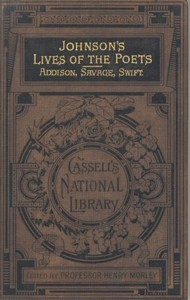
Johnson's Lives of the Poets — Volume 1 — Themes and Context

(1 User reviews)   177
Johnson, Samuel, 1709-1784 Project Gutenberg 2003 Not confirmed
English poetry -- Early modern, 1500-1700 -- History and criticism; English poetry -- 18th century -- History and criticism; Poets, English -- Biography -- Early works to 1800 Readers of public-domain and historical texts
Project Gutenberg digital edition en

Edition facts

Words 65,992
Reading time 287 min
Text sections 6

For Johnson's Lives of the Poets — Volume 1 — Themes and Context, the stored edition analysis reports 65,992 words, 4 hr 47 min estimated reading time, and 6 detected text sections.

The text analysis averages about 33.2 words per sentence, while the detected sections provide another way to judge how the source is divided.

Project Gutenberg metadata also associates the work with “English poetry -- Early modern, 1500-1700 -- History and criticism,” connecting these edition facts with the source record’s subject description.

Samuel Johnson's biographical portraits of Addison, Savage, and Swift, revealing his authorial choices in diction, dialogue, and description. The Life of Savage stands out for its sympathetic yet critical portrayal, blending moral judgment with vivid anecdote.
Share
Editorial Edition Score 4.7/5

Calculated from edition completeness, EPUB availability, text structure and catalogue metadata. Not a user rating.

How this score is calculated
  • Description quality20 pts
  • Title & short description10 pts
  • Source metadata20 pts
  • Text length15 pts
  • Chapters / structure15 pts
  • EPUB file integrity20 pts

Total of 100 points, scaled to a 2.5-5.0 range. Editions with an empty description or a missing EPUB file are not scored.

Edition quality

Read the Text

deceived except in judgment upon the fraudulent claims which then gave rise to division of opinion. The Life of Savage is a noble piece of truth, although it rests on faith put in a fraud.

JOSEPH ADDISON was born on the 1st of May, 1672, at Milston, of which his father, Lancelot Addison, was then rector, near Ambrosebury, in Wiltshire, and, appearing weak and unlikely to live, he was christened the same day. After the usual domestic education, which from the character of his father may be reasonably supposed to have given him strong impressions of piety, he was committed to the care of Mr. Naish at Ambrosebury, and afterwards of Mr. Taylor at Salisbury.

Not to name the school or the masters of men illustrious for literature, is a kind of historical fraud, by which honest fame is injuriously diminished: I would therefore trace him through the whole process of his education. In 1683, in the beginning of his twelfth year, his father, being made Dean of Lichfield, naturally carried his family to his new residence, and, I believe, placed him for some time, probably not long, under Mr. Shaw, then master of the school at Lichfield, father of the late Dr. Peter Shaw. Of this interval his biographers have given no account, and I know it only from a story of a _barring-out_, told me, when I was a boy, by Andrew Corbet, of Shropshire, who had heard it from Mr. Pigot, his uncle.

The practice of _barring-out_ was a savage licence, practised in many schools to the end of the last century, by which the boys, when the periodical vacation drew near, growing petulant at the approach of liberty, some days before the time of regular recess, took possession of the school, of which they barred the doors, and bade their master defiance from the windows. It is not easy to suppose that on such occasions the master would do more than laugh; yet, if tradition may be credited, he often struggled hard to force or surprise the garrison. The master, when Pigot was a schoolboy, was _barred out_ at Lichfield; and the whole operation, as he said, was planned and conducted by Addison.

To judge better of the probability of this story, I have inquired when he was sent to the Chartreux; but, as he was not one of those who enjoyed the founder’s benefaction, there is no account preserved of his admission. At the school of the Chartreux, to which he was removed either from that of Salisbury or Lichfield, he pursued his juvenile studies under the care of Dr. Ellis, and contracted that intimacy with Sir Richard Steele which their joint labours have so effectually recorded.

Of this memorable friendship the greater praise must be given to Steele. It is not hard to love those from whom nothing can be feared; and Addison never considered Steele as a rival; but Steele lived, as he confesses, under an habitual subjection to the predominating genius of Addison, whom he always mentioned with reverence, and treated with obsequiousness.

Addison, who knew his own dignity, could not always forbear to show it, by playing a little upon his admirer; but he was in no danger of retort; his jests were endured without resistance or resentment. But the sneer of jocularity was not the worst. Steele, whose imprudence of generosity, or vanity of profusion, kept him always incurably necessitous, upon some pressing exigence, in an evil hour, borrowed a hundred pounds of his friend probably without much purpose of repayment; but Addison, who seems to have had other notions of a hundred pounds, grew impatient of delay, and reclaimed his loan by an execution. Steele felt with great sensibility the obduracy of his creditor, but with emotions of sorrow rather than of anger.

In 1687 he was entered into Queen’s College in Oxford, where, in 1689, the accidental perusal of some Latin verses gained him the patronage of Dr. Lancaster, afterwards Provost of Queen’s College; by whose recommendation he was elected into Magdalen College as a demy, a term by which that society denominates those who are elsewhere called scholars: young men who partake of the founder’s benefaction, and succeed in their order to vacant fellowships. Here he continued to cultivate poetry and criticism, and grew first eminent by his Latin compositions, which are indeed entitled to particular praise. He has not confined himself to the imitation of any ancient author, but has formed his style from the general language, such as a diligent perusal of the productions of different ages happened to supply. His Latin compositions seem to have had much of his fondness, for he collected a second volume of the “Musæ Anglicanæ” perhaps for a convenient receptacle, in which all his Latin pieces are inserted, and where his poem on the Peace has the first place. He afterwards presented the collection to Boileau, who from that time “conceived,” says Tickell, “an opinion of the English genius for poetry.” Nothing is better known of Boileau than that he had an injudicious and peevish contempt of modern Latin, and therefore his profession of regard was probably the effect of his civility rather than approbation.

Three of his Latin poems are upon subjects on which perhaps he would not have ventured to have written in his own language: “The Battle of the Pigmies and Cranes,” “The Barometer,” and “A Bowling-green.” When the matter is low or scanty, a dead language, in which nothing is mean because nothing is familiar, affords great conveniences; and by the sonorous magnificence of Roman syllables, the writer conceals penury of thought, and want of novelty, often from the reader and often from himself.

In his twenty-second year he first showed his power of English poetry by some verses addressed to Dryden; and soon after published a translation of the greater part of the Fourth Georgic upon Bees; after which, says Dryden, “my latter swarm is scarcely worth the hiving.” About the same time he composed the arguments prefixed to the several books of Dryden’s Virgil; and produced an Essay on the Georgics, juvenile, superficial, and uninstructive, without much either of the scholar’s learning or the critic’s penetration. His next paper of verses contained a character of the principal English poets, inscribed to Henry Sacheverell, who was then, if not a poet, a writer of verses; as is shown by his version of a small part of Virgil’s Georgics, published in the Miscellanies; and a Latin encomium on Queen Mary, in the “Musæ Anglicanæ.” These verses exhibit all the fondness of friendship; but, on one side or the other, friendship was afterwards too weak for the malignity of faction. In this poem is a very confident and discriminate character of Spenser, whose work he had then never read; so little sometimes is criticism the effect of judgment. It is necessary to inform the reader that about this time he was introduced by Congreve to Montague, then Chancellor of the Exchequer: Addison was then learning the trade of a courtier, and subjoined Montague as a poetical name to those of Cowley and of Dryden. By the influence of Mr. Montague, concurring, according to Tickell, with his natural modesty, he was diverted from his original design of entering into holy orders. Montague alleged the corruption of men who engaged in civil employments without liberal education; and declared that, though he was represented as an enemy to the Church, he would never do it any injury but by withholding Addison from it.

Soon after (in 1695) he wrote a poem to King William, with a rhyming introduction addressed to Lord Somers. King William had no regard to elegance or literature; his study was only war; yet by a choice of Ministers, whose disposition was very different from his own, he procured, without intention, a very liberal patronage to poetry. Addison was caressed both by Somers and Montague.

In 1697 appeared his Latin verses on the Peace of Ryswick, which he dedicated to Montague, and which was afterwards called, by Smith, “the best Latin poem since the ‘Æneid.’” Praise must not be too rigorously examined; but the performance cannot be denied to be vigorous and elegant. Having yet no public employment, he obtained (in 1699) a pension of three hundred pounds a year, that he might be enabled to travel. He stayed a year at Blois, probably to learn the French language and then proceeded in his journey to Italy, which he surveyed with the eyes of a poet. While he was travelling at leisure, he was far from being idle: for he not only collected his observations on the country, but found time to write his “Dialogues on Medals,” and four acts of _Cato_. Such, at least, is the relation of Tickell. Perhaps he only collected his materials and formed his plan. Whatever were his other employments in Italy, he there wrote the letter to Lord Halifax which is justly considered as the most elegant, if not the most sublime, of his poetical productions. But in about two years he found it necessary to hasten home; being, as Swift informs us, distressed by indigence, and compelled to become the tutor of a travelling squire, because his pension was not remitted.

At his return he published his Travels, with a dedication to Lord Somers. As his stay in foreign countries was short, his observations are such as might be supplied by a hasty view, and consist chiefly in comparisons of the present face of the country with the descriptions left us by the Roman poets, from whom he made preparatory collections, though he might have spared the trouble had he known that such collections had been made twice before by Italian authors.

The most amusing passage of his book is his account of the minute republic of San Marino; of many parts it is not a very severe censure to say that they might have been written at home. His elegance of language, and variegation of prose and verse, however, gain upon the reader; and the book, though awhile neglected, became in time so much the favourite of the public that before it was reprinted it rose to five times its price.

When he returned to England (in 1702), with a meanness of appearance which gave testimony of the difficulties to which he had been reduced, he found his old patrons out of power, and was therefore, for a time, at full leisure for the cultivation of his mind; and a mind so cultivated gives reason to believe that little time was lost. But he remained not long neglected or useless. The victory at Blenheim (1704) spread triumph and confidence over the nation; and Lord Godolphin, lamenting to Lord Halifax that it had not been celebrated in a manner equal to the subject, desired him to propose it to some better poet. Halifax told him that there was no encouragement for genius; that worthless men were unprofitably enriched with public money, without any care to find or employ those whose appearance might do honour to their country. To this Godolphin replied that such abuses should in time be rectified; and that, if a man could be found capable of the task then proposed, he should not want an ample recompense. Halifax then named Addison, but required that the Treasurer should apply to him in his own person. Godolphin sent the message by Mr. Boyle, afterwards Lord Carlton; and Addison, having undertaken the work, communicated it to the Treasury while it was yet advanced no further than the simile of the angel, and was immediately rewarded by succeeding Mr. Locke in the place of Commissioner of Appeals.

In the following year he was at Hanover with Lord Halifax: and the year after he was made Under Secretary of State, first to Sir Charles Hedges, and in a few months more to the Earl of Sunderland. About this time the prevalent taste for Italian operas inclined him to try what would be the effect of a musical drama in our own language. He therefore wrote the opera of Rosamond, which, when exhibited on the stage, was either hissed or neglected; but, trusting that the readers would do him more justice, he published it with an inscription to the Duchess of Marlborough—a woman without skill, or pretensions to skill, in poetry or literature. His dedication was therefore an instance of servile absurdity, to be exceeded only by Joshua Barnes’s dedication of a Greek Anacreon to the Duke. His reputation had been somewhat advanced by The Tender Husband, a comedy which Steele dedicated to him, with a confession that he owed to him several of the most successful scenes. To this play Addison supplied a prologue.

When the Marquis of Wharton was appointed Lord Lieutenant of Ireland, Addison attended him as his secretary; and was made Keeper of the Records, in Birmingham’s Tower, with a salary of three hundred pounds a year. The office was little more than nominal, and the salary was augmented for his accommodation. Interest and faction allow little to the operation of particular dispositions or private opinions. Two men of personal characters more opposite than those of Wharton and Addison could not easily be brought together. Wharton was impious, profligate, and shameless; without regard, or appearance of regard, to right and wrong. Whatever is contrary to this may be said of Addison; but as agents of a party they were connected, and how they adjusted their other sentiments we cannot know.

Addison must, however, not be too hastily condemned. It is not necessary to refuse benefits from a bad man when the acceptance implies no approbation of his crimes; nor has the subordinate officer any obligation to examine the opinions or conduct of those under whom he acts, except that he may not be made the instrument of wickedness. It is reasonable to suppose that Addison counteracted, as far as he was able, the malignant and blasting influence of the Lieutenant; and that at least by his intervention some good was done, and some mischief prevented. When he was in office he made a law to himself, as Swift has recorded, never to remit his regular fees in civility to his friends: “for,” said he, “I may have a hundred friends; and if my fee be two guineas, I shall, by relinquishing my right, lose two hundred guineas, and no friend gain more than two; there is therefore no proportion between the good imparted and the evil suffered.” He was in Ireland when Steele, without any communication of his design, began the publication of the _Tatler_; but he was not long concealed; by inserting a remark on Virgil which Addison had given him he discovered himself. It is, indeed, not easy for any man to write upon literature or common life so as not to make himself known to those with whom he familiarly converses, and who are acquainted with his track of study, his favourite topic, his peculiar notions, and his habitual phrases.

If Steele desired to write in secret, he was not lucky; a single month detected him. His first _Tatler_ was published April 22 (1709); and Addison’s contribution appeared May 26. Tickell observes that the _Tatler_ began and was concluded without his concurrence. This is doubtless literally true; but the work did not suffer much by his unconsciousness of its commencement, or his absence at its cessation; for he continued his assistance to December 23, and the paper stopped on January 2. He did not distinguish his pieces by any signature; and I know not whether his name was not kept secret till the papers were collected into volumes.

To the _Tatler_, in about two months, succeeded the _Spectator_: a series of essays of the same kind, but written with less levity, upon a more regular plan, and published daily. Such an undertaking showed the writers not to distrust their own copiousness of materials or facility of composition, and their performance justified their confidence. They found, however, in their progress many auxiliaries. To attempt a single paper was no terrifying labour; many pieces were offered, and many were received.

Addison had enough of the zeal of party; but Steele had at that time almost nothing else. The _Spectator_, in one of the first papers, showed the political tenets of its authors; but a resolution was soon taken of courting general approbation by general topics, and subjects on which faction had produced no diversity of sentiments—such as literature, morality, and familiar life. To this practice they adhered with few deviations. The ardour of Steele once broke out in praise of Marlborough; and when Dr. Fleetwood prefixed to some sermons a preface overflowing with Whiggish opinions, that it might be read by the Queen, it was reprinted in the _Spectator_.

To teach the minuter decencies and inferior duties, to regulate the practice of daily conversation, to correct those depravities which are rather ridiculous than criminal, and remove those grievances which, if they produce no lasting calamities, impress hourly vexation, was first attempted by Casa in his book of “Manners,” and Castiglione in his “Courtier:” two books yet celebrated in Italy for purity and elegance, and which, if they are now less read, are neglected only because they have effected that reformation which their authors intended, and their precepts now are no longer wanted. Their usefulness to the age in which they were written is sufficiently attested by the translations which almost all the nations of Europe were in haste to obtain.

This species of instruction was continued, and perhaps advanced, by the French; among whom La Bruyère’s “Manners of the Age” (though, as Boileau remarked, it is written without connection) certainly deserves praise for liveliness of description and justness of observation.

Before the _Tatler_ and _Spectator_, if the writers for the theatre are excepted, England had no masters of common life. No writers had yet undertaken to reform either the savageness of neglect, or the impertinence of civility; to show when to speak, or to be silent; how to refuse, or how to comply. We had many books to teach us our more important duties, and to settle opinions in philosophy or politics; but an _arbiter elegantiarum_, (a judge of propriety) was yet wanting who should survey the track of daily conversation, and free it from thorns and prickles, which tease the passer, though they do not wound him. For this purpose nothing is so proper as the frequent publication of short papers, which we read, not as study, but amusement. If the subject be slight, the treatise is short. The busy may find time, and the idle may find patience. This mode of conveying cheap and easy knowledge began among us in the civil war, when it was much the interest of either party to raise and fix the prejudices of the people. At that time appeared _Mercurius Aulicus_, _Mercurius Rusticus_, and _Mercurius Civicus_. It is said that when any title grew popular, it was stolen by the antagonist, who by this stratagem conveyed his notions to those who would not have received him had he not worn the appearance of a friend. The tumult of those unhappy days left scarcely any man leisure to treasure up occasional compositions; and so much were they neglected that a complete collection is nowhere to be found.

These Mercuries were succeeded by L’Estrange’s _Observator_; and that by Lesley’s _Rehearsal_, and perhaps by others; but hitherto nothing had been conveyed to the people, in this commodious manner, but controversy relating to the Church or State; of which they taught many to talk, whom they could not teach to judge.

It has been suggested that the Royal Society was instituted soon after the Restoration to divert the attention of the people from public discontent. The _Tatler_ and _Spectator_ had the same tendency; they were published at a time when two parties—loud, restless, and violent, each with plausible declarations, and each perhaps without any distinct termination of its views—were agitating the nation; to minds heated with political contest they supplied cooler and more inoffensive reflections; and it is said by Addison, in a subsequent work, that they had a perceptible influence upon the conversation of that time, and taught the frolic and the gay to unite merriment with decency—an effect which they can never wholly lose while they continue to be among the first books by which both sexes are initiated in the elegances of knowledge.

Samuel Johnson's Lives of the Poets — Volume 1 opens with a biographical method that is as much moral inquiry as literary criticism. In the Life of Savage, Johnson's diction oscillates between measured judgment and raw sympathy: he describes Savage as 'formed rather to bear misery with fortitude than enjoy prosperity with moderation,' a phrase that encapsulates the tension between admiration and reproach. The narrative voice is never neutral; it leans into the drama of Savage's disputes with Lord Tyrconnel, where Johnson reports 'mutual accusations' retorted 'with the utmost degree of virulence and rage.' These choices in description and reported dialogue give the biography a novelistic intensity.

Johnson's Diction of Moral Assessment

Throughout the Life of Savage, Johnson selects words that carry ethical weight. He writes of Savage's 'superiority of wit' supplying 'the disadvantages of his fortune,' a balanced construction that acknowledges talent while noting its limits. When describing Savage's mother, Johnson uses 'unnatural mother'—a phrase that condemns without legal precision, relying on moral force. His diction often pairs abstract nouns with concrete verbs: 'the anger of Mr. Savage should be kept alive is not strange, because he felt every day the consequences of the quarrel.' Here, 'anger' is an entity sustained by daily experience, not a fleeting emotion. Johnson's vocabulary choices consistently frame biography as a forum for ethical deliberation.

Reported Speech and Dramatic Dialogue

Johnson incorporates reported speech to heighten narrative tension. In the Life of Savage, he recounts a coffee-house confrontation where Lord Tyrconnel arrived 'with a number of attendants, that did no honour to his courage, to beat him at a coffee-house.' The detail that Savage had 'left the place a few minutes' before creates a near-miss drama. Johnson then reports that Savage 'went next day to repay his visit at his own house, but was prevailed on by his domestics to retire.' The indirect dialogue—'prevailed on by his domestics'—suggests persuasion without quoting, leaving the reader to infer the scene. This technique of selective reported speech gives the biography a sense of witnessed events, even when Johnson was not present.

Descriptive Economy in Character Portrayal

Johnson's descriptions of character are economical yet vivid. Of Savage, he writes that he 'never made any mean or importunate complaints, being formed rather to bear misery with fortitude than enjoy prosperity with moderation.' The parallel structure contrasts two modes of living, and the word 'formed' implies an innate disposition. In the Life of Addison, Johnson likely employs similar compression, though the excerpts focus on Savage. The description of Savage's poem 'The Bastard' as having 'vivacious sallies of thought in the beginning' and 'pathetic sentiments at the end' shows Johnson analyzing structure through emotional effect. He does not quote the poem but characterizes its impact through carefully chosen adjectives.

Narrative Structure and Temporal Shifts

Johnson organizes the Life of Savage around a sequence of conflicts and publications. He notes that after the coffee-house incident, Savage 'now thought himself again at liberty to expose the cruelty of his mother' and published 'The Bastard.' The phrase 'now thought himself again at liberty' marks a turning point, linking personal grievance to literary production. Johnson also uses temporal markers like 'about this time' to situate events without precise dates, creating a fluid chronology. The narrative moves from quarrel to poem to public reception, showing how Johnson structures biography as a causal chain: provocation leads to publication, which leads to notoriety. This structural choice emphasizes the interplay between life events and literary output.

Readers attentive to Johnson's authorial choices will find that his diction, dialogue, and description do more than convey facts—they shape moral interpretation. The Life of Savage, in particular, rewards close reading of how Johnson balances sympathy with judgment. As you move through the volume, note how Johnson's voice shifts between the three poets, adapting his biographical method to each subject's character and circumstances.

That rainy afternoon, Johnson’s portrait of Savage lingered—how swiftly fate turns on a reputation. I set it down and found myself drifting to the Copy of Letters Sent to Great-Britain by His Excellency Thomas Hutchinson, the Hon. Andrew Oliver, and Several Other Persons — Text and Context, another world of voices defending themselves against history’s verdict. The rain kept falling, and both books seemed to whisper the same quiet truth.

Liam Walker
3 weeks ago

5
5 out of 5 (1 User reviews )

Add a Review

Your Rating *
  • ...
    Sherry Mccormick - 3 weeks ago
    This first volume of Johnson's Lives of the Poets is a significant piece of literary history, showcasing Johnson's sharp intellect and critical eye. The biographical entries are informative and well-written, but the language is quite dense and archaic for modern readers. You'll need patience and a good dictionary to fully appreciate it. It's a valuable resource for scholars, but casual readers may find it challenging to get through.

  • ...
    Alyssa Mcfarland - 2 weeks ago
    Johnson's Lives of the Poets, Volume 1, is a masterful work of literary criticism and biography. Johnson's prose is erudite, witty, and insightful, offering profound observations on the lives and works of the great poets of his time. Each biographical sketch is a treasure trove of historical context and personal anecdote, making the poets feel vivid and real. This volume is a must-read for anyone interested in the history of English literature and the craft of poetry. Absolutely essential.

  • ...
    Kelly Brittany Newman - 1 week ago
    I found Johnson's Lives of the Poets, Volume 1, to be an overrated and tedious read. The prose is pompous and overly verbose, making it difficult to extract meaningful content. Johnson's biases overshadow the biographies, and his criticism feels dated and subjective. The structure is disjointed, and the lack of modern annotations leaves the reader lost in a sea of outdated references. Unless you're a dedicated scholar, this book is a chore rather than a pleasure.


Reader reflection

Your personal reading reflection

Build a private reading journal entry for this title.

Your progress 0 / 10
1

What is your current status with this title?

2

What was your overall reaction to the book?

3

Would you recommend this book to another reader?

4

How much effort did this book require?

Related eBooks