1

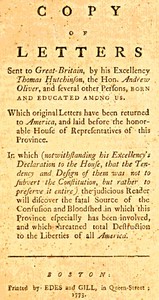
Copy of Letters Sent to Great-Britain by His Excellency Thomas Hutchinson, the Hon. Andrew Oliver, and Several Other Persons — Text and Context
(0 User reviews)
432
Project Gutenberg
2015
Not confirmed
United States -- History -- Revolution, 1775-1783 -- Sources; Massachusetts -- History -- Revolution, 1775-1783 -- Sources
Readers of public-domain and historical texts
Project Gutenberg digital edition
en
Edition facts
Words
13,293
Reading time
58 min
Text sections
2
The catalog record for Copy of Letters Sent to Great-Britain by His Excellency Thomas Hutchinson, the Hon. Andrew Oliver, and Several Other Persons — Text and Context provides practical reading context through 13,293 words, 58 min estimated reading time, and 2 detected text sections.
The text analysis averages about 29.4 words per sentence, while the detected sections provide another way to judge how the source is divided.
Project Gutenberg metadata also associates the work with “United States -- History -- Revolution, 1775-1783 -- Sources,” connecting these edition facts with the source record’s subject description.
Source:
Project Gutenberg record #48819
This editorial note examines the language, narrative voice, and shifts in pace within a 1773 collection of letters by Thomas Hutchinson and Andrew Oliver, offering precise observations on their rhetorical strategies and the tension between official report and personal grievance.
Editorial Edition Score
4.5/5
★★★★★
★★★★★
Calculated from edition completeness, EPUB availability, text structure and catalogue metadata. Not a user rating.
How this score is calculated
- Description quality20 pts
- Title & short description10 pts
- Source metadata20 pts
- Text length15 pts
- Chapters / structure15 pts
- EPUB file integrity20 pts
Total of 100 points, scaled to a 2.5-5.0 range. Editions with an empty description or a missing EPUB file are not scored.
Edition quality
Public-domain source text
Read the source text
The source text is kept in the dedicated reader, separate from this catalogue record and its commentary.
The letters in this collection, written by Massachusetts Governor Thomas Hutchinson and Lieutenant Governor Andrew Oliver between 1768 and 1769, are marked by a deliberate, measured tone that contrasts sharply with the volatile events they describe. The authors adopt the persona of loyal servants of the crown, framing their accounts as dutiful reports to superiors in Britain. Yet beneath the formal courtesy, a current of frustration and alarm runs through the prose, revealing the strain of governing a colony in open defiance. The opening letter from Oliver, dated June 18, 1768, sets this pattern: he begins with deferential phrasing—"As you allow me the honour of your correspondence"—before detailing the seizure of John Hancock's sloop and the ensuing mob violence. The language oscillates between clinical observation and veiled accusation, a duality that defines the collection's narrative voice.
The Rhetoric of Restraint
The correspondents consistently employ a rhetoric of restraint, presenting themselves as reluctant reporters of unpleasant truths. Oliver's description of the mob as "a brush or small disturbance by boys and negroes" is a dismissive phrase that the council uses to minimize the event, but Oliver himself undercuts this by noting the officers were "insulted, bruis'd and much hurt." This tension between official minimization and personal testimony recurs throughout. Hutchinson, in a later letter, adopts a similar strategy: he refers to "a few, a very few, among us" who have "planned the present measures," implying a conspiracy while avoiding direct accusation. The authors frequently hedge their claims with phrases like "it is pretended" or "it seems not very material," creating a veneer of objectivity that actually serves to insinuate blame. This careful management of tone suggests an acute awareness that their letters might be scrutinized—a prescience that proved justified when the letters were later published by the Massachusetts House of Representatives.
Shifts in Pace: From Report to Reflection
The narrative pace within individual letters varies noticeably, moving between brisk chronological accounts and slower, more reflective passages. The June 1768 letter from Oliver proceeds in a rapid, almost breathless sequence: the seizure of the sloop, the mob's assault, the commissioners' flight to the Romney. Details accumulate quickly—"a boat belonging to the collector burnt in triumph," "windows of some of their houses broke"—creating a sense of escalating crisis. In contrast, the February 1769 letter from Oliver adopts a more leisurely tempo, opening with personal thanks for hospitality shown to his children. This shift in pace is not merely social; it allows Oliver to introduce political commentary indirectly. He recounts a paraphrase of a letter from a mutual acquaintance, using it to mock the council's address to General Gage. The slower rhythm here enables a more sardonic tone, as Oliver invites his correspondent to "trace the influence under which it seems to have been penned." These changes in tempo reflect the authors' dual roles: as officials reporting events and as individuals cultivating relationships and advancing interpretations.
Voice and the Construction of Authority
The letters construct authority through a careful calibration of voice. Both Hutchinson and Oliver write as men who possess privileged information and expect their judgments to carry weight. Oliver, for instance, states that he has "very lately had occasion to know" that some colonists are determined to reject any compromise, a claim that positions him as an insider with access to secret intentions. The authors also bolster their credibility by referencing other correspondents and documents: Oliver mentions letters from his son and daughter, from "our friend Ingersoll," and from the lieutenant governor. This network of references creates an impression of a well-informed observer at the center of events. Yet the voice is not uniformly confident. Occasional notes of uncertainty creep in—"I never thought 'till very lately that they acted upon any settled plan"—which humanize the narrators and lend authenticity to their accounts. The cumulative effect is a voice that is both authoritative and fallible, a combination that makes the letters compelling as historical testimony.
Readers approaching this collection should attend to the subtle interplay between what is stated and what is implied. The letters reward close reading: a seemingly offhand remark about a "paraphrase" or a "sneer" can carry significant political weight. Because the excerpts are incomplete, the full arc of the correspondence—and the evolution of the authors' views—remains partially obscured. Yet the surviving letters offer a vivid, if partisan, window into the anxieties and calculations of colonial officials on the eve of revolution.
Reading Hutchinson’s letters, I kept noticing how privately people speak in official moments—their grievances slipping between the lines. It reminded me of that quiet ache in Journal and Letters of Philip Vickers Fithian: A Plantation Tutor of the Old Dominion, 1773-1774. — Key Ideas to Explore, where daily duties carry a similar, unspoken restlessness. Both linger like an old, half-finished conversation.
There are no reviews for this eBook.
There are no comments for this eBook.
Reader reflection
Your personal reading reflection
Build a private reading journal entry for this title.
Your progress
0
/
10
2
How much did you enjoy the reading experience?
3
Would you encourage someone else to read it?
4
How demanding did the text feel?
5
Did the book give you something worth debating?
6
How did the pace of the book feel?
7
Which element worked best for you?
8
How clearly were the main ideas presented?
9
What changed or sharpened your thinking?
10