1

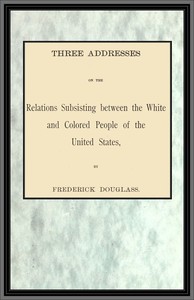
Three addresses on the relations subsisting between the white and colored people of the United States — Context and Discussion
26
4
Project Gutenberg
2022
African Americans -- Civil rights; United States -- Race relations
Readers of public-domain and historical texts
Project Gutenberg digital edition
en
Edition facts
Words: 31,701
Reading time: 138 min
Text sections: 3
Source:
Project Gutenberg record #67919
Frederick Douglass's three speeches from 1883-1886 examine post-Reconstruction race relations, using precise legal and moral arguments against the Supreme Court's Civil Rights Cases decision, with a distinctive blend of formal address and sharp rhetorical turns.
Editorial Edition Score
4.6/5
★★★★★
★★★★★
Calculated from edition completeness, EPUB availability, text structure and catalogue metadata. Not a user rating.
Edition quality
Frederick Douglass opens his 1883 Louisville address with a single sentence of extraordinary length, a periodic structure that piles clause upon clause before reaching its main verb. This syntactic weight mirrors the burden of representation he carries: he speaks as one "charged with the responsibility and duty" of advancing a people "lately enslaved." The voice is formal, almost legalistic, yet it shifts abruptly into plainspoken condemnation. When discussing the 1883 Civil Rights Cases, Douglass drops the elaborate periods for short, hammering statements: "The fourteenth amendment has been slain in the house of its friends." This alternation between measured exposition and blunt accusation defines the collection's rhetorical engine.
The Architecture of a Sentence
Douglass's opening sentence in the first address runs over 150 words, its syntax a deliberate enactment of the complexity he faces. He stacks subordinate clauses—"recognizing the great fact as we do, that the relations of the American people ... depend more upon prevailing ideas ... than upon courts of law"—before arriving at the main request. This is not mere ornament. The sentence structure forces the listener to hold multiple conditions in mind simultaneously, mirroring the layered nature of racial injustice. Later, in the Washington addresses, Douglass shifts to shorter, more aggressive rhythms: "The letter killeth, but the spirit giveth life." He quotes Paul, then immediately applies the verse to the Supreme Court's reasoning. The biblical citation is not devotional but tactical, turning scripture into a weapon against legal literalism.
Voicing Dissent from Within
Douglass repeatedly frames his criticism as loyalty to American principles. He congratulates his audience on "the altered condition both of ourselves and our common country," then catalogues failures. This double-voiced strategy—praise followed by indictment—appears in each address. When he praises Kentucky for producing "Abraham Lincoln and John M. Harlan," he does so after detailing the state's history of "evil things." The effect is to claim patriotism as the ground for protest. His voice modulates between the collective "we" of the convention and the singular "I" of personal witness: "I must say here, as I have said elsewhere, and shall say many times over if my life is spared." This insistence on repetition underscores the urgency of his message.
Pace as Persuasion
The addresses build momentum through strategic acceleration. Douglass begins each speech with slow, circumstantial reasoning, then quickens into declarative judgments. In the 1885 Washington address, he moves from a measured analysis of the Civil Rights Cases to a sudden, vivid image: "Never before was made so clear the meaning of Paul's saying, 'The letter killeth, but the spirit giveth life.'" The pace compresses. Where earlier paragraphs unfold over many clauses, here a single sentence delivers the verdict. He uses parallel structure for emphasis: "She has given us James G. Birney ... She has given us Cassius M. Clay ... She has given us John G. Fee." The repetition drives home a cumulative argument about Kentucky's contradictory legacy. The final address, from 1886, sustains this quicker tempo, as if the accumulating evidence has made lengthy preamble unnecessary.
Readers will notice how Douglass varies his address forms: the first speech is a convention document, the later ones more extemporaneous. Pay attention to his use of legal language—he was a careful reader of court decisions—and how he turns the law's own terms against it. The three addresses together show a speaker refining his tactics, moving from collective petition to individual moral authority. The shifts in sentence length and rhythm are not accidents; they are the craft of a speaker who knew that justice required not only the right argument but the right pace.
Reader reflection
How did this book work for you?
Your answers remain private and are stored only in this browser.
Your progress
0
/
10
2
Did this book hold your interest?
3
Is this a title you would suggest to others?
4
Did the language feel accessible?
5
How much did the book move you?
6
Would you start a conversation about this book?
7
How clearly were the main ideas presented?
8
Would a second reading be valuable?
9
What is the main idea you are taking away?
10