1

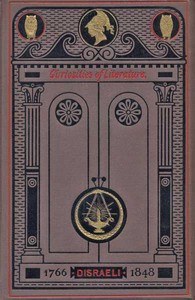
Curiosities of Literature, Vol. 1 — Key Ideas to Explore
22
3
Project Gutenberg
2007
English literature -- History and criticism; Literature -- Anecdotes; Litterateurs
Readers of public-domain and historical texts
Project Gutenberg digital edition
en
Edition facts
Words: 204,283
Reading time: 889 min
Text sections: 24
Source:
Project Gutenberg record #21615
Isaac Disraeli's miscellany of literary anecdotes, edited by his son Benjamin, explores curious customs, forgotten lore, and eccentric figures from English and European letters, drawing on antiquarian sources and personal observation.
Editorial Edition Score
4.9/5
★★★★★
★★★★★
Calculated from edition completeness, EPUB availability, text structure and catalogue metadata. Not a user rating.
Edition quality
Isaac Disraeli's Curiosities of Literature, here presented in a new edition edited by his son Benjamin Disraeli, is a sprawling miscellany that resists easy categorization. The work collects anecdotes, historical oddities, and critical observations on literary and cultural history, ranging from the origins of glove-giving customs to the medieval trade in saintly relics. The editor's preface frames the author's life as one of sustained intellectual purpose, arguing that a book may be as consequential as a battle—a claim that sets the tone for a volume where the trivial and the significant are deliberately intertwined.
Anecdotal Method and Antiquarian Sources
Disraeli's method is associative rather than systematic. He moves from a discussion of maiden assizes and the custom of removing gloves in princely stables to the phrase giving a pair of gloves, citing Gough's Sepulchral Monuments and records of glove sales from the Earl of Arran's goods. The author does not always explain the origins of these customs; he notes that the reason for removing gloves in German stables 'seems to be lost.' This willingness to present unresolved curiosities is characteristic. He draws on antiquarian authorities such as Chambers and Gough, but also on sale catalogues and family heirlooms, as when he records that gloves given by Henry VIII to Sir Anthony Denny were sold for 38 l. 17 s. The texture of the prose is dense with proper names and specific sums, lending an air of documentary precision even when the underlying rationale remains obscure.
Relics, Credulity, and the Commerce of the Sacred
The section on 'Relics of Saints' exemplifies Disraeli's interest in the intersection of belief and commerce. He describes the 'relique-mania' as a universal phenomenon where buyers and sellers engaged in 'curious impositions' and theft. He cites Guibert de Nogent's treatise against false relics, written after monks at St. Medard de Soissons claimed to possess a tooth of Christ. Disraeli reports with evident relish that Guibert denounced as 'chimerical' the belief that someone owned the navel of Christ's body. The account of St. Lewin's translation from England to Bergs includes the 'knavish modes' used to steal fragments of the saint. Disraeli's tone is detached but pointed; he does not mock the faithful but highlights the gap between the 'good faith' of purchasers and the 'impositions' of vendors. The passage reveals a collector's fascination with the mechanics of fraud and the social logic of relic-hunting.
The Editor's Frame: Biography as Defense
Benjamin Disraeli's prefatory 'Life and Writings' provides a biographical lens that shapes how the miscellany is presented. He argues that an author's life is as eventful as a statesman's, citing Voltaire, Homer, and Bacon as figures whose 'exploits' rival military victories. This defense of literary labor is pointed: Isaac Disraeli's career, Benjamin claims, exhibited 'uniformity more sustained' than most, with a 'strong bent' pursued from infancy to old age. The son's notes, added to this edition, are said to 'illustrate or correct' the text where later discoveries have superseded the father's knowledge. This editorial apparatus frames the Curiosities not as a relic but as a living document, open to revision. Benjamin's intervention also signals a shift in readership: the volumes are now offered to 'the young and ardent inquirer after knowledge,' suggesting an educational purpose that the original may not have explicitly claimed.
Readers approaching this volume should expect a work that prioritizes curiosity over argument. Disraeli's essays do not build toward a thesis; they accumulate details, often leaving the reader to draw connections. The editor's notes and biographical introduction provide context but do not resolve the miscellany's inherent looseness. For those interested in the byways of literary history, the customs of glove-giving, or the economics of relic fraud, this collection offers a wealth of specific, often surprising, information—provided one is willing to follow the author's digressive path.
Reader reflection
Before you leave, reflect on the book
Use these questions to collect your thoughts before moving on.
Your progress
0
/
10
2
How much did you enjoy the reading experience?
3
How likely are you to recommend this book?
4
How much effort did this book require?
5
How clearly were the main ideas presented?
6
What did you appreciate most?
7
Would you start a conversation about this book?
8
Did this book create an emotional response?
9
In one sentence, what did you learn?
10