1

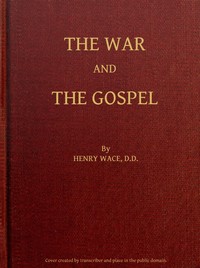
The War and the Gospel: Sermons and Addresses During the Present War — Background and Themes
22
3
Project Gutenberg
2017
World War, 1914-1918; Sermons, English
Readers of public-domain and historical texts
Project Gutenberg digital edition
en
Edition facts
Words: 53,156
Reading time: 232 min
Text sections: 24
Source:
Project Gutenberg record #55160
Henry Wace's 1917 sermons, preached at Canterbury Cathedral during WWI, apply Gospel passages to wartime suffering, judgment, and repentance, using biblical exegesis to address contemporary events without claiming knowledge of the war's outcome.
Editorial Edition Score
4.8/5
★★★★★
★★★★★
Calculated from edition completeness, EPUB availability, text structure and catalogue metadata. Not a user rating.
Edition quality
Henry Wace, Dean of Canterbury, delivered the sermons collected here on the chief festivals of the Christian year between 1914 and 1916. The preface states his aim: to bring the light of the Gospel to bear on the distressing experiences of the war. Wace addresses an audience that included soldiers, and his exegetical method is consistent: he selects a biblical passage—often from the Gospels—and draws parallels to the present conflict without predicting its end. For instance, in the sermon on the Tower of Siloam, he uses Luke 13 to argue that disasters like war are divine warnings calling for repentance, not occasions to judge the victims' sinfulness.
Exegetical Strategy: From Scripture to the Trenches
Wace's sermons are built on close reading of specific verses. In The Warning of the Tower of Siloam, he expounds Luke 13:1–5, where Jesus responds to news of Pilate's massacre of Galileans and the accidental collapse of a tower. Wace insists that the point is not to speculate why those particular people suffered, but to recognize that all are liable to perish unless they repent. He then applies this to the war: 'It is not for you to be curious about the reason why these particular men have suffered in this way.' This move—from a first-century incident to a universal principle to a contemporary application—is typical of his method. He avoids naming the enemy or predicting victory, focusing instead on the moral and spiritual condition of his hearers.
Diction of Duty and Comfort
Wace's language oscillates between stern admonition and pastoral reassurance. He speaks of 'Divine judgment going forward in the world' and warns that 'except ye repent, ye shall all likewise perish.' Yet he also describes the Gospel as 'good news of the presence of a Saviour in all the circumstances of life or death.' The sermons are peppered with phrases like 'the message of a Gospel which has brought Life and Immortality to light.' This dual register—judgment and salvation—reflects his conviction that the war is a call to repentance, not a reason for despair. His diction is formal, often employing archaic second-person pronouns ('ye'), and he frequently uses rhetorical questions to engage the congregation.
Structure: Festival Framing and Occasional Addresses
The collection is organized by the liturgical calendar: Christmas, Easter, Whitsunday, Advent, Good Friday, and the King's Accession. Each sermon is anchored to a specific date and occasion, which shapes its content. The Christmas sermons (1914 and 1915) emphasize hope and incarnation amid war, while the Easter sermons (1915 and 1916) focus on resurrection and unseen realities. The Advent sermon (1914) and the sermon on Divine Judgment (October 1914) stress eschatological themes. This structure allows Wace to address the same war from different theological angles, repeating core ideas—repentance, divine sovereignty, the need for right judgment—without monotony. The addresses are not systematic treatises but occasional pieces, each complete in itself.
Recurring Motifs: The Tower, the Massacre, and the Call to Repent
Two incidents from Luke 13 recur as a motif: Pilate's mingling of Galilean blood with sacrifices, and the fall of the tower of Siloam. Wace returns to these examples in multiple sermons, using them as shorthand for the problem of undeserved suffering. He argues that the war, like these events, is a 'Divine judgment' that should lead to repentance, not to speculation about the victims' guilt. Another recurring element is the phrase 'except ye repent, ye shall all likewise perish,' which he quotes verbatim. This repetition reinforces his central thesis: the war is a warning to all, not a punishment for some. The motif of 'the things seen and the things not seen' (from 2 Corinthians 4:18) also appears, contrasting temporal suffering with eternal realities.
Readers approaching these sermons should expect a consistent theological argument rather than a chronological narrative of the war. Wace does not comment on military strategy or political leadership; his focus is the spiritual condition of his congregation. The sermons are best read as examples of wartime preaching that uses biblical exegesis to interpret contemporary events. Pay attention to how he handles the problem of evil—by redirecting attention from the cause of suffering to the proper response of repentance. The collection offers insight into how a senior Anglican cleric sought to comfort and challenge his flock during a national crisis.
Reader reflection
How did this book work for you?
Your answers remain private and are stored only in this browser.
Your progress
0
/
10
2
Was reading this book enjoyable?
3
Would you encourage someone else to read it?
4
How much effort did this book require?
5
How well did it match your expectations?
6
What was its emotional impact?
7
How distinctive were its ideas or approach?
8
How personally connected did you feel to the book?
9
What is the main idea you are taking away?
10