1

On books and arts — Themes and Context
46
10
Project Gutenberg
2023
Literature -- History and criticism; Art criticism; Dramatic criticism
Readers of public-domain and historical texts
Project Gutenberg digital edition
en
Edition facts
Words: 64,045
Reading time: 279 min
Text sections: 32
Source:
Project Gutenberg record #72545
Sir Frederick Wedmore's collection of critical essays on literature, drama, and visual art, with a focus on authorial choices in diction, dialogue, and description. Observations traceable to his preface, his analysis of the short story, and his discussion of Dutch painting.
Editorial Edition Score
4.8/5
★★★★★
★★★★★
Calculated from edition completeness, EPUB availability, text structure and catalogue metadata. Not a user rating.
Edition quality
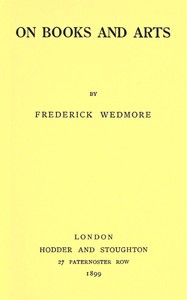
Sir Frederick Wedmore's On Books and Arts opens with a preface that frankly presents the essays as 'contributions' reprinted from periodicals, with only 'a suppression here, and there the alteration of a phrase.' This candor about the occasional nature of the pieces sets the tone for a collection that values the specific occasion over timelessness. The first essay, 'The Short Story,' immediately demonstrates Wedmore's interest in authorial stance: he cites a paradox about actors and life, then applies it to writers, suggesting that romance may be best described by those denied it. This rhetorical move—using a witty analogy to frame a critical point—recurs throughout the volume.
The Paradox of the Practitioner
In 'The Short Story,' Wedmore builds his argument on a series of borrowed paradoxes. He quotes a 'great editor' who claimed the ideal journalist 'did not know too much about his subject,' and Thackeray's protest that no one should write a love story after fifty. These are not mere name-drops; they are structural devices. Wedmore uses them to question the relationship between experience and art, a theme he returns to in later essays. The effect is to position the critic as a mediator between the artist's life and the work's effect, rather than a judge of either alone.
Notably, Wedmore does not resolve these paradoxes. He leaves them suspended, inviting the reader to consider how distance—from subject, from emotion, from fashion—might sharpen perception. This is a consistent authorial choice: his criticism proceeds by juxtaposition, not declaration.
The Vocabulary of Decline in Dutch Art
Wedmore's essay on Dutch seventeenth-century painting reveals a precise diction of artistic decay. He writes of 'the vulgar mimicry of Van Os, with the colours of the chromo-lithograph,' and of Jacob Cats carrying 'to its last length the trivial elaboration which had become the fashion.' The language is evaluative but grounded in observable shifts: from 'home-bred landscape painters' to 'the newer fashion,' from 'supreme art' to 'bastard art.'
His description of Hobbema—'worked on, with great and patient fidelity, but he worked unregarded and died poor'—is a miniature narrative of neglect. Wedmore's choice of verbs ('cast into the shade,' 'faded imperceptibly') gives the history a biological inevitability, yet he also notes the resilience of still life, where 'the early years of the Eighteenth Century surpass the achievements of fifty years before.' The pattern is not simple decline but a redistribution of excellence.
Balzac's Diamond and the Limits of Praise
In the same essay, Wedmore reports Balzac's declaration that Jan Van Huysum's work 'would hardly be paid for if it were covered with diamonds.' He then immediately adds that 'Michael, his kinsman, was perhaps almost as worthy of that praise.' This is a characteristic Wedmore move: he uses an extravagant quotation not to endorse it but to test its boundaries. The phrase 'almost as worthy' introduces a calibration, a critical fine-tuning that refuses hyperbole.
Wedmore's own prose rarely reaches for such dazzle. He prefers the measured, the comparative, the qualified. When he calls Balzac 'a French novelist who was also a connoisseur,' the appositive does double duty: it identifies Balzac's authority while subtly marking his distance from the purely aesthetic. This layering of roles—novelist, connoisseur, source—is typical of Wedmore's method of building authority through accumulation rather than assertion.
The Structure of the Collection as a Critical Act
The table of contents reveals a deliberate architecture. The volume moves from literary essays ('The Short Story,' 'Balzac,' 'George Eliot') to dramatic criticism ('Siddons and Rachel,' 'Macbeth and Irving') to art criticism (Rembrandt, Velasquez, Chardin, etc.). This sequence is not chronological but categorical, and it implies a hierarchy of attention. Wedmore's preface admits that the pieces are 'fragments' not updated, yet their arrangement suggests a coherent sensibility.
Within each section, the essays are ordered by subject's stature or by historical sequence. The art section, for instance, begins with Rembrandt and ends with Francis James, a contemporary. This movement from the canonical to the lesser-known enacts a critical judgment: that the principles applied to great art also illuminate the minor. Wedmore's authorial choice to preserve the essays 'frankly' as contributions means that the collection itself becomes a record of a critic's evolving attention, not a final statement.
Readers approaching On Books and Arts will find a critic who trusts the specific instance over the general rule. Wedmore's essays reward attention to his diction—words like 'fidelity,' 'trivial,' 'bastard' carry weight—and to his habit of embedding others' voices within his own. The collection does not argue a single thesis but demonstrates a method: close observation, historical placement, and a willingness to let paradox stand. It is best read not as a guide but as a series of demonstrations.
Reader reflection
How did this book work for you?
Your answers remain private and are stored only in this browser.
Your progress
0
/
10
2
Did this book hold your interest?
3
Would you encourage someone else to read it?
4
Did the language feel accessible?
5
How would you describe its reading pace?
6
Which element worked best for you?
7
Would this book work well in a reading group?
8
Did the book deliver what you hoped for?
9
Which lesson or insight stayed with you?
10