1

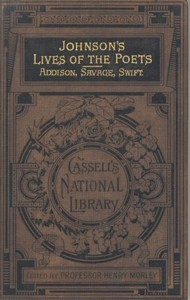
Johnson's Lives of the Poets — Volume 1 — Themes and Context
18
4
Project Gutenberg
2003
English poetry -- Early modern, 1500-1700 -- History and criticism; English poetry -- 18th century -- History and criticism; Poets, English -- Biography -- Early works to 1800
Readers of public-domain and historical texts
Project Gutenberg digital edition
en
Edition facts
Words: 65,992
Reading time: 287 min
Text sections: 6
Source:
Project Gutenberg record #4679
Samuel Johnson's biographical portraits of Addison, Savage, and Swift, revealing his authorial choices in diction, dialogue, and description. The Life of Savage stands out for its sympathetic yet critical portrayal, blending moral judgment with vivid anecdote.
Editorial Edition Score
4.7/5
★★★★★
★★★★★
Calculated from edition completeness, EPUB availability, text structure and catalogue metadata. Not a user rating.
Edition quality
Samuel Johnson's Lives of the Poets — Volume 1 opens with a biographical method that is as much moral inquiry as literary criticism. In the Life of Savage, Johnson's diction oscillates between measured judgment and raw sympathy: he describes Savage as 'formed rather to bear misery with fortitude than enjoy prosperity with moderation,' a phrase that encapsulates the tension between admiration and reproach. The narrative voice is never neutral; it leans into the drama of Savage's disputes with Lord Tyrconnel, where Johnson reports 'mutual accusations' retorted 'with the utmost degree of virulence and rage.' These choices in description and reported dialogue give the biography a novelistic intensity.
Johnson's Diction of Moral Assessment
Throughout the Life of Savage, Johnson selects words that carry ethical weight. He writes of Savage's 'superiority of wit' supplying 'the disadvantages of his fortune,' a balanced construction that acknowledges talent while noting its limits. When describing Savage's mother, Johnson uses 'unnatural mother'—a phrase that condemns without legal precision, relying on moral force. His diction often pairs abstract nouns with concrete verbs: 'the anger of Mr. Savage should be kept alive is not strange, because he felt every day the consequences of the quarrel.' Here, 'anger' is an entity sustained by daily experience, not a fleeting emotion. Johnson's vocabulary choices consistently frame biography as a forum for ethical deliberation.
Reported Speech and Dramatic Dialogue
Johnson incorporates reported speech to heighten narrative tension. In the Life of Savage, he recounts a coffee-house confrontation where Lord Tyrconnel arrived 'with a number of attendants, that did no honour to his courage, to beat him at a coffee-house.' The detail that Savage had 'left the place a few minutes' before creates a near-miss drama. Johnson then reports that Savage 'went next day to repay his visit at his own house, but was prevailed on by his domestics to retire.' The indirect dialogue—'prevailed on by his domestics'—suggests persuasion without quoting, leaving the reader to infer the scene. This technique of selective reported speech gives the biography a sense of witnessed events, even when Johnson was not present.
Descriptive Economy in Character Portrayal
Johnson's descriptions of character are economical yet vivid. Of Savage, he writes that he 'never made any mean or importunate complaints, being formed rather to bear misery with fortitude than enjoy prosperity with moderation.' The parallel structure contrasts two modes of living, and the word 'formed' implies an innate disposition. In the Life of Addison, Johnson likely employs similar compression, though the excerpts focus on Savage. The description of Savage's poem 'The Bastard' as having 'vivacious sallies of thought in the beginning' and 'pathetic sentiments at the end' shows Johnson analyzing structure through emotional effect. He does not quote the poem but characterizes its impact through carefully chosen adjectives.
Narrative Structure and Temporal Shifts
Johnson organizes the Life of Savage around a sequence of conflicts and publications. He notes that after the coffee-house incident, Savage 'now thought himself again at liberty to expose the cruelty of his mother' and published 'The Bastard.' The phrase 'now thought himself again at liberty' marks a turning point, linking personal grievance to literary production. Johnson also uses temporal markers like 'about this time' to situate events without precise dates, creating a fluid chronology. The narrative moves from quarrel to poem to public reception, showing how Johnson structures biography as a causal chain: provocation leads to publication, which leads to notoriety. This structural choice emphasizes the interplay between life events and literary output.
Readers attentive to Johnson's authorial choices will find that his diction, dialogue, and description do more than convey facts—they shape moral interpretation. The Life of Savage, in particular, rewards close reading of how Johnson balances sympathy with judgment. As you move through the volume, note how Johnson's voice shifts between the three poets, adapting his biographical method to each subject's character and circumstances.
Reader reflection
Your personal reading reflection
Build a private reading journal entry for this title.
Your progress
0
/
10
2
What was your overall reaction to the book?
3
Would you recommend this book to another reader?
4
How much effort did this book require?
5
Which part made the strongest impression?
6
Was the book easy to understand?
7
Did you gain anything practical from the text?
8
How did the pace of the book feel?
9
Which lesson or insight stayed with you?
10