1

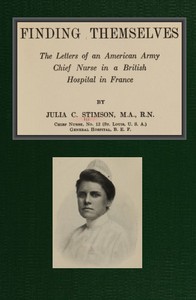
Finding Themselves The Letters of an American Amy Chief Nurse in the British Hospital in France — Reading Companion
26
4
Project Gutenberg
2019
World War, 1914-1918 -- Personal narratives; World War, 1914-1918 -- Hospitals
Readers of public-domain and historical texts
Project Gutenberg digital edition
en
Edition facts
Words: 64,267
Reading time: 280 min
Text sections: 5
Source:
Project Gutenberg record #58684
Julia C. Stimson's letters from a British base hospital in France, 1917-1918, show an American chief nurse managing a race-course hospital, coordinating transfusions by candlelight, and recording the daily grind of surgery on wounded Tommies.
Editorial Edition Score
4.7/5
★★★★★
★★★★★
Calculated from edition completeness, EPUB availability, text structure and catalogue metadata. Not a user rating.
Edition quality
Julia C. Stimson's letters, written between May 1917 and June 1918, open with a rush: less than a week's notice to mobilize sixty-five Red Cross nurses for France. The first letter, dated May 4, 1917, from St. Louis, captures the frantic preparation—"most of the nurses are ready, but it is quite certain we won't be leaving for several days." The book's subtitle, The Letters of an American Army Chief Nurse in a British Hospital in France, accurately describes its content, but the catalog subject "Fantasy & Juvenile Worlds" is a misclassification. These are not fantasies but firsthand accounts of surgery, supply shortages, and air raids.
A Race-Course Hospital and Its Daily Reality
The letters describe a British base hospital established on a race course, where Stimson's unit cared for "from eight hundred to two thousand wounded 'Tommies' at a time." The setting is not merely a backdrop but a functional space: operating huts, a "Theatre Hut" for surgery, and wards where patients hold oil lanterns to avoid being stepped on during blackouts. The excerpts show a nurse's-eye view of logistics—ordering "heavily reënforced" supper for night staff, scrubbing up for sterile procedures, and dashing for candles during an air raid. The catalog lists "World War, 1914-1918 -- Hospitals" as a subject, and the letters bear this out, but they also reveal the hospital as a makeshift, adaptive environment where race-course architecture is repurposed for triage and recovery.
Transfusion by Candlelight: A Set Piece of Wartime Medicine
One of the most detailed episodes describes a blood transfusion performed under emergency conditions. A donor is recruited from among the walking wounded, promised a trip to England as incentive. The procedure is intricate: "a nurse was holding a droplight over the bed, another nurse was holding the arm, a doctor was adjusting the tourniquet." When the lights fail, Stimson retrieves candles, and the team continues by their light, moving ether bottles away to prevent explosion. The patient stops breathing; the doctors "came in from working over the dead man." This passage, spanning several pages, illustrates the improvisation and mortality that defined base hospital work. The catalog subject "Personal narratives" fits, but the excerpt shows that these are not retrospective memoirs but immediate, unpolished letters—Stimson writes as events unfold, without literary framing.
Voice and Structure: The Letter as Record
Stimson's letters are addressed to "Dearest Mother and Dad," a framing that shapes their tone: intimate, hurried, and unguarded. She reports thirty-four operations in twenty-four hours, notes that some patients "screamed and fought and cursed" under ether, and describes a paralyzed man with shrapnel in his spine. The prose is factual, with occasional dry humor—an acetylene lamp is "quite all right for emergencies if you have about ten minutes in which to start it." The letters were written "with no thought of publication," as Henry A. Stimson's introduction states, and this origin explains their lack of narrative arc. They do not build toward a climax; they simply record. The catalog's "Fantasy & Juvenile Worlds" category is contradicted by the graphic, unsentimental content. Readers should approach the book as a documentary artifact, not a constructed story.
The letters in Finding Themselves offer a granular view of American nurses working under British command in 1917-1918. Because the excerpts are incomplete, the full scope of Stimson's experience—whether she describes later battles, the influenza pandemic, or the armistice—is unknown. Readers interested in the history of military nursing, medical logistics, or women's wartime writing will find these letters a primary source of daily operations, free of retrospective gloss. The book's value lies in its immediacy and specificity, not in any overarching argument.
Reader reflection
How did this book work for you?
Your answers remain private and are stored only in this browser.
Your progress
0
/
10
2
What was your overall reaction to the book?
3
Would you pass this book on to a friend?
4
Did the language feel accessible?
5
Did any part of the book stay with you emotionally?
6
Was the book easy to understand?
7
Is this a title worth rereading?
8
Did any part of the book feel personally relevant?
9
Which lesson or insight stayed with you?
10