1

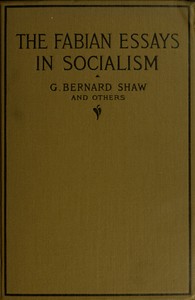
Fabian Essays in Socialism — Reading Companion
43
9
Project Gutenberg
2022
Socialism; Socialism -- Great Britain
Readers of public-domain and historical texts
Project Gutenberg digital edition
en
Edition facts
Words: 100,822
Reading time: 439 min
Text sections: 20
Source:
Project Gutenberg record #69088
A collection of essays by Fabian Society members, including Bernard Shaw and Sidney Webb, arguing for gradual socialist reform through economic, historical, industrial, and moral lenses, with a focus on British conditions.
Editorial Edition Score
4.9/5
★★★★★
★★★★★
Calculated from edition completeness, EPUB availability, text structure and catalogue metadata. Not a user rating.
Edition quality
The Fabian Essays, edited by Bernard Shaw, open with a detailed table of contents that maps out a systematic argument: economic principles, historical development, industrial change, and moral justification. The first essay, by Shaw himself, immediately tackles economic rent, value, and wages, using technical terms like 'final utility' and 'subsistence wage.' This is not a popular pamphlet but a rigorous, academic-style treatise aimed at convincing the educated reader.
The collection's structure reveals its method: each essay builds on the previous, moving from abstract theory to concrete historical and industrial evidence, then to ethical appeals. The reader should expect dense argumentation, frequent references to contemporary economists and historians, and a tone that is earnest but not dogmatic.
Opening with Economic Theory
Shaw's opening essay, 'Economic,' sets the stage with a focus on rent, value, and wages. He defines socialism narrowly as a property form, not a religion or family system. The language is precise: 'the replacement of private capital by collective capital.' Shaw engages with classical economists like Ricardo and Marx, but his argument is distinctly Fabian—evolutionary, not revolutionary. He concludes that socialism is economically sound, a 'meliorist' path. Readers unfamiliar with economic jargon may find the first pages challenging, but the essay rewards careful attention.
Historical and Industrial Arguments
Sidney Webb's 'Historic' essay traces the development of democracy and the disintegration of medievalism, linking socialism to the evolution of state activity. He cites the Industrial Revolution and French Revolution as turning points. William Clarke's 'Industrial' essay then examines the factory system, joint-stock companies, and trusts, arguing that individualist production has been superseded. Both essays rely on historical evidence—statistics, parliamentary reports, and contemporary sources—to show that socialism is not a utopian dream but a logical next step.
Moral Justification and Ethical Appeal
Sydney Olivier's 'Moral' essay attempts to justify socialist ideals by appealing to accepted moral canons and 'positive ethical science.' He addresses critics who see poverty as necessary for progress or as a moral discipline. Olivier argues that socialism would eliminate abject poverty and ensure 'sufficient food and covering' for a moderate day's work. His tone is defensive but reasoned, engaging with religious and evolutionary objections. This essay reveals the Fabian strategy: to win over not just economists but also moralists and clergy.
Structure and Reading Strategy
The essays are designed to be read sequentially, each assuming knowledge of the previous. The table of contents acts as a roadmap, with subheadings like 'The Period of Anarchy' and 'The New Synthesis.' Readers should note the frequent footnotes citing sources such as the Encyclopædia Britannica and parliamentary reports. The collection is not a single argument but a collaborative one, with each author contributing a distinct perspective. For a first reading, focus on the opening and closing paragraphs of each essay, which often summarize the key claims.
The Fabian Essays present socialism as a practical, gradual reform, not a sudden upheaval. Readers should approach the text as a series of interconnected lectures, each building a case from different angles. The essays are dense with references to contemporary debates and data, so patience is rewarded. Pay attention to the footnotes: they reveal the authors' sources and the intellectual context of late 19th-century Britain. This is a work of persuasion, not a neutral survey, and its power lies in its cumulative argument.
Reader reflection
How will you remember this book?
Save your reaction, strongest insight, and memorable passage.
Your progress
0
/
10
2
Did this book hold your interest?
3
How likely are you to recommend this book?
4
Did the language feel accessible?
5
Did any part of the book stay with you emotionally?
6
Did you gain anything practical from the text?
7
Which part made the strongest impression?
8
Is this a title worth rereading?
9
What changed or sharpened your thinking?
10