1

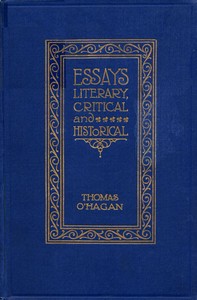
Essays Literary, Critical and Historical — A Closer Reading
25
4
Project Gutenberg
2016
Literature -- History and criticism; Tennyson, Alfred Tennyson, Baron, 1809-1892. Princess; Catholic Church -- Controversial literature -- History and criticism; Literature -- Study and teaching -- Ontario
Readers of public-domain and historical texts
Project Gutenberg digital edition
en
Edition facts
Words: 23,877
Reading time: 104 min
Text sections: 4
Source:
Project Gutenberg record #51593
Thomas O'Hagan's 1909 collection of five essays argues for a spiritually informed literary study, critiques Tennyson's 'The Princess,' and defends Catholic truth against misrepresentation in history and poetry.
Editorial Edition Score
4.6/5
★★★★★
★★★★★
Calculated from edition completeness, EPUB availability, text structure and catalogue metadata. Not a user rating.
Edition quality
Thomas O'Hagan opens his 1909 collection with a pointed defense of Tennyson's 'The Princess,' a poem he claims has been 'singularly underrated and misunderstood' since its birth. Drawing on Dr. S. E. Dawson's analysis, O'Hagan positions his study as a corrective to adverse criticism. The preface reveals a dual purpose: to champion a spiritual, anti-analytical approach to literature and to counter what he sees as the misrepresentation of Catholic truth in contemporary history and poetry. The essays, four previously published in Catholic periodicals, blend literary criticism with educational polemic, reflecting O'Hagan's experience teaching in Ontario high schools and his postgraduate studies at American universities.
A Polemic Against Analytical Reading
In 'The Study and Interpretation of Literature,' O'Hagan launches a sustained attack on what he calls 'brilliant analytics' that reduce poems to 'barren abstraction.' He insists that the 'spiritual element constitutes the INFORMING life of a poem' and that teachers who focus on grammar or historical linguistics—tracing 'the gerundial infinitive through Chaucer’s “Canterbury Tales”'—miss the essence of literature. His solution is radical: better to turn students loose in a library to browse freely than to subject them to examinations that 'dull the finer faculties of appreciation.' O'Hagan quotes Brother Azarias's definition of literature as 'the verbal expression of man’s affections' and cites Ruskin on the value of studying a few epochal cities. The tone is urgent, even exasperated, as he warns that 'literature is a jealous mistress and will brook no rival.'
The Case for a Canon of Twenty
O'Hagan proposes a focused canon of twenty authors—Homer, Virgil, Dante, Calderon, Molière, Goethe, Chaucer, Spenser, Shakespeare, Milton, Wordsworth, Tennyson, and others—as sufficient to cover 'the best poetic thought in all ages.' He contrasts these with the 'flood of ephemeral literature—chiefly novels' that he believes corrupt literary taste. This argument appears in the essay on literary study, but its implications ripple through the volume. O'Hagan's own essays, however, do not strictly adhere to this canon; he writes on Tennyson and the Italian Renaissance, but also on Catholic controversies and educational reform. The tension between his prescriptive ideal and his broader practice suggests a pragmatic willingness to engage with contemporary debates.
Voice and Structure: A Recurring Urgency
O'Hagan's prose is marked by a recurring rhetorical pattern: he states a problem, diagnoses its cause, and prescribes a remedy, often with italicized emphasis. In the preface, he declares that 'the courage to state the truth is a more valuable asset of character than the gift of bestowing false praise.' This combative stance reappears in his critique of examinations and his defense of Catholic truth. The essays vary in pace: the Tennyson study is measured and analytical, while 'Poetry and History Teaching Falsehood' adopts a more accusatory tone. O'Hagan frequently addresses the reader directly—'Let the reader, divested of every predilection and bias, examine it carefully'—creating a sense of personal engagement. His sentences are often long and periodic, building to a climactic point, as when he quotes Mrs. Browning on the proper way to read a book.
O'Hagan's essays reward readers who attend to his recurring concerns: the primacy of spirit over method, the danger of misreading history, and the need for a disciplined literary education. His voice is that of a teacher-critic, earnest and occasionally dogmatic, but grounded in specific institutional experience. The collection offers a window into early twentieth-century Catholic intellectual life in Canada, and into the debates about literary study that still resonate today.
Reader reflection
What did you think of this book?
Answer a few questions and save a private reflection on this device.
Your progress
0
/
10
2
Was reading this book enjoyable?
3
Would you recommend this book to another reader?
4
How easy was the book to follow?
5
Did the book deliver what you hoped for?
6
How original did the book feel?
7
How valuable was this book for your own interests?
8
How closely did the book connect with your experience?
9
Which lesson or insight stayed with you?
10