1

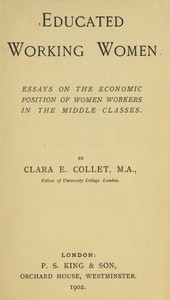
Educated working women: Essays on the economic position of women workers in the middle classes — A Reader’s Guide
42
10
Project Gutenberg
2022
Women -- Employment; Women -- Education
Readers of public-domain and historical texts
Project Gutenberg digital edition
en
Edition facts
Words: 31,703
Reading time: 138 min
Text sections: 11
Source:
Project Gutenberg record #68623
Clara Collet's 1902 essays examine the economic realities of educated middle-class women in England, using detailed budgets and statistical analysis to challenge assumptions about women's work, marriage prospects, and financial independence.
Editorial Edition Score
4.7/5
★★★★★
★★★★★
Calculated from edition completeness, EPUB availability, text structure and catalogue metadata. Not a user rating.
Edition quality
Clara E. Collet opens her 1902 collection with a pointed epigraph from Elizabeth Barrett Browning's Aurora Leigh: “By speaking we prove only we can speak, / Which he, the man here, never doubted. / What He doubts is, whether we can DO the thing.” This sets the tone for six essays that rely not on rhetoric but on empirical evidence—budgets, tables, and surveys—to document the economic position of educated women in the middle classes. Collet, a Fellow of University College London, addresses a narrow but significant demographic: women whose education and social standing placed them above manual labor but whose need to earn a living placed them in a precarious, often invisible, economic category.
Budgets as Evidence
The most striking feature of Collet's method is her use of detailed personal budgets. She presents accounts from a high school mistress, clerks, and a journalist, breaking down expenditures on dress, food, rent, and even “small expenses” like cabs and stationery. For example, a clerk (No. 5) spent £16 on dress in a year, while a journalist (No. 6) spent £42. Collet notes that the clerk's dress expenditure was £10 less than when she lived at home as a “lady of leisure,” yet produced a better effect—a concrete measure of the economic pressure on working women. These budgets are not anecdotes but data points, and Collet treats them with the rigor of an economist, noting discrepancies (e.g., washing costs understated because items were sent to a country laundry) and gaps (income tax not stated). The reader is invited to see how these women allocated scarce resources, revealing priorities and constraints that abstract discussions of “women's work” often miss.
The Marriage Question Recast
Collet's essay “Prospects of Marriage for Women” (1892) reframes a common anxiety of the era. Rather than lamenting the “surplus” of unmarried women, she examines the economic logic behind marriage decisions. She argues that for educated middle-class women, marriage was not a universal goal but one weighed against the possibility of independent earnings. The budgets show that some women could support themselves, albeit modestly, and that marriage might entail a loss of autonomy. Collet does not romanticize either state; she presents the trade-offs in pounds and pence. The essay is notable for its cool, statistical tone—a deliberate counter to the sentimental or panicked discourse on “redundant women.” She does not predict trends but documents conditions “true in 1891,” acknowledging that their applicability may narrow or widen over time.
The Limits of the Evidence
Collet is scrupulous about the boundaries of her study. In the preface, she states that her point of view is “circumscribed by the conditions set forth in the first two chapters,” and that many questions about working women remain “almost untouched.” The excerpts show her focus on a small section of the community—the middle classes—and she does not claim to speak for working-class women or for all educated women. The budgets come from a handful of volunteers, and Collet notes when data is incomplete (e.g., the journalist's holiday spending was unusually low that year). This honesty about the limits of her sample is a strength: it reminds the reader that the essays are a snapshot, not a comprehensive survey. The catalog subjects “Women—Employment” and “Women—Education” are thus both addressed and qualified by the text itself, which insists on the specificity of its subjects.
Readers should approach Educated Working Women as a primary source for the economic history of women, not as a manifesto. Collet's value lies in her method: she lets numbers and individual accounts speak, and she resists sweeping conclusions. The budgets, in particular, reward close reading—each line item is a clue to a life. To get the most from this book, compare the tables across essays and note what is omitted as well as what is recorded. The result is a rare, unvarnished view of how educated women managed money, work, and expectations at the turn of the twentieth century.
Reader reflection
What did you think of this book?
Answer a few questions and save a private reflection on this device.
Your progress
0
/
10
2
What was your overall reaction to the book?
3
Is this a title you would suggest to others?
4
Did the language feel accessible?
5
Which element worked best for you?
6
Would this book work well in a reading group?
7
Did any part of the book feel personally relevant?
8
Was the book moving at the right speed?
9
Which lesson or insight stayed with you?
10