1

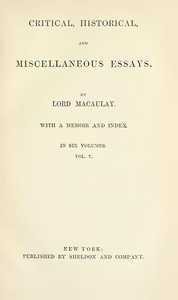
Critical, Historical, and Miscellaneous Essays; Vol. 5 With a Memoir and Index — A Closer Reading
22
3
Project Gutenberg
2017
Great Britain -- History; English literature -- History and criticism
Readers of public-domain and historical texts
Project Gutenberg digital edition
en
Edition facts
Words: 192,202
Reading time: 836 min
Text sections: 32
Source:
Project Gutenberg record #55905
Macaulay's essays on Warren Hastings, Frederick the Great, Madame d'Arblay, and Addison, edited by Edwin Percy Whipple, showcase a vigorous prose style that balances moral judgment with historical analysis, often drawing on vivid analogies and classical references.
Editorial Edition Score
4.9/5
★★★★★
★★★★★
Calculated from edition completeness, EPUB availability, text structure and catalogue metadata. Not a user rating.
Edition quality
Macaulay opens his essay on Warren Hastings with a striking declaration of intent: he will not minutely examine the book under review but instead offer his own view of Hastings's life and character. This sets the tone for the volume, where the author's voice is as much a subject as the figures he discusses. The essays are marked by a confident, almost judicial tone, as Macaulay weighs virtues against faults, insisting that Hastings, like Cromwell, would prefer to be 'painted as I am'—warts and all. This preference for unvarnished portraiture recurs throughout the collection, giving the prose a moral urgency that drives the narrative forward.
The Use of Classical Allusions as Evidence
In the essay on Addison, Macaulay deploys classical quotations not merely as ornament but as forensic evidence. He argues that Addison's Latin verse was superior to his prose, and that his knowledge of Greek was limited. To prove this, Macaulay points out that Addison's notes on Ovid's Metamorphoses contain no references to Euripides or Theocritus, despite Ovid's debt to them. Similarly, in his travels, Addison cites Silius Italicus for Hannibal's crossing of the Alps rather than Polybius or Livy, and relies on Lucan for the civil war instead of Caesar or Cicero. This method—using an author's own citations to diagnose his intellectual range—is characteristic of Macaulay's critical approach. It allows him to make precise claims about Addison's scholarly limitations without resorting to vague praise or blame.
Shifts in Pace Between Narrative and Argument
Macaulay varies his sentence length and rhythm to control the reader's attention. In the Hastings essay, the opening paragraph moves from a measured, almost conversational tone—'We are inclined to think that we shall best meet the wishes of our readers'—to a series of short, emphatic clauses: 'He had great qualities, and he rendered great services to the state. But to represent him as a man of stainless virtue is to make him ridiculous.' This abrupt shift signals a turning point in the argument. Later, when recounting Hastings's ancestry, the pace slows with a long, periodic sentence tracing the lineage back to 'the great Danish sea-king.' Such changes in tempo are not accidental; they mirror the essay's movement between moral evaluation and historical narrative, keeping the reader engaged through variety.
Recurring Imagery of Portraiture and Judgment
Macaulay repeatedly returns to the metaphor of painting to frame his biographical judgments. In the Hastings essay, he invokes Cromwell's command to Lely—'Paint me as I am'—to argue that a truthful likeness, even with 'scars and wrinkles,' is preferable to a flattering 'daub.' This image reappears implicitly in the Addison essay, where Macaulay describes his own method as a 'minute examination' that will 'fully bear out' his remarks. The language of visual accuracy—'spots,' 'likeness,' 'portrayed'—suggests that Macaulay sees himself as a portraitist of character, not a mere chronicler of events. This consistent imagery ties together essays on disparate subjects, giving the volume a cohesive thematic thread about the ethics of representation.
Readers approaching this volume should attend to the way Macaulay structures his arguments: he often begins with a bold thesis, then supports it with a cascade of specific examples drawn from the subject's own writings or actions. The essays reward careful attention to his use of analogy and allusion, which serve both as evidence and as rhetorical devices. Because the excerpts are incomplete, some essays—such as those on Frederick the Great and Madame d'Arblay—are only partially represented, but the patterns of voice and method visible in the Hastings and Addison pieces are likely to recur throughout.
Reader reflection
What did you think of this book?
Answer a few questions and save a private reflection on this device.
Your progress
0
/
10
2
How did the book work for you overall?
3
Would you encourage someone else to read it?
4
How much effort did this book require?
5
How did the reading compare with what you expected?
6
How personally connected did you feel to the book?
7
Was the book moving at the right speed?
8
Did any part of the book stay with you emotionally?
9
Which lesson or insight stayed with you?
10