1

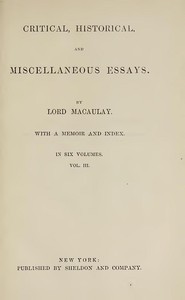
Critical, Historical, and Miscellaneous Essays; Vol. 3 With a Memoir and Index — A Reader’s Guide
26
5
Project Gutenberg
2017
Great Britain -- History; English literature -- History and criticism
Readers of public-domain and historical texts
Project Gutenberg digital edition
en
Edition facts
Words: 177,041
Reading time: 770 min
Text sections: 33
Source:
Project Gutenberg record #55903
Macaulay's third volume of essays showcases his characteristic blend of historical analysis and biting wit, with pieces on Burleigh, Mirabeau, and Horace Walpole. The opening review of Nares's Burghley biography satirizes scholarly excess through exaggerated physical descriptions, while later essays dissect political hypocrisy and literary character.
Editorial Edition Score
4.9/5
★★★★★
★★★★★
Calculated from edition completeness, EPUB availability, text structure and catalogue metadata. Not a user rating.
Edition quality
Macaulay opens his review of Dr. Nares's biography of Lord Burghley with a sustained comic conceit: the book is so massive that it 'weighs sixty pounds avoirdupois' and reading it is harder labor than 'thieves on the treadmill.' This hyperbolic physical description—corn as high as oaks, thimbles as large as buckets—sets the tone for a volume where Macaulay repeatedly uses scale and weight as metaphors for intellectual and moral failings. The essay on James II, for instance, pivots from the king's professed toleration to his actual persecution, contrasting 'the milk-white and immortal hind' with 'the unclean panther.'
Scale as Satirical Weapon
Macaulay's opening assault on Nares's Burghley biography is a masterclass in using physical magnitude to imply intellectual emptiness. He notes that the book 'occupies fifteen hundred inches cubic measure' and that reading it is 'an agreeable recreation' only compared to penal labor. This is not mere mockery: it establishes a method. Throughout the volume, Macaulay measures historical figures by the gap between their self-presentation and their actions. The essay on James II, for example, exposes the king's 'liberal professions' by juxtaposing them with his dismissal of Lord Rochester for refusing to convert to Catholicism. Macaulay cites the Papal Nuncio's despatches to show that even contemporaries saw through the hypocrisy: 'gli animi sono inaspriti' at the minister's removal for not being Catholic. The contrast between rhetorical scale and actual conduct becomes a recurring analytical tool.
The Rhetoric of Persecution
In the essay on James II, Macaulay dissects the king's claim to champion religious liberty. He argues that James persecuted not 'in defence of truth against error, but in defence of one damnable error against another'—specifically, forcing Episcopalians into Presbyterianism. The passage is dense with ironic reversals: James 'torture and murder for the difference between two roads to hell.' Macaulay then turns to James's ally Louis XIV, whose 'intolerant policy had turned the fairest tracts of France into deserts.' The essay does not merely condemn James; it exposes the logic of persecution as self-defeating. By quoting Dr. Lingard—'a very competent, and assuredly not a very willing witness'—Macaulay builds his case from sources that would normally favor the king. The result is a layered argument about how power corrupts even the language of toleration.
Character Through Contrast
Macaulay's method of characterization relies on sharp juxtapositions. In the Burghley review, he contrasts Nares's 'stupendous mass of paper' with the actual historical figure of Cecil, who was known for subtlety and indirection. The essay on Horace Walpole (not excerpted here but listed in the contents) likely continues this pattern of using a subject's writings to reveal character. The volume as a whole moves between public figures (Burleigh, Mirabeau, Pitt) and literary ones (Walpole, Bacon), suggesting that Macaulay sees statecraft and authorship as parallel arenas for moral judgment. His own prose mirrors this: the same sentence that catalogues a book's cubic inches can pivot to a devastating moral verdict. The reader is invited to watch a mind that measures everything—books, kings, policies—by the same exacting standard of integrity.
Readers approaching this volume should attend to Macaulay's use of scale as a critical device: he treats books, policies, and characters as objects to be weighed. The essays reward careful attention to his sources—he often lets opponents speak before demolishing them. Because the excerpts are incomplete, some essays (like those on Mirabeau or Walpole) are only partially represented, but the pattern of moral and intellectual scrutiny is consistent throughout. Macaulay's voice is that of a prosecutor who has read the entire dossier.
Reader reflection
What did you think of this book?
Answer a few questions and save a private reflection on this device.
Your progress
0
/
10
2
How did the book work for you overall?
3
How likely are you to recommend this book?
4
How much effort did this book require?
5
How useful did the reading feel?
6
How original did the book feel?
7
Was the book easy to understand?
8
How strong was your personal connection to the text?
9
Which lesson or insight stayed with you?
10