1

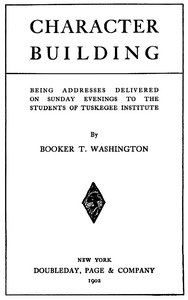
Character Building Being Addresses Delivered on Sunday Evenings to the Students of Tuskegee Institute — Inside the Classic
26
4
Project Gutenberg
2019
Character; African Americans -- Education; College students -- Conduct of life
Readers of public-domain and historical texts
Project Gutenberg digital edition
en
Edition facts
Words: 59,795
Reading time: 260 min
Text sections: 6
Source:
Project Gutenberg record #60484
Booker T. Washington's Sunday evening talks to Tuskegee students, preserved in this 1902 collection, emphasize practical character building through diligence in everyday occupations, using direct, conversational addresses that reveal his educational philosophy and the specific challenges facing African Americans in the post-Reconstruction South.
Editorial Edition Score
4.7/5
★★★★★
★★★★★
Calculated from edition completeness, EPUB availability, text structure and catalogue metadata. Not a user rating.
Edition quality
Booker T. Washington's Sunday evening addresses to Tuskegee students, collected in Character Building, are not abstract moral lectures but practical, occupation-focused talks. In the excerpt on domestic service, Washington argues that the Negro coachman and butler must embrace their roles with full commitment, improving their skills rather than treating these jobs as mere stepping stones. He warns that poor service by a few can shape white perceptions of the entire race, yet he balances criticism with acknowledgment of progress: 'the people of no race, under similar circumstances, have made greater progress in thirty-five years.' The addresses, delivered in a conversational tone 'much in the same manner that I would speak to my own children,' blend earnestness with common-sense advice grounded in daily life at the institute.
The Coachman and the Butler as Foundations
Washington devotes significant attention to domestic occupations, using the coachman and butler as case studies. He observes that in cities like New York and Philadelphia, the Negro has lost the coachman's occupation 'not because he was a Negro, but because in many cases he did not see that the occupation of coachman was constantly being improved.' The remedy, he insists, is to learn 'the proper dress for a coachman' and how to care for horses and vehicles 'in the most approved manner.' This attention to detail extends to the butler, whom Washington criticizes for using such roles 'merely as stepping stones, holding on to them until we can find something else to do, in a careless and slipshod manner.' His call is to 'put our whole souls into these occupations' and make them life-work, because 'the foundation of every race must be laid in the common every-day occupations that are right about our doors.'
A Training School for Domestic Service
Washington expresses a wish for a large training-school 'for giving instruction in all lines of domestic service,' arguing that few things 'would add more to the fundamental usefulness of the race.' He illustrates the need with an anecdote about a hotel run by coloured people in a Southern city, where the proprietors struggled to find chambermaids who would 'do their work systematically and well.' In three months, they employed fifteen different chambermaids, dismissing most for poor work. Washington uses this to highlight a systemic weakness: 'it is too easy for our people to find work.' He proposes a rule that no one be hired without a letter of recommendation from the last employer, which he believes would 'lift up' domestic service 'a hundred per cent.' The passage reveals his belief that structural changes in hiring practices are necessary to improve both character and reputation.
The Conversational Tone and Its Purpose
Washington's preface explains that these addresses were always delivered 'in a conversational tone' and 'much in the same manner that I would speak to my own children around my fireside.' This intimate style is deliberate: he aims to 'speak straight to the hearts of our students and teachers and visitors concerning the problems and questions that confront them in their daily life here in the South.' The addresses were stenographically reported and later revised for publication, with assistance from his secretary Emmett J. Scott and Max Bennett Thrasher. The publishers' note emphasizes that these talks 'have had much to do with the building up of the character of his race' and show Washington 'at his work,' offering 'an inside view of the school.' The conversational framing underscores the practical, immediate nature of the advice, distinguishing it from formal oratory.
Readers approaching Character Building will find not a systematic treatise but a series of situational exhortations. Washington's method is to diagnose a specific failing—such as the chambermaid's neglect or the butler's restlessness—and then prescribe a concrete remedy rooted in self-improvement and collective reputation. The addresses reward attention to the recurring tension between individual responsibility and systemic constraints, a dynamic Washington navigates without resolving. His voice remains that of a principal speaking to his school, not a theorist addressing posterity.
Reader reflection
What did you think of this book?
Answer a few questions and save a private reflection on this device.
Your progress
0
/
10
2
Was reading this book enjoyable?
3
Is this a title you would suggest to others?
4
How much effort did this book require?
5
How valuable was this book for your own interests?
6
What did you appreciate most?
7
How closely did the book connect with your experience?
8
Would you read this book again?
9
What is the main idea you are taking away?
10