1

Ariosto, Shakespeare and Corneille — Key Ideas to Explore
22
4
Project Gutenberg
2017
Shakespeare, William, 1564-1616 -- Criticism and interpretation; Ariosto, Lodovico, 1474-1533; Corneille, Pierre, 1606-1684
Readers of public-domain and historical texts
Project Gutenberg digital edition
en
Edition facts
Words: 90,872
Reading time: 396 min
Text sections: 12
Source:
Project Gutenberg record #54165
Benedetto Croce's literary criticism applies his theory of art as intuition-expression to three major playwrights, analyzing structure and recurring images in Macbeth and King Lear without summarizing plots.
Editorial Edition Score
4.8/5
★★★★★
★★★★★
Calculated from edition completeness, EPUB availability, text structure and catalogue metadata. Not a user rating.
Edition quality
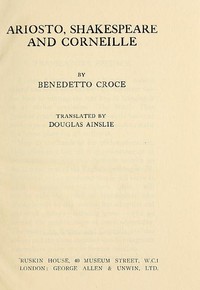
Benedetto Croce's Ariosto, Shakespeare and Corneille (1920) applies his aesthetic theory—art as lyrical intuition—to three canonical dramatists. The volume opens with a translator's preface by Douglas Ainslie that situates Croce's work as a philosophical corrective to earlier critics like Sainte-Beuve and Taine. Croce's method is not biographical or historical but structural: he examines how each playwright's work embodies a distinct poetic form. The excerpts from the Shakespeare section reveal a critic who reads closely, tracing internal conflicts through recurring images of sleep, blood, and moral paralysis.
The Structure of Moral Conflict in Macbeth
Croce's analysis of Macbeth centers on the protagonist's internal discord, which he describes as a conflict that never resolves. He notes that Macbeth's tragedy lies in his 'incapacity to hold himself right or wrong.' The critic traces this through the play's structure: Macbeth's crimes increase alongside his torment, with no salvation or complete damnation. Croce highlights the recurring image of sleep—Macbeth envies Duncan's 'great final, dissolving sleep'—and the tactile horror of Lady Macbeth's bloody hands. The essay argues that the good appears only as revenge or remorse, never personified, a structural choice that deepens the tragedy.
Cordelia as a Single Star in King Lear
In King Lear, Croce identifies a different structural principle: goodness is 'impersonated and takes the name of Cordelia.' He compares her to a single star shining in a dark sky, a striking image that contrasts with the sequence of betrayals and torments. The critic notes that the play inspires 'tremendous doubt as to the non-existence of goodness,' a doubt generated by the moral deceit that mimics rectitude. Croce's reading focuses on how the play's structure—a tempest of cruelty—allows one figure to embody virtue without sentimentality. He also cites the boy's logical wonderment that good does not choke evil, a detail that underscores the play's philosophical unease.
Recurring Images and Their Thematic Weight
Croce's criticism is notable for its attention to recurring images that carry thematic weight. In Macbeth, he emphasizes the 'nauseating odour of blood' that clings to Lady Macbeth's hands, a sensory detail that recurs in her sleepwalking. The image of sleep—as a 'suavity of desire' and a final dissolution—appears multiple times, linking Macbeth's longing for peace to his moral paralysis. Croce also notes the structural parallel between Macbeth and his wife: both 'consume themselves' but in different ways, he through an implacable call, she through sensible images. These observations ground his philosophical claims in the text's concrete language.
Movement Between Scenes and Character Dynamics
Croce's analysis pays close attention to how characters move between scenes and how their dynamics shift. In Macbeth, he observes that Duncan 'glides along on the outside of things, unsuspectful of betrayals,' a movement that contrasts with Macbeth's internal turmoil. Lady Macduff and her son are 'innocent victims, who flee the knife of the murderers in vain,' their flight a structural counterpoint to Macbeth's aggression. Croce also notes the moment when Macbeth receives news of his wife's death with 'desolate coldness,' a shift that marks his renunciation of affection. These movements—from suspicion to flight, from love to coldness—structure the tragedy's emotional arc.
Croce's essays reward readers who attend to his precise observations of structure and image. Rather than offering a general theory, he demonstrates how each play's form generates its meaning. The excerpts suggest a critic who reads with philosophical rigor but never loses sight of the text's concrete details. Readers interested in Croce's aesthetic theory will find its application here, but the essays also stand as independent critical performances.
Reader reflection
Your personal reading reflection
Build a private reading journal entry for this title.
Your progress
0
/
10
2
Did this book hold your interest?
3
Would you pass this book on to a friend?
4
What was the reading difficulty like?
5
How clear did the writing feel?
6
How distinctive were its ideas or approach?
7
Would you start a conversation about this book?
8
Would a second reading be valuable?
9
Which lesson or insight stayed with you?
10