1

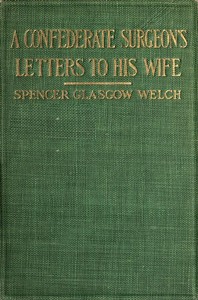
A Confederate surgeon's letters to his wife — Reading Notes
53
10
Project Gutenberg
2025
United States -- History -- Civil War, 1861-1865 -- Personal narratives, Confederate; Confederate States of America. Army. South Carolina Infantry Regiment, 13th
Readers of public-domain and historical texts
Project Gutenberg digital edition
en
Edition facts
Words: 26,423
Reading time: 115 min
Text sections: 8
Source:
Project Gutenberg record #76190
Spencer Glasgow Welch, surgeon of the 13th South Carolina Volunteers, writes to his wife from camps and battlefields. His letters record the physical toll of marching, the sudden violence of skirmishes, and the quiet after battles, with sharp observations on commanders and the mundane hardships of camp life.
Surgeon Spencer Glasgow Welch’s letters to his wife open not with grand strategy but with the immediate friction of movement and climate. Writing from near Fredericksburg on May 16, 1862, he notes that tents have been taken from the men and that the change of climate from coastal South Carolina has caused much sickness in the regiment. The enemy is close—Captain Hunt’s men shot at Yankees that morning—yet Welch’s attention is drawn to the chinquapin bushes where the regiment now camps. This interplay of the mundane and the mortal runs through the correspondence.
Welch writes as a medical officer embedded in McGowan’s Brigade, and his perspective is shaped by the rhythms of march, halt, and recovery. He records the fatigue of long trips, the loss of commanders like General Pender, and the scarcity of food during severe winters. His voice is direct, often understated, and attentive to the physical condition of the army.
The Body of the Army
Welch’s letters are unusually attentive to the physical state of the soldiers under his care. He notes that the removal of tents and the change of climate caused much sickness in the regiment, and later describes how the long trip from Pennsylvania left the men “very thin and lean, although our health remained fine.” The body is a constant concern: the exhaustion of climbing mountains, the quagmire roads that came “nearly to the knees,” and the wet guns that could not be loaded when cavalry attacked. Welch does not dwell on wounds or surgery; instead, he records the cumulative wear of campaign life. His medical eye sees the army as a creature of flesh and weather, not just of tactics.
Officers Under Scrutiny
Welch evaluates commanders with a surgeon’s bluntness. Of General Pender, killed at Gettysburg, he writes that he was “a very superior little man, though a very strict disciplinarian.” He contrasts Pender with his successor, Wilcox of Alabama, saying Wilcox “cannot surpass General Pender.” When a surprise attack at Falling Waters results in General Pettigrew’s death, Welch calls it “disgraceful either to General Hill or General Heth” and notes that one is certainly to blame. These judgments are not theoretical; they arise from Welch’s proximity to the fighting. He was lying down near a spring between two brigades when Pettigrew was killed. His assessments are grounded in what he saw, not in reputation.
The Texture of Waiting
Between battles, Welch’s letters capture the peculiar stillness of camp. After Gettysburg, he writes: “All is quiet here now. When two armies have a great battle both sides are so crippled up that neither is anxious to fight soon again.” He speculates that Meade will not attack and that the Confederates must make the next move. This waiting is filled with small details: the chinquapin bushes, the rain that fell “such as I thought I never before knew to fall,” the pontoon bridge at Falling Waters, and the shells that came “very near hitting” the bridge as he crossed. Welch’s letters are a record of what it felt like to be suspended between marches, between fights, between the known and the unknown.
These letters were preserved and edited by Welch’s daughter, who condensed them by removing the most personal matter. What remains is a document of the Civil War as experienced by a surgeon who moved with the army, saw its leaders fall, and wrote home about the mud, the hunger, and the quiet after battle. Readers should attend to the gaps—the lost letters, the personal details omitted—and to the way Welch’s voice shifts between the clinical and the weary. The letters do not tell a complete story, but they offer a vivid fragment of one man’s war.
Reader reflection
How did this book work for you?
Your answers remain private and are stored only in this browser.
Your progress
0
/
10
2
How much did you enjoy the reading experience?
3
Would you recommend this book to another reader?
4
How much effort did this book require?
5
Did the book offer a fresh perspective?
6
What did you appreciate most?
7
Did any part of the book feel personally relevant?
8
How valuable was this book for your own interests?
9
What is the main idea you are taking away?
10