1

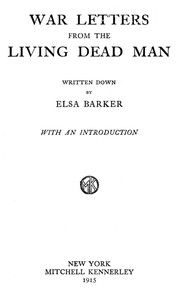
War letters from the living dead man — A Reader’s Guide
(0 User reviews)
2875
Project Gutenberg
2025
Not confirmed
Spiritualism; Spirit writings; World War, 1914-1918 -- Miscellanea
Readers of public-domain and historical texts
Project Gutenberg digital edition
en
Edition facts
Words
60,726
Reading time
265 min
Text sections
55
This digital edition of War letters from the living dead man — A Reader’s Guide is described by source-level measurements including 60,726 words, 4 hr 25 min estimated reading time, and 55 detected text sections.
The text analysis averages about 17.1 words per sentence, while the detected sections provide another way to judge how the source is divided.
Project Gutenberg metadata also associates the work with “Spiritualism,” connecting these edition facts with the source record’s subject description.
Source:
Project Gutenberg record #76949
Elsa Barker's automatic writings from a spirit called 'X' offer wartime reflections on astral beings, karma, and free will, blending spiritualist philosophy with World War I commentary.
Editorial Edition Score
4.8/5
★★★★★
★★★★★
Calculated from edition completeness, EPUB availability, text structure and catalogue metadata. Not a user rating.
How this score is calculated
- Description quality20 pts
- Title & short description10 pts
- Source metadata20 pts
- Text length15 pts
- Chapters / structure15 pts
- EPUB file integrity20 pts
Total of 100 points, scaled to a 2.5-5.0 range. Editions with an empty description or a missing EPUB file are not scored.
Edition quality
Read the Text
connected with the writing of that book, explained in some detail in the Introduction, which made any other hypothesis than that of genuine communication from the other world seem untenable to me. It began, for instance, some days before I knew in Paris that my friend had died on the Pacific coast of America.
In that first book of “X” I did not state who the writer was, not feeling at liberty to do so without the consent of his family; but in the Summer of 1914, while I was still living in Europe, a long interview with Mr. Bruce Hatch appeared in the _New York Sunday World_, in which he expressed the conviction that the “Letters” were genuine communications from his father, the late Judge David P. Hatch, of Los Angeles, California.
For the benefit of those who have not read the former book, I wish to say that “X” was not an ordinary man. He came nearer than any other Occidental of my acquaintance to that mastery of self and of life which has been called Adeptship.
After the “Letters” were finished in 1913, during a period of about two years I was conscious of the presence of “X” only on two or three occasions, when he wrote some brief advice in regard to my personal affairs.
On the fourth of February, 1915, in New York, I was suddenly made aware one day that “X” stood in the room and wished to write; but as always before, with one or two exceptions, I had not the remotest idea what he was going to say. He wrote as follows:
“When I come back and tell you the story of this war, as seen from the other side, you will know more than all the Chancelleries of the nations.”
This letter I confided to two friends who had been much interested in the former book, Mr. and Mrs. Vance Thompson; and it was arranged, with the cordial consent of “X,” that they should sit with me about once a week, to make a better “focus.” Their loyal faith was a great support to me during the first half of a trying labor.
The writing was not confined to the days when we three sat together; but about a third of the first half of the book was written in the presence and in the house of Mr. and Mrs. Thompson. Then they went to California, and I continued the work alone.
It may be of interest to some readers if I describe the process of this writing, which has changed gradually from a violent and mechanical seizure of the hand from the outside, as in the beginning of the first book, to a quiet impression on the mind within.
If the reader will imagine a well-known friend of vivid personality present with him, then subtract from that impression the seeing of the physical eye, leaving only the subtle vibration of the actual thinking and feeling presence, then add the indescribable “inner sight,” he may begin to realize how I know that “X” is in the room.
It is probable that Helen Keller knows when her friends are near her, and can tell one from the other, though she is deaf and blind.
When made aware of the presence of “X,” I take a pencil and a notebook, as any other amanuensis would, and by an effort of will, now easy from long practice, I still the activity of my objective mind, until there is no thought or shadow of a thought in it. Then into _the brain itself_ come the words, which flow out without conscious effort at the point of the pencil. It is exactly as if I heard the dictation with a single auditory instrument, like a small and very sensitive sphere, in the centre of the brain.
I never know at the beginning of a sentence how it will end. I never know whether the sentence I am writing will be the last or if two thousand words will follow it. I simply write on, in a state of voluntary negativity, until the impression of personality described above leaves suddenly. Then no more words come. The writing is at an end for that time.
The question will naturally arise in the mind of the skeptical reader (it has in mine), whether my own subconscious mind has not itself dictated the following “War Letters from the Living Dead Man,” in the attempt to explain a world tragedy which would have seemed impossible two years ago.
Elsa Barker's War Letters from the Living Dead Man presents itself as a series of automatic writings channeled from a spirit identified as 'X,' an American judge and teacher of philosophy who died in 1914. The book's introduction explains that Barker began receiving communications days before learning of his death, a detail she offers as evidence of genuine otherworldly contact. The letters, dated from 1914 to 1915, address World War I from a spiritualist perspective, mixing astral travel, cosmic hierarchies, and moral lessons with observations on the conflict. Readers encounter a voice that claims to observe battlefields from beyond, describe 'Masters of Mind,' and interpret the war as a karmic reckoning. The text is dense with esoteric terminology and assumes familiarity with theosophical concepts, yet it also contains vivid, concrete imagery of war's spiritual dimensions.
The Voice from Beyond
The book's opening letters establish the narrator's identity and purpose. In 'The Return of X,' the spirit describes his transition to the afterlife and his continued interest in earthly affairs. Barker's introduction stresses that the writings began spontaneously, without her conscious intent, a claim that frames the entire work as a dictated document rather than a literary composition. The voice is authoritative, often pedagogical, and occasionally apologetic about its limitations: 'I rarely permit myself to prophesy,' it states in Letter XXVI, 'I only figure out the probable result of causes known to me.' This self-awareness lends a peculiar credibility to the narrative, even as it ventures into speculative metaphysics. The spirit's tone is consistently earnest, blending philosophical discourse with personal asides, as when it compares the unpredictability of human will to the charm of cats: 'A cat is a wilful erratic animal; so are many men.' Such moments humanize the disembodied speaker and invite the reader to treat the letters as genuine correspondence rather than fiction.
War as Spiritual Theater
The letters repeatedly frame World War I as a manifestation of cosmic forces. In 'A Master of Mind,' the spirit describes a 'great spiritual being' passing along the battle line, a being 'whose body is mind' and who works through thought alone. This being is credited with inspiring historical movements, such as the abolition of slavery and Columbus's voyage, and now intervenes to influence the war's outcome. The spirit explains that such beings calculate effects with 'celestial algebra,' but must account for the 'erratic element' of free will. Elsewhere, letters address 'astral monsters,' 'invisible enemies,' and 'black magic in America,' suggesting that the conflict has supernatural dimensions. The spirit interprets the war as a purgative process, a 'crucible' that will lead to a new brotherhood. These passages blend theosophical doctrine with contemporary events, creating a unique hybrid of war commentary and spiritual instruction. Readers unfamiliar with esoteric traditions may find the terminology dense, but the underlying moral framework—that suffering serves a higher purpose—is accessible.
The Mechanics of Channeling
Barker's role as scribe is both central and self-effacing. The introduction explains the circumstances of the automatic writing, but the letters themselves rarely acknowledge her presence. The spirit speaks directly to an implied human audience, often using the second person: 'You can do the same, if you let reason take the place of predilection.' This direct address creates an intimate, instructional tone, as if the reader is being personally tutored in spiritual law. The spirit also reflects on the process of communication, noting that it must 'impress' ideas upon 'chosen instruments' through 'contact with their naked minds.' This meta-commentary reinforces the book's claim to authenticity while also providing a framework for interpreting its content. The letters are dated and sometimes reference specific events, such as the sinking of the Lusitania, grounding the spiritual discourse in historical reality. For a first-time reader, paying attention to these dates and references can help situate the abstract teachings within the concrete context of the war.
A Reader's Approach to the Text
Given the book's unusual origin story and dense esoteric content, a first reading benefits from a flexible approach. The letters vary in length and focus; some are philosophical treatises, others are narrative accounts of astral journeys. Readers may find it helpful to read the introduction first, as it establishes the framework for the entire collection. The table of contents reveals a progression from personal messages to broader reflections on war and spirituality. Letter XXVI, 'A Master of Mind,' exemplifies the book's style: it begins with a specific event (a being passing along the battle line), expands into a discussion of cosmic law, and concludes with a meditation on free will. This pattern recurs throughout. The spirit's voice is consistent but not monotonous; it shifts between explanation, exhortation, and occasional prophecy. Because the text is presented as genuine communication, readers must decide how to engage with its claims—whether as spiritual literature, historical curiosity, or philosophical allegory. The book rewards patience and an openness to its unconventional premises.
War Letters from the Living Dead Man occupies a distinctive place in World War I literature, offering a perspective that is neither soldier's diary nor political analysis but rather a spiritualist's view of the conflict. Its value lies less in its factual content than in its representation of how some contemporaries sought meaning in the catastrophe. For readers interested in the intersection of war, religion, and popular occultism, this text provides a rich primary source. Approach it as a document of its time, and let the spirit's voice speak for itself.
Some nights I think about how Elsa Barker’s letters felt less like doctrine and more like someone thinking aloud across a great distance. That same patient voice came back to me recently while rereading the old Letters Exhibiting the Most Prominent Doctrines of the Church of Jesus Christ of Latter-Day Saints — A Closer Reading. Both carry questions about will and consequence, asked softly, as if the answer matters only in the asking.
There are no reviews for this eBook.
There are no comments for this eBook.
Reader reflection
How did this book work for you?
Your answers remain private and are stored only in this browser.
Your progress
0
/
10
2
What was your overall reaction to the book?
3
How likely are you to recommend this book?
4
How demanding did the text feel?
5
Would you like to discuss this book with someone?
6
Did this book create an emotional response?
7
Did the book offer a fresh perspective?
8
Was the book moving at the right speed?
9
What did this book teach you most?
10