
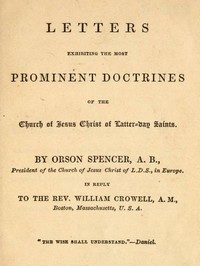
Letters Exhibiting the Most Prominent Doctrines of the Church of Jesus Christ of Latter-Day Saints — A Closer Reading
Edition facts
This digital edition of Letters Exhibiting the Most Prominent Doctrines of the Church of Jesus Christ of Latter-Day Saints — A Closer Reading is described by source-level measurements including 65,072 words, 4 hr 43 min estimated reading time, and 7 detected text sections.
The text analysis averages about 25.9 words per sentence, while the detected sections provide another way to judge how the source is divided.
Project Gutenberg metadata also associates the work with “Latter Day Saint churches -- Doctrines,” connecting these edition facts with the source record’s subject description.
Calculated from edition completeness, EPUB availability, text structure and catalogue metadata. Not a user rating.
How this score is calculated
- Description quality20 pts
- Title & short description10 pts
- Source metadata20 pts
- Text length15 pts
- Chapters / structure15 pts
- EPUB file integrity20 pts
Total of 100 points, scaled to a 2.5-5.0 range. Editions with an empty description or a missing EPUB file are not scored.
Read the Text
Christ was more obnoxious in proportion to the superior magnitude of his claims as the Son of God. How difficult it is for persons, in the present age, to form a correct estimate of the true character and views of Mr. Smith. The public mind is always forestalled concerning him. It is taken to be sound orthodoxy that there is no more need of prophets or revelations; the canon of scripture is full; consequently the man that will claim to be a prophet, or revelator, and seer, must be a base impostor and knave. With this educational prejudice, sanctioned by the best men for a thousand years past, and riveted by solemn vows to abide in orthodoxy, they see as though they saw not, and hear as though they heard not.
If excellent things are taught by Mr. Smith, it is considered by prejudiced minds as a good bait employed to cover a well-barbed hook; by many he is considered _more_ detestable and dangerous, because, say they, if he did not mix so much good with his system, he would not be so dangerous and so likely to deceive.
Again, can the people of this country obtain a correct knowledge of the prophet through the religious prints? I apprehend they never will. Those who control the religious prints, conceive they know in the premises, that God has not raised up such a prophet, therefore they will not tarnish the columns of their periodicals by publishing any thing favourable to him. While they feel bound to withhold whatever might commend the prophet to the favourable regards of impartial men, they feel solemnly constrained to advertise the public of all rising heresies. Thus while our supposed heresies are published from very questionable data, our real virtues are buried in oblivion. We do not murmur; if Jesus, the master, could not be known in his true character, but said with mingled pity and forgiveness, they know not what they do, we cannot expect better treatment from those who know but little of us, while they say much to our disadvantage.
Paul did the Ancient Saints much harm, and wasted them greatly, being ignorant of their true character, and unbelieving as to their doctrines. It is certain that Latter-day Saints have received much harm from those who are ignorant of their character, and unbelieving as to their doctrines. Religious editors, generally, know very little of us, except what they have learned from our enemies. Jesus Christ was entirely stript of his reputation by his enemies, and was put to death by learned, yet ignorant, zealots, who were too self-wise to be taught by one whom they knew to be an impostor in the start; but those men were mistaken in the character of our Lord; and so are our enemies mistaken in the character and views of the modern prophet.
My own personal observation teaches that it is a very difficult matter to instil into the minds of sectarian churches, a true knowledge of the faith and practice of Latter-day Saints. Though one should go among them that was once highly esteemed by them, they are alarmed at his approach, and his virtues are conceived to render him more deserving of a repulse. His influence, say they, may be formidable; we must not bid him God speed, consequently he is not asked to pray in the family or public meeting. If he can, by great effort, get an opportunity to preach, it is not thought advisable for any body to go and hear him, lest they should be led away by his errors.
Thus you see, brother, how difficult in former and latter days to bring the true faith to the knowledge of men, through prejudice. They have prejudged a matter of which they are almost wholly ignorant. This same notion of treating new matters has veiled the sun in darkness, and hung the Prince of Life in agonies. How long shall this treatment of the Saints be persisted in? How long shall prophets be persecuted and slain, without being fully known, and the servants of God be excluded from an impartial hearing, when they seek to publish good tidings--even salvation to the inhabitants of the earth?
Now let me ask my former friends in the eastern churches, with whom I once held sweet intercourse, how it is possible for the Latter-day Saints to introduce their views among the sectarian churches and the world, with any more favourable reception than the Ancient Saints had in introducing theirs? Prejudice and persecution faced them down always, and so it is in these days. It is certainly a mistaken idea to suppose that people are much better now than they were anciently, when the true gospel was misunderstood, and its promoters sincerely accounted disturbers, and heretics worthy of exemplary punishment. But, say the wise and great men among the sectarian churches, "we do understand the true gospel, and have already embraced it, and it is only error and heresy we oppose; and the weight of our contempt and ridicule is hurled at impostors and knaves, who palm off gross deceptions upon the public, and lead captive ignorant zealots by pretended revelations and spurious miracles." But do they not know that substantially the same charge was brought against Jesus Christ and the primitive disciples. Let it be proved that we are what our enemies call us; let us file our respective pleas and come to a speedy and impartial trial. To this our opposers will not consent; they intend to employ all the advantage of education and prejudice to exclude us from a hearing--so did the opposers of the Ancient Saints: but I solemnly ask whether it has ever been necessary, in any moral enterprise, for those who have the truth on their side, especially gospel truth, to defend that truth by foreclosing discussion, and shunning public investigation, and then carry on their depredations by the use of such small arms as ridicule and preconceived objections, that need only be brought to light to be dissipated like fog in the meridian sun?
Do temperance lecturers, bible and education agents, and other moral reformers find it necessary to carry on their enterprises by such means? Do they seek to avoid an open and frank discussion with the intemperate portions of the community? Do they avoid a manly investigation because the intemperate portions of the community combine, in their life and conduct, beastly sottishness, unprovoked abuse to wives and children, a prodigal waste of competence and ample fortunes, and the overthrow of intellect, and the dissolution of all moral ties? No, by no means! They seek the broad day light of public discussion, because they know the truth and power of that side of the cause which they have espoused. They know that intemperance cannot survive the impartial observation of good men. All we ask is that the word of God may have free course. We wish that it may come distinctly to the knowledge of men, that they may sit in impartial judgment upon it.
By the _word_ of God, we mean not only what was revealed for the ancients especially, but also what is _now_ revealed for this generation. Oh! says the objector, he wants the word of Joseph Smith to have a free circulation, and this we oppose, because it is blasphemous and preposterous. Yes, we want the word of God by Joseph Smith, to be known and read of all men, because it is written not with ink, but by the spirit of the living God. What were Peter, Elijah, or Moses, but earthen vessels, by whom God communicated his own knowledge, power, and glory? Does not the word by Joseph commend itself to every man's conscience where it is heard with due candour? I have never seen that person who had read the Book of Mormon, and the Book of Doctrine and Covenants entirely through, with an earnest desire to know whether it was of God or not, who could raise any worthy objection against them. A few isolated portions of these books are often selected out and made to speak some other besides their true meaning, and thereby a dislike for these books is created; consequently, some refuse to read them at all, while some others read only to confirm their prepossessions and prejudices; and superficial inquirers hear with credulity that such a minister, editor, or professor of some College, has published an exposè or refutation of Mormonism, that will inflict a fatal wound upon this glaring and blasphemous heresy.
Now it is well known that the novelties of this age are so many and so various, that no man has time to examine into them all; and many consider that a hint from a pious editor, or distinguished reviewer against Mormonism, is sufficient apology for them not to examine it. Now under these considerations, it is easy to divine that the doctrines of the Latter-day Saints must travel through obstacles and difficulties of the greatest magnitude; and I am ready, dear brother, to mourn over the prospect, because many bad men, and some good men, will fight against the faith, not knowing what they do. My bosom heaves with the deeper concern, because I know this to be the true gospel, and that it will prevail, even though the foe should be so great and powerful as the Lord's enemies were in the days of Noah. Pardon my assurance when I say that those beautiful systems, called benevolent operations, must come to nought; not because they are not honestly designed for some good effect, but because they are a mixture of human device with the wisdom of God, or the gospel perverted. I know, too, that these beautiful systems, together with the various orders of sectarianism, cannot well be vanquished without a desperate struggle ensue. Sectarianism is old and venerable, and having undergone many costly repairs, without much substantial improvement, it never can be demolished without violent resistance. There is an air of sacredness around it that will stimulate its votaries insensibly; and when they are assailed by the strong hand of Bible truth, rather than see their fortress taken by the illiterate followers of the despised prophet, will summon to their aid the worst passions, and push matters to the greatest extremities. These remarks are amply supported by the history of the past, both in respect to Former and Latter-day Saints.
See the ancient Jew of our Lord's day--his piety was scrupulously exact--he knew the worth of his religion by the pains and expense it had cost him. Every thing had with great trouble been fashioned into a system of sacredness. They had been striving hard for a beautiful system of perfection that would commend them to God, and mourned that any of Abraham's children should teach that there was no resurrection, &c., and not harmonize with them in bearing heavy burdens in order to save men's souls. And when an obscure personage sprung up, and broke over their rules of piety, and mingled with the profane without ceremonious washing, and was seen to drink wine, probably, and eat with the boisterous and odious classes, without pretending to wash away the contagion that accrued, and to travel on the Sabbath day, and to pluck ears of corn without any signs of confession, and to heap harsh sounding and heavy anathemas upon the most intelligent and devoted men of the age, and claim to be a prophet, while he ignorantly conversed with an adulterous woman. All this, the scrupulous Jew could not, and would not, bear; and his anger was heightened to madness when he found that many adhered to the new teacher, and occasionally a person of wealth and standing was won over to the impostor by his artifice and jugglery. And as the influence of this odious personage spread, especially among the common people, who had not sufficient sagacity to detect his fraudulent tricks; and as the orthodoxy and piety of the children of Abraham and Moses began to be suspected, and suspicion even preached in synagogues that were too holy for such pollution, the devoted children of Abraham became exasperated. If we let him alone, say they, all men will believe on him. Fearful to use the rod and power, by reason of the Romans, to the utmost rigour, they, at first, sought to render him obnoxious to Caesar; but as measures successively failed, they thirsted for his blood until their pious malice was glutted in his expiring agonies. Then thought they, every body may know that his miracles are all a humbug, because he could not save himself.
Now, brother, I ask you to stop and make a full pause by way of reflection. How do devoted sectarians entertain the Latter-day Saints? Not surely by a candid exposure of our errors, coupled with a patient effort to reclaim us. "By no means," said a highly respectable deaconess, "Brother Spencer, I would rather have heard that you were dead." She knew in the general that I had embraced Mormonism; but of the true character of Mormonism she was grossly ignorant; and she was actually driven into fits when she found I defended the doctrines of Latter-day Saints. Look at the conduct of devoted sectarians towards the Latter-day Saints, and mark the resemblance to that of ancient Jews to former Saints. The same proscriptive spirit reigns now as then,-- the same spirit that dictated expulsion from the synagogue then, now closes the doors of meetinghouses against us,--the same spirit that closed men's ears against the burning eloquence of Stephen then, counsels men not to hear or go nigh Mormon preachers now.
You ask "If the Latter-day Saints are persecuted; if so, by whom are they persecuted?" The answer is a painful one, because it inculpates those who were bound to us by many tender ties. As a people we have been truly persecuted from the beginning.
From the moment we embrace this doctrine, in most cases we are virtually banished from friends, and rank, and station, and business. Says the venerated father, "if you have embraced that doctrine, my son, I never want to see your face any more." Says the partner in trade, "if you are a Mormon, we must dissolve partnership forthwith." If such an one occupying an important office of profit and honour does not give up his Mormonism, we will sue him at the law, and calumniate him, and embarrass him until he is ousted and broken up, and obliged to leave our village. We are separated from men's company, while the licentious, and profane, and intemperate are suffered to dwell in peace; while our opposers cherish to their bosom the rankest infidels, they repulse _us_ with disdain; though none can point out ought wherein we differ from the ancient apostles and prophets. Almost daily my eyes behold those who have suffered too much to mention; but I would rather refer you to printed documents, than to attempt a description of the sufferings of our people in Missouri. From forty to sixty of our brethren suffered death, by violent hands, in Missouri, and as many more, in consequence of the abuse and privations to which they were exposed by an infuriated and bloodthirsty mob; and the disappointment, privation, and homeless condition of survivors was very great. Many widows and orphans knew not what to do, having just begun to live in a comfortable and thriving manner. They had almost forgotten their first sorrow of parting from early friends and possessions, when lo! the hideous mob came upon them; at one blow their homes were made desolate; in some instances father and son were no more; their sufferings in planting themselves anew in this State, without means or friends, though I have often heard them told, I will not attempt to rehearse.
Perhaps some will say, we understand the Mormons were in fault in that matter, and brought merited sufferings upon themselves by their misconduct. The same has always been understood to be true of all persecuted Saints. The greater part of people probably thought Stephen deserved the punishment that terminated his life. The same might be said of John the Baptist, who meddled with the matrimonial concerns of those who did not acknowledge his ecclesiastical jurisdiction. The prophet Elijah was designated to death because he troubled Israel. Daniel refused lawful obedience to the established governor of the realm. In short, persecutors in every age, have always had a plausible pretext for their doings, in the popular estimation of their own day and age.
You ask, "By whom we are persecuted?" In reply I could mention as instigators of mobs, the names of a Baptist missionary, a Methodist and Presbyterian minister. You may also be apprised that ex-Governor Boggs, of Missouri, made affidavit that Joseph Smith was accessory to an attempt to murder him; and that Governor Carlin, of Illinois, in the face of superabundant testimony and law, gave a warrant to arrest him (Joseph Smith) on that affidavit. A heavy reward has been offered for his apprehension, and bold menaces are occasionally hung over our heads, that we, as a people, shall be driven from the State. These things have a tendency to check our prosperity. In one instance some of our brethren were kidnapped by Missourians from this State, and put to shame and scourging. The malignant and vexatious lawsuits to which our people have been subject, are exceedingly numerous; and owing to our impoverished condition, rendered sometimes distressing. But none of these things move us, because we know that if they have hated the master, they will also hate the disciples. Such as are born of the bond woman, will persecute them that are born of the free woman. But it seems like a discouraging effort, to attempt to convince our opposers that we are persecuted, because editors and other philanthropic men are reluctant to tell to the public our side of the matter. They themselves would thereby become suspected of espousing our cause. Men are so sensitive on the subject of our religion, that whoever speaks peaceably of it, perils his influence and reputation; but hireling editors and priests will speak and publish against us.
You ask me to give an account of the faith which I have embraced. I believe that Jesus Christ is God, co-eternal with God the Father; and that such as have the knowledge of the gospel and believe upon him, will be saved; and such as believe not, will be damned. I believe the Old and New Testaments to be the word of God. I believe that every person should be born, not only of the spirit, but also of the water, in order to enter into the kingdom of God. There are three that bear witness on earth, as there are three that bear record in heaven--the spirit, the water, and the blood, bear concurrent testimony to our obedience on earth; for the want of any one, or all of these witnesses on earth, in our favour, there will be no registry of our perfect acceptance in heaven. Hence the baptism for the dead. The righteous dead have a merciful provision made for them in the testimony of the three witnesses on earth, which secures a record of their perfect acceptance in heaven, without which they cannot attain to the highest glory. I believe in the resurrection of the dead, the righteous to life eternal, and the wicked to shame and everlasting contempt. I believe that repentance towards God, and faith in our Lord Jesus Christ, are among the elementary and cardinal truths of the gospel.
In some, and, indeed, many respects do we differ from sectarian denominations. We believe that God is a being that has both body and parts, and also passions; also in the existence of the gifts in the true church spoken of in St. Paul's letter to the Corinthians.
I believe that every church, in gospel order, has a priesthood, consisting of prophets, apostles, elders, &c., and that the knowledge and power of a priesthood, ordained of God, as the ancient priesthood was, is indispensably necessary to the prosperity of the church. I do not believe that the canon of sacred scripture was closed with the revelation of John, but believe that wherever God has a true church, there he makes frequent revelations of his will: and as God takes cognizance of all things, both temporal and spiritual, his revelations will pertain to all things whereby his glory may be promoted, and the temporal and spiritual well-being of his people advanced. Any people that are destitute of the teachings of prophets and apostles, which come by immediate revelation, will soon fall into divisions and strifes, and depart from the truth as it is in Jesus.
Orson Spencer's Letters opens with a pointed asymmetry: the Reverend William Crowel's initial letter of inquiry is included but not answered point-by-point. Instead, Spencer uses it as a springboard for a sustained, fourteen-letter exposition of Latter-day Saint beliefs. The author's preface establishes his credentials—a former Baptist preacher, a graduate of Union College—and frames the work as a response to 'minute and interesting inquiries' that he claims are representative of many others. This framing immediately positions the reader as an observer of a doctrinal debate conducted through the epistolary form, a choice that shapes the work's tone and structure.
Rhetorical Posture and Audience
Spencer addresses Crowel directly as 'Sir,' maintaining a formal, respectful tone even as he challenges the minister's assumptions. The letters are not private correspondence but public argument: Spencer notes that he published them 'after consultation with the Prophet and Patriarch (since martyred).' This detail reveals that the work is both a defense and a recruitment tool, aimed at readers familiar with Protestant theology. Spencer frequently invokes shared scriptural ground—citing Daniel, Ruth, and the patriarchs—before introducing distinctive Latter-day Saint interpretations. His strategy is to claim continuity with biblical precedent while asserting that modern revelation restores lost truths.
The Metaphor of Gathering
One of the most striking features of the excerpts is Spencer's extended metaphor of the 'gathering' as a physical and spiritual migration. He writes of depositing 'our very bones in the land of Zion' with the same fervor as the patriarchs, and describes the Latter-day Saints as 'flying as clouds and as doves to their windows.' The language is deliberately apocalyptic: 'the gathering is the great universal national preacher of the last days' and 'speaks in trumpet tones.' Spencer contrasts the faithful with those who, like Orpah or Lot's family, hesitate to leave their native countries. This binary—gathered versus scattered, obedient versus rebellious—structures his argument throughout the letters.
Scriptural Argument and Prophetic Urgency
Spencer's method is to weave together Old Testament types and New Testament promises, treating them as directly applicable to the 1840s. He cites the valley of dry bones, the inheritance of Canaan, and the 144,000 as proof that the Latter-day Saints are reenacting ancient patterns. The tone is urgent: 'If men have not the spirit of gathering they are blind and cannot see afar off, and are nigh unto burning.' This urgency is reinforced by the historical context—the work was published in Liverpool in 1848, a year of revolutions and cholera outbreaks, though Spencer does not mention these events. Instead, he insists that the 'nations wonder at the spectacle' of the Saints' migration, a claim that positions the reader as a witness to prophecy in action.
Diction and the Voice of Authority
Spencer's prose is marked by a distinctive blend of learned formality and prophetic intensity. He uses legalistic phrases ('for ought I know'), academic titles ('A.B.'), and references to his own education, yet he also employs vivid, almost poetic imagery: 'their bones, like the precious valley of dry bones, will be the guardian care of angels.' The sentences are often long and periodic, building to a climax. The farewell address and the appended poems—including one by 'Miss E. R. Snow'—suggest a communal, devotional dimension to the work. Spencer's voice is that of a scholar-pastor who believes he is delivering a divine message, and his diction reinforces this authority.
Readers approaching Spencer's Letters should attend to the interplay between its public, polemical purpose and its intimate epistolary form. The work rewards attention to how Spencer selects and interprets scripture, how he constructs his audience, and how he uses metaphor to make abstract doctrine concrete. The excerpts provided offer only a partial view—particularly of the later letters on priesthood, apostasy, and restitution—but they reveal a writer deeply engaged in a rhetorical project of persuasion and identity formation.
I keep thinking about Spencer’s letters—the way he framed gathering as a quiet, inevitable tide rather than a shout. It reminded me of something gentler I found later, how The Great War in Verse and Prose — Background and Themes holds sorrow the same way, not arguing with you, just letting the weight sit until you notice it. Strange how two different worlds can leave the same hush.
Sebastian Martin
3 weeks ago-
Johnathan Gonzales - 4 weeks ago
{'rating': 1, 'text': "While the historical value is undeniable, the book feels convoluted and repetitive. The author's arguments are not presented systematically, making it hard to follow the overall arc. It reads more like a disjointed correspondence than a structured doctrinal work. I would recommend it only for specialists in Mormon history, not casual readers."} -
Jessica Simmons - 4 weeks ago
{'rating': 5, 'text': "This collection of letters is a vital resource for anyone seeking to understand the core doctrines of the LDS Church from a historical perspective. The author presents complex theological arguments with clarity and depth, making it accessible to both scholars and lay readers. It's a fascinating window into early Mormon thought, and the correspondence format brings the ideas to life. A must-read for students of religious history."} -
Mark Anderson - 2 weeks ago
{'rating': 3, 'text': "The book offers a thorough examination of LDS doctrines, and the letters are well-arranged. However, the language is quite archaic and dense, which might be challenging for modern readers. Still, if you're interested in the topic, it's a valuable addition to your library. It could have benefited from footnotes to clarify some references."}
What did you think of this book?
Answer a few questions and save a private reflection on this device.
John Miller
3 weeks ago