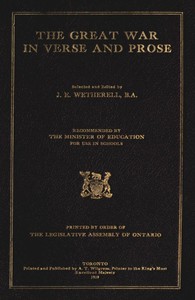
The Great War in Verse and Prose — Background and Themes

(3 User reviews)   502
Wetherell, J. E. (James Elgin), 1851-1940 [Editor], Cody, Henry John, 1868-1951 [Author of introduction, etc.] Project Gutenberg 2014 Not confirmed
World War, 1914-1918 -- Poetry; World War, 1914-1918 Readers of public-domain and historical texts
Project Gutenberg digital edition en

Edition facts

Words 35,889
Reading time 157 min
Text sections 8

For The Great War in Verse and Prose — Background and Themes, the stored edition analysis reports 35,889 words, 2 hr 37 min estimated reading time, and 8 detected text sections.

The text analysis averages about 23.7 words per sentence, while the detected sections provide another way to judge how the source is divided.

Project Gutenberg metadata also associates the work with “World War, 1914-1918 -- Poetry,” connecting these edition facts with the source record’s subject description.

This anthology, compiled for Ontario schools in 1919, juxtaposes Kipling, Brooke, and Grenfell with speeches by Asquith, Churchill, and Roosevelt, revealing how wartime poetry and prose were curated to shape patriotic sentiment.
Share
Editorial Edition Score 4.6/5

Calculated from edition completeness, EPUB availability, text structure and catalogue metadata. Not a user rating.

How this score is calculated
  • Description quality20 pts
  • Title & short description10 pts
  • Source metadata20 pts
  • Text length15 pts
  • Chapters / structure15 pts
  • EPUB file integrity20 pts

Total of 100 points, scaled to a 2.5-5.0 range. Editions with an empty description or a missing EPUB file are not scored.

Edition quality

Read the Text

Never was there a more timely occasion for the teaching of an ardent and enlightened patriotism. Those who understand the issues at stake in the Great War, the genius of the world-wide British Commonwealth, the national consciousness of our own fair Canada, the lessons taught us by the mighty struggle, will be well-instructed citizens of this Dominion, equipped by knowledge and by spirit to serve their country, their Empire, and the world.

The selections of Verse and Prose in this book set forth the varying and successive phases of the War, and seek to remind, to inform, and to inspire. The teachers will use them as vehicles of moral and patriotic instruction. The pupils will keep them forever in their hearts and minds. Surely if we wish to introduce any good element into the life of a nation, it can best be introduced through its schools and colleges.

It is well to recall the issues that have been decided; for in no struggle have greater hung in the balance. The crime perpetrated against the Belgians, aggravated by its accompanying treachery and brutality and immediately followed by unparalleled sanguinary atrocity, revealed as by a lurid flash the nature and the greatness of the menace to which Christian civilization was exposed. Prussian militarism, in this belated, almost incredible but all too terrible, outbreak of Pagan barbarism, threatened to overthrow all the best elements in international life.

(1) The very idea of a Commonwealth of Europe, the growing sense of solidarity, the recognition of general interests, the existence of international institutions such as the Hague Tribunal--were seen to be doomed, if Germany should come forth a victor.

(2) The law of international good faith,--the absolutely indispensable foundation for any international fabric,--would be abolished, if a single criminal state could defy it with impunity, and could profitably disregard treaties, oaths, Geneva Conventions, Hague Declarations, if these interfered with its own selfish advantage.

(3) The fate of the smaller States of Europe, with their own special contributions to civilization, would be sealed, if the arrogant _Kultur_ of Germany were forced upon a subjugated world.

(4) The principle of nationality, vital to a stable and organic modern state, would be crushed or remain as a source of constant unrest in Austro-Hungary, in the Balkan Peninsula, and in other disturbed parts of Europe.

(5) Democracy, with all it implies of self-government, freedom from external compulsion, peaceful development, and civic progress, was recognized as having come to deathgrips with its ancient foe--militaristic autocracy.

(6) The future development of all the Free States of the world, the Entente Powers and the neutrals, was threatened by the German blow for world-power. The very existence of the British Empire as a free, prosperous, and progressive commonwealth, was imperilled. The freedom of our own Dominion was assailed.

(7) Behind all political and material interests, profound moral issues were at stake. The struggle was against the "armed doctrine,"--that diabolical perversion of all sound political thinking,--that the essence of the State is might, that the State is above all moral restraints, that war is its normal and noblest activity, and that war may be waged with pitiless ferocity and scientific frightfulness.

All the forces that opposed freedom, self-government, and progress gathered around the despotisms of Central Europe. In 1914 they made their bid for world dominion. Never before had so much been at stake; perhaps never again will such issues be put to the test. Thank God, the judgment has been given; the righteous government of the world has been vindicated; Right has triumphed over Might.

Gradually the real nature of the struggle was recognized by the free peoples of the world. Their sons felt they were summoned to a new crusade. They went forth as champions of democracy against autocracy, of freedom against tyranny, of mercy against ruthlessness, of justice against iniquity, of decency against shamefulness, of good faith against perfidy, of Right against Might, of peace against war, of humane and Christian civilization against savage and pagan barbarism. All the world was presently forced to give a moral and political judgment on the issues.

Our own glorious British Empire, with its traditions of justice, honour, and liberty, soon became the soul and centre of the Allied resistance. By her Fleet, by her Armies, by her aircraft, by her financing, by her supplies, by her indomitable spirit--she endured and smote the foe. We pay grateful tribute to the achievements of all our Allies in the common cause; but we do not forget Britain's mighty burden.

Among the British Armies, no troops have won higher distinction than the Canadian Corps, under their great leader, Sir Arthur Currie. They were ranked among the most formidable fighting units on the Western Front, and as an offensive spear-head of shock troops they were unsurpassed. They fought in almost every critical engagement of the War. They "saved the day" at the second Battle of Ypres, in face of the hideous emission of poison gas; they fought in the long-drawn agony of the Somme; they won Vimy Ridge, Hill 70, and Passchendaele in 1917; they were in the thickest of the battle in the last "hundred days", as they fought triumphantly at Amiens, Arras, Cambrai, Valenciennes, and Mons. The last blow struck before the Armistice was signed, was struck by the Canadians, who entered Mons early on the morning of the eleventh of November. The course of the war for the British Armies on the Western Front was _from Mons_, where the "Old Contemptibles" were flung into the furnace of the fight in August, 1914, _to Mons_, won by our men from overseas in November, 1918. It was "a long, long way", a way stained by blood and sweat, but at last the grim journey ended. Canada has made a worthy contribution to world-freedom and world-brotherhood.

Canada is dearer to us than ever, because it has been purchased anew at a great cost of precious blood. Those who have fallen are worthy of everlasting remembrance. They will be commemorated by public monuments, by tablets of bronze, or brass or marble in public buildings, by "storied windows richly dight". They deserve this. But, before God, they deserve at our hands a better monument--even the monument of a purer, nobler Canada, more intelligent, more united, more sober, more kindly, more God-fearing. Dying for Canada, they have recreated Canada. Let us be worthy of those whose deaths have kept us free.

Through the experiences of these recent years, we have learned the possibilities of heroism latent in every man. We need not hesitate to make high demands on our citizens for worthy ends. We have regained a right sense of the relative value of things, and we know that the first things are those which are ideal, spiritual, eternal. We know that persons are of infinitely more value than things; that the development and enrichment of personality mark the only true advance in civilization; and that the basis of national progress is the health, efficiency, and spiritual well-being of the people. We have realized the power of organized effort. We shall not forget the bonds of sympathy which common sorrows have created. We have gained a wider outlook on the world and a truer conception of the meaning of Empire. We understand more clearly the national problems that lie before us in this new era. A better Canada will not come of itself. It must be planned for and striven for. But it will come, if there is kindled in the souls of our citizens the same flame of sacrifice and service which burned so brightly in the hearts of Canada's citizen-soldiers of the Great War.

DEPARTMENT OF EDUCATION, TORONTO, APRIL 4, 1919

THE GREAT WAR IN VERSE AND PROSE

"FOR ALL WE HAVE AND ARE"

For all we have and are, For all our children's fate, Stand up and meet the war. The Hun is at the gate! Our world has passed away In wantonness o'erthrown. There is nothing left to-day But steel and fire and stone.

Though all we knew depart, The old commandments stand: "In courage keep your heart, In strength lift up your hand."

Once more we hear the word That sickened earth of old: "No law except the sword Unsheathed and uncontrolled," Once more it knits mankind, Once more the nations go To meet and break and bind A crazed and driven foe.

Comfort, content, delight-- The ages' slow-bought gain-- They shrivelled in a night. Only ourselves remain To face the naked days In silent fortitude, Through perils and dismays Renewed and re-renewed.

Though all we made depart, The old commandments stand: "In patience keep your heart, In strength lift up your hand."

No easy hopes or lies Shall bring us to our goal, But iron sacrifice Of body, will, and soul. There is but one task for all-- For each one life to give. Who stands if freedom fall? Who dies if England live? RUDYARD KIPLING _By permission of the Author_

LORD KITCHENER'S INSTRUCTIONS TO THE BRITISH SOLDIER

You are ordered abroad as a soldier of the King to help our French comrades against the invasion of a common enemy. You have to perform a task which will need your courage, your energy, your patience. Remember that the honour of the British Army depends on your individual conduct.

It will be your duty, not only to set an example of discipline and perfect steadiness under fire, but also to maintain the most friendly relations with those whom you are helping in this struggle. The operations in which you are engaged will, for the most part, take place in a friendly country, and you can do your own country no better service than in showing yourself in France and Belgium in the true character of a British soldier.

Be invariably courteous, considerate, and kind. Never do anything likely to injure or destroy property, and always look upon looting as a disgraceful act. You are sure to meet with a welcome and to be trusted; your conduct must justify that welcome and that trust.

Your duty cannot be done unless your health is sound. So keep constantly on your guard against any excesses. In this new experience you may find temptations both in wine and women. You must entirely resist both temptations, and, while treating all women with perfect courtesy, you should avoid any intimacy.

Do your duty bravely. Fear God. Honour the King.

KITCHENER, _Field-Marshal_

England, in this great fight to which you go Because, where Honour calls you, go you must, Be glad, whatever comes, at least to know You have your quarrel just.

Peace was your care; before the nations' bar Her cause you pleaded and her ends you sought; But not for her sake, being what you are, Could you be bribed or bought.

Others may spurn the pledge of land to land, May with the brute sword stain a gallant past; But by the seal to which _you_ set your hand, Thank God, you still stand fast!

Forth, then, to front that peril of the deep With smiling lips and in your eyes the light, Steadfast and confident, of those who keep Their storied scutcheon bright.

And we, whose burden is to watch and wait-- High-hearted ever, strong in faith and prayer, We ask what offering we may consecrate, What humble service share?

To steel our souls against the lust of ease; To find our welfare in the general good; To hold together, merging all degrees In one wide brotherhood;--

To teach that he who saves himself is lost; To bear in silence though our hearts may bleed; To spend ourselves, and never count the cost, For others' greater need;--

To go our quiet ways, subdued and sane; To hush all vulgar clamour of the street; With level calm to face alike the strain Of triumph or defeat;--

This be our part, for so we serve you best, So best confirm their prowess and their pride, Your warrior sons, to whom in this high test Our fortunes we confide.

SIR OWEN SEAMAN _Reprinted by permission of London "Punch"_

STATEMENT BY LORD KITCHENER

(_House of Lords, August 25, 1914_)

My Lords, as this is the first time I have had the honour of addressing your Lordships, I must ask for the indulgence of the House. In the first place, I desire to make a personal statement. Noble Lords on both sides of the House doubtless know that while associating myself in the fullest degree for the prosecution of the war with my colleagues in His Majesty's Government, my position on this bench does not in any way imply that I belong to any political party, for, as a soldier, I have no politics. Another point is that my occupation of the post of Secretary of State for War is a temporary one. The terms of my service are the same as those under which some of the finest portions of our manhood, now so willingly stepping forward to join the colours, are engaging--that is to say, for the war, or, if it lasts longer than three years, then for three years. It has been asked why this latter limit has been fixed. It is because that should this disastrous war be prolonged--and no one can foretell with any certainty its duration--then after three years' war there will be others fresh and fully prepared to take our places and see this matter through.

The very serious conflict in which we are now engaged on the Continent has been none of our seeking. It will undoubtedly strain the resources of our Empire and entail considerable sacrifices on our people. These will be willingly borne for our honour and for the preservation of our position in the world; and they will be shared by our Dominions beyond the seas, now sending contingents and assistance of every kind to help the Mother Country in this struggle. If I am unable, owing to military considerations for the best interests of the Allied Armies in the field, to speak with much detail on the present situation of our Army on the Continent, I am sure your Lordships will pardon me for the necessary restraint which is imposed upon me.

The Expeditionary Force has taken the field on the French North-West frontier, and advanced to the neighbourhood of Mons in Belgium. Our troops have already been for thirty-six hours in contact with a superior force of German invaders. During that time they have maintained the traditions of British soldiers, and have behaved with the utmost gallantry.

BETWEEN MIDNIGHT AND MORNING

You that have faith to look with fearless eyes Beyond the tragedy of a world at strife, And trust that out of night and death shall rise The dawn of ampler life;

Rejoice, whatever anguish rend your heart, That God has given you, for a priceless dower, To live in these great times and have your part In Freedom's crowning hour;

That you may tell your sons who see the light High in the heavens, their heritage to take:-- "I saw the powers of darkness put to flight! I saw the morning break!"

SIR OWEN SEAMAN _By permission of the Author_

(This poem was first published before 1914, but during the Great War it was very widely quoted, the refrain voicing the spirit of England.)

ENGLAND! where the sacred flame Burns before the inmost shrine, Where the lips that love thy name Consecrate their hopes and thine, Where the banners of thy dead Weave their shadows overhead, Watch beside thine arms to-night, Pray that God defend the Right.

Think that when to-morrow comes War shall claim command of all, Thou must hear the roll of drums, Thou must hear the trumpet's call. Now before they silence ruth, Commune with the voice of truth; England! on thy knees to-night Pray that God defend the Right.

Hast thou counted up the cost, What to foeman, what to friend? Glory sought is Honour lost, How should this be knighthood's end? Know'st thou what is Hatred's meed? What the surest gain of Greed? England! wilt thou dare to-night Pray that God defend the Right?

Single-hearted, unafraid, Hither all thy heroes came, On this altar's steps were laid Gordon's life and Outram's fame. England! if thy will be yet By their great example set, Here beside thine arms to-night Pray that God defend the Right.

So shalt thou when morning comes Rise to conquer or to fall, Joyful hear the rolling drums, Joyful hear the trumpets call. Then let Memory tell thy heart; "_England! what thou wert, thou art!_" Gird thee with thine ancient might, Forth! and God defend the Right!

SIR HENRY NEWBOLT _By permission of the Author_

We've shut the gates by Dover Straits, And North, where the tides run free, Cheek by jowl, our watchdogs prowl, Gray hulks in a grayer sea. And the prayer that England prays to-night-- O Lord of our destiny!-- As the foam of our plunging prows, is white; We have stood for peace, and we war for right. God give us victory!

Now slack, now strung, from the mainmast flung, The flag throbs fast in the breeze; Strained o'er the foam, like the hearts at home That beat for their sons on the seas. For mothers and wives are praying to-night-- O Lord of our destiny!-- But we've no time, for our lips are tight, Our fists are clenched, and we're stripped to fight. God give us victory!

The west winds blow in the face of the foe-- Old Drake is beating his drum-- They drank to "The Day", for "The Hour" we pray; The day and the hour have come. The sea-strewn Empire prays to-night-- O Lord of our destiny!-- Thou did'st give the seas into Britain's might, For the freedom of Thy seas we smite. God give us victory!

JAMES BERNARD FAGAN _By permission of the Author_

Ghostly ships in a ghostly sea, (Here's to Drake in the Spanish Main!) Hark to the turbines, running free, Oil-cups full and the orders plain. Plunging into the misty night, Surging into the rolling brine, Never a word, and never a light, --This for England, that love of mine!

Look! a gleam on the starboard bow, (Here's to the _Fighting Téméraire_!) Quartermaster, be ready now, Two points over, and keep her there. Ghostly ships--let the foemen grieve. Yon's the Admiral tight and trim, And one more--with an empty sleeve-- Standing a little aft of him!

Slender, young, in a coat of blue, (Here's to the _Agamemnon's_ pride!) Out of the mists that long he knew, Out of the _Victory_, where he died, Here to the battle-front he came. See, he smiles in his gallant way! Ghostly ships in a ghostly game, Roaring guns on a ghostly day!

There in his white silk smalls he stands, (Here's to Nelson, with three times three!) Coming out of the misty lands Far, far over the misty sea. Now the Foe is a crippled wreck, Limping out of the deadly fight. Smiling yond on the quarter-deck Stands the Spirit, all silver-bright.

J. E. MIDDLETON _From "Sea Dogs and Men at Arms"-- G. P. Putnam's Sons, New York. By permission of the Author_

(_At the Guildhall, London, September 4, 1914_)

J. E. Wetherell’s 1919 anthology, produced by order of the Ontario Legislative Assembly, opens with Rudyard Kipling’s “For All We Have and Are” and closes with a prose section that includes Theodore Roosevelt’s “Fear God and Take Your Own Part.” The table of contents alone signals a deliberate pairing: Kitchener’s “Instructions to the British Soldier” sits beside Sir Owen Seaman’s elegy “To the Memory of Field-Marshal Earl Kitchener,” while Rupert Brooke’s “The Soldier” appears two pages after John Oxenham’s “Edith Cavell.” This is not a random collection but a carefully structured volume designed for classroom use, where poetry and official documents reinforce each other.

The Opening Sequence: Kipling, Kitchener, and the Call to Arms

The first five entries establish a rhetorical arc. Kipling’s “For All We Have and Are” (1914) issues a stark warning: “No doubt shall make us doubt.” Immediately following is Lord Kitchener’s “Instructions to the British Soldier,” a prose piece that advises troops on conduct. The juxtaposition is telling—the poet’s abstract resolve meets the general’s practical commands. Sir Owen Seaman’s “Pro Patria” then shifts to a satirical tone, mocking German pretensions. The section closes with Kitchener’s “Statement in House of Lords,” a factual report on troop numbers. A first-time reader should note how the editor moves from lyrical urgency to bureaucratic detail, establishing a pattern of alternating registers that recurs throughout the anthology.

Poems of Sacrifice and the Elegiac Mode

Several poems in the middle of the collection dwell on death and memorial. Julian Grenfell’s “Into Battle” (written shortly before his own death) celebrates the soldier’s fate with a pagan vitality: “The thundering line of battle stands.” In contrast, Frederick George Scott’s “A Grave in Flanders” offers a quiet, Christian consolation. The most striking juxtaposition comes when Rupert Brooke’s “The Soldier”—with its famous line “some corner of a foreign field / That is for ever England”—is placed immediately after John Oxenham’s “Edith Cavell,” a poem about the executed nurse. The reader is invited to compare Brooke’s idealized death in battle with Cavell’s deliberate martyrdom. The editor does not comment, but the arrangement itself prompts reflection on different kinds of sacrifice.

Prose Interventions: Speeches, Sermons, and Official Reports

Wetherell intersperses poems with substantial prose extracts. Winston Churchill’s speech on the naval war, David Lloyd George’s “A Scrap of Paper” address, and Henri Bergson’s philosophical “The Meaning of War” appear alongside verse. These prose pieces serve as historical anchors, grounding the emotional poetry in documented events. For instance, Lloyd George’s speech condemns the invasion of Belgium, while the poem “To Belgium in Exile” by Seaman immediately follows. The reader can trace how the same political argument is rendered in different modes. The inclusion of Bergson’s lecture is notable—it introduces a philosophical dimension rare in school anthologies, suggesting the editor aimed to elevate the discussion beyond mere jingoism.

The Canadian Contribution and Imperial Unity

Given the book’s Ontario provenance, Canadian voices feature prominently. Robert J. C. Stead’s “We Were Men of the Furrow” contrasts rural Canadian life with the war’s mechanized horror. Private Harold R. Peat’s “Canadians—Canadians—That’s All!” is a rare enlisted man’s perspective, written in colloquial prose. The anthology also includes Sir Robert Borden’s Guildhall speech, where he asserts Canada’s autonomous war effort. A reader attentive to imperial politics will notice how these selections balance loyalty to Britain with emerging Canadian nationalism. The final poem, “Kitchener’s March” by Stead, imagines the dead general’s spirit marching on—a fitting close for a volume that consistently treats Kitchener as a secular saint.

Because the excerpts are incomplete, the full range of the anthology’s later sections—including pieces by Emile Cammaerts, Gilbert Murray, and Joyce Kilmer—cannot be assessed here. However, the pattern established in the first half suggests that Wetherell valued thematic resonance over chronology. Readers approaching the complete text should watch for how each poem and speech answers or complicates the one before it, and consider what the editor’s choices reveal about the values promoted in Ontario classrooms a century ago.

Holding this 1919 anthology, I remembered my father's old school copy, its margins tense with pencil marks beside the war poems. It felt like eavesdropping on a classroom conversation across decades. Something similar stirred when I later found A Williams Anthology A Collection of the Verse and Prose of Williams College, 1798-1910 — Context and Discussion, another curated echo of young voices bound by their era's earnestness.

Jack Perez
2 weeks ago

Sofia Perez
3 weeks ago

Sophia Lopez
2 weeks ago

4
4 out of 5 (3 User reviews )

Add a Review

Your Rating *
There are no comments for this eBook.

Reader reflection

How will you remember this book?

Save your reaction, strongest insight, and memorable passage.

Your progress 0 / 10
1

How far have you progressed with this book?

2

Did this book hold your interest?

3

Would you encourage someone else to read it?

4

How much effort did this book require?

Related eBooks