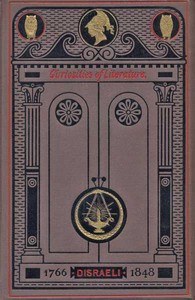
Curiosities of Literature, Vol. 1 — Key Ideas to Explore
Edition facts
For Curiosities of Literature, Vol. 1 — Key Ideas to Explore, the stored edition analysis reports 204,283 words, 14 hr 49 min estimated reading time, and 24 detected text sections.
The text analysis averages about 24.0 words per sentence, while the detected sections provide another way to judge how the source is divided.
Project Gutenberg metadata also associates the work with “English literature -- History and criticism,” connecting these edition facts with the source record’s subject description.
Calculated from edition completeness, EPUB availability, text structure and catalogue metadata. Not a user rating.
How this score is calculated
- Description quality20 pts
- Title & short description10 pts
- Source metadata20 pts
- Text length15 pts
- Chapters / structure15 pts
- EPUB file integrity20 pts
Total of 100 points, scaled to a 2.5-5.0 range. Editions with an empty description or a missing EPUB file are not scored.
Read the Text
Republic was himself a child of Israel. But towards the middle of the eighteenth century, the altered circumstances of England, favourable, as it was then supposed, to commerce and religious liberty, attracted the attention of my great-grandfather to this island, and he resolved that the youngest of his two sons, Benjamin, the "son of his right hand," should settle in a country where the dynasty seemed at length established, through the recent failure of Prince Charles Edward, and where public opinion appeared definitively adverse to persecution on matters of creed and conscience.
The Jewish families who were then settled in England were few, though, from their wealth and other circumstances, they were far from unimportant. They were all of them Sephardim, that is to say, children of Israel, who had never quitted the shores of the Midland Ocean, until Torquamada had driven them from their pleasant residences and rich estates in Arragon, and Andalusia, and Portugal, to seek greater blessings, even than a clear atmosphere and a glowing sun, amid the marshes of Holland and the fogs of Britain. Most of these families, who held themselves aloof from the Hebrews of Northern Europe, then only occasionally stealing into England, as from an inferior caste, and whose synagogue was reserved only for Sephardim, are now extinct; while the branch of the great family, which, notwithstanding their own sufferings from prejudice, they had the hardihood to look down upon, have achieved an amount of wealth and consideration which the Sephardim, even with the patronage of Mr. Pelham, never could have contemplated. Nevertheless, at the time when my grandfather settled in England, and when Mr. Pelham, who was very favourable to the Jews, was Prime Minister, there might be found, among other Jewish families flourishing in this country, the Villa Reals, who brought wealth to these shores almost as great as their name, though that is the second in Portugal, and who have twice allied themselves with the English aristocracy, the Medinas--the Laras, who were our kinsmen--and the Mendez da Costas, who, I believe, still exist.
Whether it were that my grandfather, on his arrival, was not encouraged by those to whom he had a right to look up,--which is often our hard case in the outset of life,--or whether he was alarmed at the unexpected consequences of Mr. Pelham's favourable disposition to his countrymen in the disgraceful repeal of the Jew Bill, which occurred a very few years after his arrival in this country, I know not; but certainly he appears never to have cordially or intimately mixed with his community. This tendency to alienation was, no doubt, subsequently encouraged by his marriage, which took place in 1765. My grandmother, the beautiful daughter of a family who had suffered much from persecution, had imbibed that dislike for her race which the vain are too apt to adopt when they find that they are born to public contempt. The indignant feeling that should be reserved for the persecutor, in the mortification of their disturbed sensibility, is too often visited on the victim; and the cause of annoyance is recognised not in the ignorant malevolence of the powerful, but in the conscientious conviction of the innocent sufferer. Seventeen years, however, elapsed before my grandfather entered into this union, and during that interval he had not been idle. He was only eighteen when he commenced his career, and when a great responsibility devolved upon him. He was not unequal to it. He was a man of ardent character; sanguine, courageous, speculative, and fortunate; with a temper which no disappointment could disturb, and a brain, amid reverses, full of resource. He made his fortune in the midway of life, and settled near Enfield, where he formed an Italian garden, entertained his friends, played whist with Sir Horace Mann, who was his great acquaintance, and who had known his brother at Venice as a banker, eat macaroni which was dressed by the Venetian Consul, sang canzonettas, and notwithstanding a wife who never pardoned him for his name, and a son who disappointed all his plans, and who to the last hour of his life was an enigma to him, lived till he was nearly ninety, and then died in 1817, in the full enjoyment of prolonged existence.
My grandfather retired from active business on the eve of that great financial epoch, to grapple with which his talents were well adapted; and when the wars and loans of the Revolution were about to create those families of millionaires, in which he might probably have enrolled his own. That, however, was not our destiny. My grandfather had only one child, and nature had disqualified him, from his cradle, for the busy pursuits of men.
A pale, pensive child, with large dark brown eyes, and flowing hair, such as may be beheld in one of the portraits annexed to these volumes, had grown up beneath this roof of worldly energy and enjoyment, indicating even in his infancy, by the whole carriage of his life, that he was of a different order from those among whom he lived. Timid, susceptible, lost in reverie, fond of solitude, or seeking no better company than a book, the years had stolen on, till he had arrived at that mournful period of boyhood when eccentricities excite attention and command no sympathy. In the chapter on Predisposition, in the most delightful of his works,[1] my father has drawn from his own, though his unacknowledged feelings, immortal truths. Then commenced the age of domestic criticism. His mother, not incapable of deep affections, but so mortified by her social position that she lived until eighty without indulging in a tender expression, did not recognise in her only offspring a being qualified to control or vanquish his impending fate. His existence only served to swell the aggregate of many humiliating particulars. It was not to her a source of joy, or sympathy, or solace. She foresaw for her child only a future of degradation. Having a strong, clear mind, without any imagination, she believed that she beheld an inevitable doom. The tart remark and the contemptuous comment on her part, elicited, on the other, all the irritability of the poetic idiosyncrasy. After frantic ebullitions, for which, when the circumstances were analysed by an ordinary mind, there seemed no sufficient cause, my grandfather always interfered to soothe with good-tempered commonplaces, and promote peace. He was a man who thought that the only way to make people happy was to make them a present. He took it for granted that a boy in a passion wanted a toy or a guinea. At a later date, when my father ran away from home, and after some wanderings was brought back, found lying on a tombstone in Hackney churchyard, he embraced him, and gave him a pony.
In this state of affairs, being sent to school in the neighbourhood, was a rather agreeable incident. The school was kept by a Scotchman, one Morison, a good man, and not untinctured with scholarship, and it is possible that my father might have reaped some advantage from this change; but the school was too near home, and his mother, though she tormented his existence, was never content if he were out of her sight. His delicate health was an excuse for converting him, after a short interval, into a day scholar; then many days of attendance were omitted; finally, the solitary walk home through Mr. Mellish's park was dangerous to the sensibilities that too often exploded when they encountered on the arrival at the domestic hearth a scene which did not harmonise with the fairy-land of reverie.
The crisis arrived, when, after months of unusual abstraction and irritability, my father produced a poem. For the first time, my grandfather was seriously alarmed. The loss of one of his argosies, uninsured, could not have filled him with more blank dismay. His idea of a poet was formed from one of the prints of Hogarth hanging in his room, where an unfortunate wight in a garret was inditing an ode to riches, while dunned for his milk-score. Decisive measures were required to eradicate this evil, and to prevent future disgrace--so, as seems the custom when a person is in a scrape, it was resolved that my father should be sent abroad, where a new scene and a new language might divert his mind from the ignominious pursuit which so fatally attracted him. The unhappy poet was consigned like a bale of goods to my grandfather's correspondent at Amsterdam, who had instructions to place him at some collegium of repute in that city. Here were passed some years not without profit, though his tutor was a great impostor, very neglectful of his pupils, and both unable and disinclined to guide them in severe studies. This preceptor was a man of letters, though a wretched writer, with a good library, and a spirit inflamed with all the philosophy of the eighteenth century, then (1780-1) about to bring forth and bear its long-matured fruits. The intelligence and disposition of my father attracted his attention, and rather interested him. He taught his charge little, for he was himself generally occupied in writing bad odes, but he gave him free warren in his library, and before his pupil was fifteen, he had read the works of Voltaire and had dipped into Bayle. Strange that the characteristics of a writer so born and brought up should have been so essentially English; not merely from his mastery over our language, but from his keen and profound sympathy with all that concerned the literary and political history of our country at its most important epoch.
When he was eighteen, he returned to England a disciple of Rousseau. He had exercised his imagination during the voyage in idealizing the interview with his mother, which was to be conducted on both sides with sublime pathos. His other parent had frequently visited him during his absence. He was prepared to throw himself on his mother's bosom, to bedew her hands with his tears, and to stop her own with his lips; but, when he entered, his strange appearance, his gaunt figure, his excited manners, his long hair, and his unfashionable costume, only filled her with a sentiment of tender aversion; she broke into derisive laughter, and noticing his intolerable garments, she reluctantly lent him her cheek. Whereupon Emile, of course, went into heroics, wept, sobbed, and finally, shut up in his chamber, composed an impassioned epistle. My grandfather, to soothe him, dwelt on the united solicitude of his parents for his welfare, and broke to him their intention, if it were agreeable to him, to place him in the establishment of a great merchant at Bordeaux. My father replied that he had written a poem of considerable length, which he wished to publish, against Commerce, which was the corrupter of man. In eight-and-forty hours confusion again reigned in this household, and all from a want of psychological perception in its master and mistress.
My father, who had lost the timidity of his childhood, who, by nature, was very impulsive, and indeed endowed with a degree of volatility which is only witnessed in the south of France, and which never deserted him to his last hour, was no longer to be controlled. His conduct was decisive. He enclosed his poem to Dr. Johnson, with an impassioned statement of his case, complaining, which he ever did, that he had never found a counsellor or literary friend. He left his packet himself at Bolt Court, where he was received by Mr. Francis Barber, the doctor's well-known black servant, and told to call again in a week. Be sure that he was very punctual; but the packet was returned to him unopened, with a message that the illustrious doctor was too ill to read anything. The unhappy and obscure aspirant, who received this disheartening message, accepted it, in his utter despondency, as a mechanical excuse. But, alas! the cause was too true; and, a few weeks after, on that bed, beside which the voice of Mr. Burke faltered, and the tender spirit of Benett Langton was ever vigilant, the great soul of Johnson quitted earth.
But the spirit of self-confidence, the resolution to struggle against his fate, the paramount desire to find some sympathising sage--some guide, philosopher, and friend--was so strong and rooted in my father, that I observed, a few weeks ago, in a magazine, an original letter, written by him about this time to Dr. Vicesimus Knox, full of high-flown sentiments, reading indeed like a romance of Scudery, and entreating the learned critic to receive him in his family, and give him the advantage of his wisdom, his taste, and his erudition.
With a home that ought to have been happy, surrounded with more than comfort, with the most good-natured father in the world, and an agreeable man; and with a mother whose strong intellect, under ordinary circumstances, might have been of great importance to him; my father, though himself of a very sweet disposition, was most unhappy. His parents looked upon him as moonstruck, while he himself, whatever his aspirations, was conscious that he had done nothing to justify the eccentricity of his course, or the violation of all prudential considerations in which he daily indulged. In these perplexities, the usual alternative was again had recourse to--absence; he was sent abroad, to travel in France, which the peace then permitted, visit some friends, see Paris, and then proceed to Bordeaux if he felt inclined. My father travelled in France, and then proceeded to Paris, where he remained till the eve of great events in that capital. This was a visit recollected with satisfaction. He lived with learned men and moved in vast libraries, and returned in the earlier part of 1788, with some little knowledge of life, and with a considerable quantity of books.
At this time Peter Pindar flourished in all the wantonness of literary riot. He was at the height of his flagrant notoriety. The novelty and the boldness of his style carried the million with him. The most exalted station was not exempt from his audacious criticism, and learned institutions trembled at the sallies whose ribaldry often cloaked taste, intelligence, and good sense. His "Odes to the Academicians," which first secured him the ear of the town, were written by one who could himself guide the pencil with skill and feeling, and who, in the form of a mechanic's son, had even the felicity to discover the vigorous genius of Opie. The mock-heroic which invaded with success the sacred recesses of the palace, and which was fruitlessly menaced by Secretaries of State, proved a reckless intrepidity, which is apt to be popular with "the general." The powerful and the learned quailed beneath the lash with an affected contempt which scarcely veiled their tremor. In the meantime, as in the latter days of the Empire, the barbarian ravaged the country, while the pale-faced patricians were inactive within the walls. No one offered resistance.
There appeared about this time a satire "On the Abuse of Satire." The verses were polished and pointed; a happy echo of that style of Mr. Pope which still lingered in the spell-bound ear of the public. Peculiarly they offered a contrast to the irregular effusions of the popular assailant whom they in turn assailed, for the object of their indignant invective was the bard of the "Lousiad." The poem was anonymous, and was addressed to Dr. Warton in lines of even classic grace. Its publication was appropriate. There are moments when every one is inclined to praise, especially when the praise of a new pen may at the same time revenge the insults of an old one.
But if there could be any doubt of the success of this new hand, it was quickly removed by the conduct of Peter Pindar himself. As is not unusual with persons of his habits, Wolcot was extremely sensitive, and, brandishing a tomahawk, always himself shrank from a scratch. This was shown some years afterwards by his violent assault on Mr. Gifford, with a bludgeon, in a bookseller's shop, because the author of the "Baviad and Mæviad" had presumed to castigate the great lampooner of the age. In the present instance, the furious Wolcot leapt to the rash conclusion, that the author of the satire was no less a personage than Mr. Hayley, and he assailed the elegant author of the "Triumphs of Temper" in a virulent pasquinade. This ill-considered movement of his adversary of course achieved the complete success of the anonymous writer.
My father, who came up to town to read the newspapers at the St. James's Coffee-house, found their columns filled with extracts from the fortunate effusion of the hour, conjectures as to its writer, and much gossip respecting Wolcot and Hayley. He returned to Enfield laden with the journals, and, presenting them to his parents, broke to them the intelligence, that at length he was not only an author, but a successful one.
He was indebted to this slight effort for something almost as agreeable as the public recognition of his ability, and that was the acquaintance, and almost immediately the warm personal friendship, of Mr. Pye. Mr. Pye was the head of an ancient English family that figured in the Parliaments and struggles of the Stuarts; he was member for the County of Berkshire, where his ancestral seat of Faringdon was situate, and at a later period (1790) became Poet Laureat. In those days, when literary clubs did not exist, and when even political ones were extremely limited and exclusive in their character, the booksellers' shops were social rendezvous. Debrett's was the chief haunt of the Whigs; Hatchard's, I believe, of the Tories. It was at the latter house that my father made the acquaintance of Mr. Pye, then publishing his translation of Aristotle's Poetics, and so strong was party feeling at that period, that one day, walking together down Piccadilly, Mr. Pye, stopping at the door of Debrett, requested his companion to go in and purchase a particular pamphlet for him, adding that if he had the audacity to enter, more than one person would tread upon his toes.
My father at last had a friend. Mr. Pye, though double his age, was still a young man, and the literary sympathy between them was complete. Unfortunately, the member for Berkshire was a man rather of an elegant turn of mind, than one of that energy and vigour which a youth required for a companion at that moment. Their tastes and pursuits were perhaps a little too similar. They addressed poetical epistles to each other, and were, reciprocally, too gentle critics. But Mr. Pye was a most amiable and accomplished man, a fine classical scholar, and a master of correct versification. He paid a visit to Enfield, and by his influence hastened a conclusion at which my grandfather was just arriving, to wit, that he would no longer persist in the fruitless effort of converting a poet into a merchant, and that content with the independence he had realised, he would abandon his dreams of founding a dynasty of financiers. From this moment all disquietude ceased beneath this always well-meaning, though often perplexed, roof, while my father, enabled amply to gratify his darling passion of book-collecting, passed his days in tranquil study, and in the society of congenial spirits.
His new friend introduced him almost immediately to Mr. James Pettit Andrews, a Berkshire gentleman of literary pursuits, and whose hospitable table at Brompton was the resort of the best literary society of the day. Here my father was a frequent guest, and walking home one night together from this house, where they had both dined, he made the acquaintance of a young poet, which soon ripened into intimacy, and which throughout sixty years, notwithstanding many changes of life, never died away. This youthful poet had already gained laurels, though he was only three or four years older than my father, but I am not at this moment quite aware whether his brow was yet encircled with the amaranthine wreath of the "Pleasures of Memory."
Some years after this, great vicissitudes unhappily occurred in the family of Mr. Pye. He was obliged to retire from Parliament, and to sell his family estate of Faringdon. His Majesty had already, on the death of Thomas Warton, nominated him Poet Laureat, and after his retirement from Parliament, the government which he had supported, appointed him a Commissioner of Police. It was in these days that his friend, Mr. Penn, of Stoke Park, in Buckinghamshire, presented him with a cottage worthy of a poet on his beautiful estate; and it was thus my father became acquainted with the amiable descendant of the most successful of colonisers, and with that classic domain which the genius of Gray, as it were, now haunts, and has for ever hallowed, and from which he beheld with fond and musing eye, those
Isaac Disraeli's Curiosities of Literature, here presented in a new edition edited by his son Benjamin Disraeli, is a sprawling miscellany that resists easy categorization. The work collects anecdotes, historical oddities, and critical observations on literary and cultural history, ranging from the origins of glove-giving customs to the medieval trade in saintly relics. The editor's preface frames the author's life as one of sustained intellectual purpose, arguing that a book may be as consequential as a battle—a claim that sets the tone for a volume where the trivial and the significant are deliberately intertwined.
Anecdotal Method and Antiquarian Sources
Disraeli's method is associative rather than systematic. He moves from a discussion of maiden assizes and the custom of removing gloves in princely stables to the phrase giving a pair of gloves, citing Gough's Sepulchral Monuments and records of glove sales from the Earl of Arran's goods. The author does not always explain the origins of these customs; he notes that the reason for removing gloves in German stables 'seems to be lost.' This willingness to present unresolved curiosities is characteristic. He draws on antiquarian authorities such as Chambers and Gough, but also on sale catalogues and family heirlooms, as when he records that gloves given by Henry VIII to Sir Anthony Denny were sold for 38 l. 17 s. The texture of the prose is dense with proper names and specific sums, lending an air of documentary precision even when the underlying rationale remains obscure.
Relics, Credulity, and the Commerce of the Sacred
The section on 'Relics of Saints' exemplifies Disraeli's interest in the intersection of belief and commerce. He describes the 'relique-mania' as a universal phenomenon where buyers and sellers engaged in 'curious impositions' and theft. He cites Guibert de Nogent's treatise against false relics, written after monks at St. Medard de Soissons claimed to possess a tooth of Christ. Disraeli reports with evident relish that Guibert denounced as 'chimerical' the belief that someone owned the navel of Christ's body. The account of St. Lewin's translation from England to Bergs includes the 'knavish modes' used to steal fragments of the saint. Disraeli's tone is detached but pointed; he does not mock the faithful but highlights the gap between the 'good faith' of purchasers and the 'impositions' of vendors. The passage reveals a collector's fascination with the mechanics of fraud and the social logic of relic-hunting.
The Editor's Frame: Biography as Defense
Benjamin Disraeli's prefatory 'Life and Writings' provides a biographical lens that shapes how the miscellany is presented. He argues that an author's life is as eventful as a statesman's, citing Voltaire, Homer, and Bacon as figures whose 'exploits' rival military victories. This defense of literary labor is pointed: Isaac Disraeli's career, Benjamin claims, exhibited 'uniformity more sustained' than most, with a 'strong bent' pursued from infancy to old age. The son's notes, added to this edition, are said to 'illustrate or correct' the text where later discoveries have superseded the father's knowledge. This editorial apparatus frames the Curiosities not as a relic but as a living document, open to revision. Benjamin's intervention also signals a shift in readership: the volumes are now offered to 'the young and ardent inquirer after knowledge,' suggesting an educational purpose that the original may not have explicitly claimed.
Readers approaching this volume should expect a work that prioritizes curiosity over argument. Disraeli's essays do not build toward a thesis; they accumulate details, often leaving the reader to draw connections. The editor's notes and biographical introduction provide context but do not resolve the miscellany's inherent looseness. For those interested in the byways of literary history, the customs of glove-giving, or the economics of relic fraud, this collection offers a wealth of specific, often surprising, information—provided one is willing to follow the author's digressive path.
There’s something tender about a father collecting oddities and a son later preserving them—generations holding the same page. Reading Disraeli’s miscellany feels like inheriting a quiet, cluttered study. I keep thinking of how those fragile treasures carried on through darker years, much like the voices gathered in The Great War in Verse and Prose — Background and Themes, each one a small, stubborn light against forgetting.
Dylan Hill
3 weeks agoDaniel Roberts
1 week agoLiam Rodriguez
2 weeks agoSamuel Johnson
1 month ago-
Mark Thomas - 1 month ago
Isaac D'Israeli's 'Curiosities of Literature' is a delightful ramble through the byways of literary history. Volume 1 is packed with fascinating anecdotes, obscure facts, and forgotten tales that will captivate any book lover. D'Israeli's prose is engaging and his curiosity infectious. This is a perfect book to dip into at random, and it will enrich your understanding of literature and history. A true classic that deserves a place on every shelf. -
Amanda Reed - 1 month ago
This volume offers a charming collection of literary oddities and historical anecdotes. It's perfect for light reading, and D'Israeli's style is pleasant. However, the material is somewhat dated, and some of the 'curiosities' may seem trivial to modern readers. There's no overarching narrative, so it's best enjoyed as a casual read rather than a scholarly resource. Still, it has its charms. -
Allison Sutton - 3 weeks ago
This book is essentially a random assortment of trivia that lacks depth and coherence. D'Israeli's writing style is old-fashioned and full of digressions that add little value. Many of the 'curiosities' are mundane, and the absence of notes or modern context makes it hard to verify or appreciate the significance. It feels more like a vanity project than a serious work of literary exploration. Not recommended for serious readers.
Before you leave, reflect on the book
Use these questions to collect your thoughts before moving on.
Isaac Moore
1 week ago