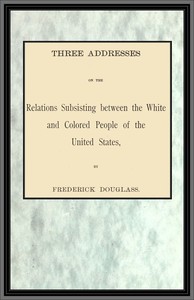
Three addresses on the relations subsisting between the white and colored people of the United States — Context and Discussion
Edition facts
This digital edition of Three addresses on the relations subsisting between the white and colored people of the United States — Context and Discussion is described by source-level measurements including 31,701 words, 2 hr 18 min estimated reading time, and 3 detected text sections.
The text analysis averages about 26.3 words per sentence, while the detected sections provide another way to judge how the source is divided.
Project Gutenberg metadata also associates the work with “African Americans -- Civil rights,” connecting these edition facts with the source record’s subject description.
Calculated from edition completeness, EPUB availability, text structure and catalogue metadata. Not a user rating.
How this score is calculated
- Description quality20 pts
- Title & short description10 pts
- Source metadata20 pts
- Text length15 pts
- Chapters / structure15 pts
- EPUB file integrity20 pts
Total of 100 points, scaled to a 2.5-5.0 range. Editions with an empty description or a missing EPUB file are not scored.
Read the Text
e of maintaining good faith with the freedmen or the Indian, or the protection of the constitutional rights of American citizens, except where such rights were in no danger.
The great thing to be protected was American industry against competition with the pauper labor of Europe--not protection of the starving labor of the South. The body of the nation was everything; the soul of the nation was nothing. It did not appear from the campaign speeches that it was important to protect and preserve both, or that the body was not more dependent upon bread for life than was the soul dependent upon truth, justice, benevolence, and good faith for health and life. In the absence of these, the soul of the nation starves, sickens, and dies. It may not fall at once upon the withdrawal of these, but persistent injustice will, in the end, do its certain work of moral destruction. No nation, no party, no man can live long and flourish on falsehood, deceit, injustice, and broken pledges. Loyalty will perish where protection and good faith are denied and withheld, and nothing other that this should be expected, either by a party, a man, or by a government. On the other hand, where good faith is maintained, where justice is upheld, where truth and right prevail, the government will be like the wise man’s house in Scripture--the winds may blow, the rains may descend, the flood may come and beat upon it, but it will stand, because it is founded upon the solid rock of principle. I speak this, not only for the Republican party, but for all parties. Though I am a party man, to me parties are valuable only as they subserve the ends of good government. When they persistently violate the fundamental rights of the humblest and weakest in the land I scout them, despise them, and leave them.
We boast of our riches, power, and glory as a nation, and we have reason to do so. But what is prosperity, what is power, what is national glory, when national honor, national good faith, and national protection to the rights of our citizens are denied? Of what avail is citizenship and the elective franchise where a whole people are deliberately abandoned to anarchy by the Government under which they live, and told they must protect themselves from violence as best they may, for, practically, this is just what the American Government has said to the colored and white Republican voters of the South during the last eight years. Minister Lowell was accused of not protecting the rights of Irish-Americans in England, and our ships are just now ordered to Panama to look after the interests of American citizens in Central America. This is all right, but when and where have our army and navy gone to protect the rights of American citizens at home? To say, “I am a Roman citizen!” could once arrest the bloody scourge and cause the brutal tyrant to turn pale. But who cares now for the citizenship of any American Republican, black or white, in Mississippi or South Carolina? We are rich and powerful. But we should remember that the whole vast volume of human history is dotted all along with the wrecks of nations which have perished amid wealth, luxury, and splendor. What doth it profit a nation to gain the whole world if it shall lose its own soul? Henry Clay, in 1839, made an elaborate defence of the right to hold property in man. Two hundred years of legislation has sanctioned and identified negro slaves as property. When warned by anti-slavery men of the dreadful consequences of perpetuating slavery, he said that that warning had been given fifty years before, and that it had been answered by fifty years of unexampled prosperity. His idea was that if slavery were a curse God would not allow a nation that upheld it to prosper. The argument was sophistical, but it contained a great truth after all, and time only was required to verify it. He forgot that God reigns in eternity; that space is sometimes given for repentance. He did not remember, as Jefferson did, that God is just, and that His justice cannot sleep forever.
Had Mr. Clay lived to see, as we have seen, the union of his beloved country rent asunder at the centre, and hostile armies composed of his beloved countrymen on the field of battle, amid dust, smoke, and fire, blowing each other to pieces from the cannon’s mouth; had he seen five hundred thousand of the youth and flower of both sections of this land cut down by the sword and flung down into bloody graves; had he seen in the wake of this fratricidal war the smoldering ruins of noble towns and cities, and the nation staggering under a debt heavier than a mountain of gold; had he seen the sullen discontent and deadly hate which survived the war, and traced all these calamities and more, as he must do, to the existence of slavery, he would, in all the bitterness of his soul, have cursed the day when he poured out his eloquence in defence of that system which brought upon his country these accumulated horrors.
The lesson of this national experience is in place to-day, and it would be well for this nation to study and learn it. Look abroad! What rocks Europe to-day? What causes the Emperor of all the Russias to be uneasy on his pillow? What makes Austria tremble? Why does England start up frantically at midnight and search her premises? You know, and I know, that these countries have aggrieved classes among them who have just ground of complaint against their governments.
Now, fellow-citizens, let me speak plainly. This is an age when men go to and fro in the earth, and knowledge increases oppressed peoples all over the world are protesting with earthquake emphasis against all forms of injustice, some by one means and some by another. Examples, like certain diseases, are contagious. Railroads, steam navigation, electric wires, newspapers, and traveling emissaries are abroad. Can you be quite sure that the oppressed laborers in this country, white and colored, will not some day make common cause and learn some of the dangerous modes of protest against injustice adopted in other countries? I deal in no threats, for myself or for any of my countrymen, and am only for peaceful methods; but I say to all oppressors, “Have a care how you goad and imbrute the colored man of the South!” He is weak, but not powerless. He is submissive to wrongs, but not insensible to his rights. He is hopeful, but not incapable of despair. He can endure, but even to him may come a time when he shall think endurance has ceased to be a virtue. All the world is a school, and in it one lesson is just now being taught in letters of fire and blood, and that is, the utter insecurity of life and property in the presence of an aggrieved class. This lesson can be learned by the ignorant as well as by the wise. Who can blame the negro if, when he is driven from the ballot-box, the jury-box, and the schoolhouse, denied equal rights on railroads and steamboats, called out of his bed at midnight and whipped by regulators, compelled to live in rags and wretchedness, and his wages kept back by fraud, denied a fair trial when accused of crime, he shall imitate the example of other oppressed classes and invokes some terrible explosive power as a means of bringing his oppressors to their senses, and making them respect the claims of justice? This would indeed be madness, but oppression will make even a wise man mad.
It should not be forgotten that the negro is not what he was twenty years ago. Kossuth once said that bayonets think. The negro is beginning to think. Years ago a book had as little to say to him and had as little meaning for him as a brick. It was then a thing of darkness and silence. Now it is a thing of light and speech. Education, the sheet anchor of safety to society where liberty and justice are secure, is a dangerous thing to society in the presence of injustice and oppression.
I pursue this thought no further. A hint to the wise ought to be sufficient. Let not my words be construed as a menace, but taken as I mean them--as a warning; not interpreted as inviting disaster, but considered as designed to avert disaster.
Fellow-citizens, many things calculated to make us thoughtful have occurred since I addressed you on an occasion like this, two years ago; but nothing has occurred which ought to make us more thoughtful than the recent decision of the Supreme Court of the United States on the civil rights bill. That decision came upon the country like a clap of thunder from a clear sky. It came without warning. It was a surprise to enemies and a bitter disappointment to friends. Had the bench been composed of Democratic judges some such a decision might have come upon us without producing any very startling effect. But the fact was otherwise. This blow was dealt us in the house of our friends. The bench was composed of nine learned Republican judges, and of these nine honorable men only one came to our help, I mean Honorable Justice John M. Harlan. He stood up for the rights of colored citizens as those rights are defined by the fourteenth amendment of the Constitution of the United States.
It was a magnificent spectacle, this grand representation of American justice standing alone, and the country will not soon forget it. Without meaning any disrespect to the Supreme Court, or reflecting upon the purity of its motives, I must say here, as I have said elsewhere, and shall say many times over if my life is spared, that that decision is the most striking illustration I have ever seen of how it is possible to keep alive the letter of the law and at the same time stab its spirit to death. Portia strictly construed the law of Venice for mercy, and this rule of construction has the approval of all the ages, but the Supreme Court of the United States construed American law against the weak and in the interest of prejudice and brutality. Never before was made so clear the meaning of Paul’s saying, “The letter killeth, but the spirit giveth life.”
I am glad, and I know that you are glad, that there was one man on that bench who had the mind and heart to be as true to liberty in this its day as was the old Supreme Court of slavery in its day. While slavery existed all presumptions were made in its favor. The obvious intention of the law prevailed, but now the plain intention of the law has been strangled by the letter of the law.
The fourteenth amendment of the Constitution was plainly intended to secure equal rights to all citizens of the United States, without regard to race or color, and Congress was authorized to carry out this provision by appropriate legislation. But by this decision of the Supreme Court the fourteenth amendment has been slain in the house of its friends. I have no doubt that that decision contributed to the defeat of the Republican party in the late election. I repeat, that decision may well make colored men thoughtful.
Kentucky has done many evil things in her time, but she has also done many great and good things. She has recently given us a law by which equal educational advantages have been extended to colored children. Long ago she gave us James G. Birney, the first abolition candidate for the presidency of the United States; a former slave-holder, but one who emancipated his slaves on his own motion; a genuine gentleman of the old school, and one to be gratefully remembered by every friend of liberty in this country. She has given us Cassius M. Clay, the man who fought his way to freedom of speech on his native soil. She has given us John G. Fee, the earnest and devoted educator of the freedman. Nor is this all. She has given us two of the largest hearts and broadest minds of which our country can boast; men who had the courage of their convictions, and who dared, at the peril of what men hold most dear, to be true to their convictions. These strong men--one dead and the other living--are Abraham Lincoln and John M. Harlan. Abraham Lincoln is already enshrined in the hearts of the American people, and Justice John M. Harlan will hold a place beside him in the hearts of his countrymen.
You remember the public meeting held in Lincoln Hall, and the free expression of opinion upon the unsoundness of the decision of the Supreme Court on the civil rights bill. You will also remember that the ablest and boldest words there spoken were from the lips of Robert G. Ingersoll, a man everywhere spoken against as an infidel and a blasphemer. Well, my friends, better be an infidel and a so-called blasphemer than a hypocrite who steals the livery of the court of heaven to serve the devil in.
Infidel though Mr. Ingersoll may be called, he never turned his back upon his colored brothers, as did the evangelical Christians of this city on the occasion of the late visit of Mr. Moody. Of all the forms of negro hate in this world, save me from that one which clothes itself with the name of the loving Jesus, who, when on earth, especially identified himself with the lowest classes of suffering men, and the proof given of his Messiahship was that the poor had the Gospel preached unto them. The negro can go into the circus, the theatre, the cars, and can be admitted into the lectures of Mr. Ingersoll, but cannot go into an Evangelical Christian meeting.
I do not forget that on the occasion of the civil rights meeting I have mentioned, one evangelical clergyman, a real man of God, gave to the gospel trumpet a certain sound. The religion of Dr. John E. Rankin, like the love of his Redeemer, is not bounded by race or color, but takes in the whole human family. No truer man than he ever ascended a Washington pulpit.
In conclusion let me say one word more of the soul of the nation and of the importance of keeping it sensitive and responsive to the claims of truth, justice, liberty, and progress. In speaking of the soul of the nation I deal in no cant phraseology. I speak of that mysterious, invisible, impalpable something which underlies the life alike of individuals and of nations, and determines their character and destiny.
It is the soul that makes a nation great or small, noble or ignoble, weak or strong. It is the soul that exalts it to happiness, or sinks it to misery. While it modifies and shapes all physical conditions, it is itself superior to all such conditions. It is the spiritual side of humanity. Fire cannot burn it, water cannot quench it. Though occult and impalpable, it is just as real as granite or iron. The laws of its life are spiritual, not carnal, and it must conform to these laws or it starves and dies. The outward semblance of it may survive for a time, just as ancient temples and old cathedrals may stand long after the spirit that inspired them has vanished. But they, too, will moulder to ruin and vanish. The life of the nation is secure only while the nation is honest, truthful, and virtuous; for upon these conditions depend the life of its life.
A few years ago a terrible and desolating fire swept over the proud young city of Chicago, and left her architectural splendors in ashes. In a few hours her “cloud-capped towers and gorgeous palaces” and solemn temples crumbled to dust, and were scattered to the four winds of heaven, so that no man could find them, but there remained the invisible soul of a great people, full of energy, enterprise, and faith, and hence, out of the ashes and hollow desolation, a grander Chicago than the one destroyed arose “as if by magic.”
“What constitutes a state? Not high raised battlements, or labored mound, Thick walls or moated gate; Not cities proud, with spires and turrets crowned; Not bays and broad armed ports, Where, laughing at the storm, rich navies ride. No, men; high-minded men! With power as far above dull brutes endued, In forest, brake, or den, As beasts excel cold rocks and brambles rude; Men who their duties know, But know their rights, and knowing, dare maintain.”
IN WASHINGTON, D. C., 1886.
In introducing Mr. FREDERICK DOUGLASS, on the occasion of the Twenty-fourth Anniversary of Emancipation in the District of Columbia, Prof. J. M. GREGORY made the following remarks:
LADIES AND GENTLEMEN: For many years prior to 1861 the friends of freedom, seeing the prominence slavery had acquired because of its existence at the capital of the nation, and the evil influence which it necessarily exerted upon legislation, sought in vain by petitions and other measures for its abolition in the District of Columbia. It was not, however, till the national conscience began to be quickened by the reverses of our armies, and legislators to realize the dangers which threatened the life of the nation, that the cause could muster sufficient strength to gain a hearing in Congress.
On the 16th of December, 1861, Mr. Wilson, of Massachusetts, introduced into the Senate a bill providing for the immediate emancipation of slaves in the District upon the payment to the owners of $300 for each slave. As was to be expected the bill was antagonized by pro-slavery men in the Senate and House. They feared that the measure proposed was the entering wedge for the final overthrow of their pet institution in the South. As subsequent events proved their fears were not without foundation. Notwithstanding the bitter opposition which the bill encountered, it passed both houses of Congress in less than four months from its first introduction in the Senate, and was approved by the President on the 16th of April, just twenty-four years ago to-day.
The debates on this and kindred questions makes memorable the second session of the Thirty-seventh Congress, and they are of special interest because they indicated a new departure in the line of argument pursued by Northern statesmen. They based their arguments for emancipation, not upon grounds of expediency, but the great principles of right and justice.
The importance of this act must not be overlooked. It struck the shackles from the limbs of 3,000 human beings and placed them in the ranks of freemen. It took away the shame which slavery had brought upon the National Capital. But this was not all. It elevated the nation in its own eyes and in the eyes of the civilized world, and roused a feeling of patriotism and pride. It called forth an expression from the National Legislature, and a majority of the members by solemn vote arrayed themselves on the side of emancipation and liberty, in opposition to slavery and oppression. It was the forerunner of the great emancipation proclamation--that proclamation which more than all his other acts makes the name of Abraham Lincoln secure to all posterity.
In our rejoicing on this occasion we should not forget to hold in grateful remembrance the men whose votes secured the passage of the bill, and especially its author, a man who by his works proved himself a friend of the oppressed, Hon. Henry Wilson, the benefactor of the District.
When the emancipation bill became a law in 1862, there were 15,000 colored people in the District of Columbia, 12,000 of whom were free and the remainder slaves. They maintained eight schools for the education of their children, and were the owners of twelve churches, which cost about $75,000. With the increase of population came the demand for more churches, so that to-day they have eighty churches and missions in the District. Many of the churches are very valuable and located on some of the principal streets and avenues, the new Metropolitan Church alone being valued at $100,000.
Frederick Douglass opens his 1883 Louisville address with a single sentence of extraordinary length, a periodic structure that piles clause upon clause before reaching its main verb. This syntactic weight mirrors the burden of representation he carries: he speaks as one "charged with the responsibility and duty" of advancing a people "lately enslaved." The voice is formal, almost legalistic, yet it shifts abruptly into plainspoken condemnation. When discussing the 1883 Civil Rights Cases, Douglass drops the elaborate periods for short, hammering statements: "The fourteenth amendment has been slain in the house of its friends." This alternation between measured exposition and blunt accusation defines the collection's rhetorical engine.
The Architecture of a Sentence
Douglass's opening sentence in the first address runs over 150 words, its syntax a deliberate enactment of the complexity he faces. He stacks subordinate clauses—"recognizing the great fact as we do, that the relations of the American people ... depend more upon prevailing ideas ... than upon courts of law"—before arriving at the main request. This is not mere ornament. The sentence structure forces the listener to hold multiple conditions in mind simultaneously, mirroring the layered nature of racial injustice. Later, in the Washington addresses, Douglass shifts to shorter, more aggressive rhythms: "The letter killeth, but the spirit giveth life." He quotes Paul, then immediately applies the verse to the Supreme Court's reasoning. The biblical citation is not devotional but tactical, turning scripture into a weapon against legal literalism.
Voicing Dissent from Within
Douglass repeatedly frames his criticism as loyalty to American principles. He congratulates his audience on "the altered condition both of ourselves and our common country," then catalogues failures. This double-voiced strategy—praise followed by indictment—appears in each address. When he praises Kentucky for producing "Abraham Lincoln and John M. Harlan," he does so after detailing the state's history of "evil things." The effect is to claim patriotism as the ground for protest. His voice modulates between the collective "we" of the convention and the singular "I" of personal witness: "I must say here, as I have said elsewhere, and shall say many times over if my life is spared." This insistence on repetition underscores the urgency of his message.
Pace as Persuasion
The addresses build momentum through strategic acceleration. Douglass begins each speech with slow, circumstantial reasoning, then quickens into declarative judgments. In the 1885 Washington address, he moves from a measured analysis of the Civil Rights Cases to a sudden, vivid image: "Never before was made so clear the meaning of Paul's saying, 'The letter killeth, but the spirit giveth life.'" The pace compresses. Where earlier paragraphs unfold over many clauses, here a single sentence delivers the verdict. He uses parallel structure for emphasis: "She has given us James G. Birney ... She has given us Cassius M. Clay ... She has given us John G. Fee." The repetition drives home a cumulative argument about Kentucky's contradictory legacy. The final address, from 1886, sustains this quicker tempo, as if the accumulating evidence has made lengthy preamble unnecessary.
Readers will notice how Douglass varies his address forms: the first speech is a convention document, the later ones more extemporaneous. Pay attention to his use of legal language—he was a careful reader of court decisions—and how he turns the law's own terms against it. The three addresses together show a speaker refining his tactics, moving from collective petition to individual moral authority. The shifts in sentence length and rhythm are not accidents; they are the craft of a speaker who knew that justice required not only the right argument but the right pace.
Douglass’s precise grief over a broken promise feels achingly familiar. I kept thinking how those legal arguments echo, in a different key, the quiet ache in A Confederate surgeon's letters to his wife — Reading Notes—the slow realization that home won’t be waiting as it was. Both voices, so far apart, share that same wistful weight of distance.
Isabella Perez
2 weeks agoSofia Allen
2 weeks ago-
Kimberly Ryan Arnold - 1 month ago
Three Addresses... is unfortunately a difficult read, both in style and substance. The prose is dense and overly academic, making the arguments hard to follow. Moreover, the author's perspective is very much a product of its time, and some of his views and terminology are distasteful by modern standards. While historically significant, the book lacks the nuance and depth needed to truly understand the complexities of race relations. I'd recommend reading more recent scholarship instead. -
Christina Allen Martin - 1 month ago
This collection of addresses offers a valuable historical perspective on race relations in the United States. The author's arguments are sincere and reflect a thoughtful, progressive mindset for the era. However, the language and style are very much of the 19th century, requiring effort to fully grasp. Additionally, some passages feel repetitive. It's an important piece for historical study, but general readers may find it challenging to read through. -
Jenna Julia Martinez - 1 week ago
Three Addresses on the Relations Subsisting Between the White and Colored People of the United States is a powerful and courageous historical document. The author speaks with eloquence and moral clarity, addressing the complex and painful subject of race relations in post-Civil War America. His arguments for justice and equality are surprisingly progressive for the time and remain deeply relevant today. This book is essential reading for anyone seeking to understand the roots of America's racial challenges. Its wisdom and honesty are inspiring.
How did this book work for you?
Your answers remain private and are stored only in this browser.
Olivia Gonzalez
4 weeks ago