
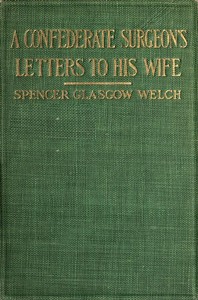
A Confederate surgeon's letters to his wife — Reading Notes

(1 User reviews)   310
Welch, Spencer Glasgow, 1834-1916, Wright, Eloise Welch, 1874-1973 [Editor] Project Gutenberg 2025 Not confirmed
United States -- History -- Civil War, 1861-1865 -- Personal narratives, Confederate; Confederate States of America. Army. South Carolina Infantry Regiment, 13th Readers of public-domain and historical texts
Project Gutenberg digital edition en

Edition facts

Words 26,423
Reading time 115 min
Text sections 8

The catalog record for A Confederate surgeon's letters to his wife — Reading Notes provides practical reading context through 26,423 words, 1 hr 55 min estimated reading time, and 8 detected text sections.

The text analysis averages about 17.5 words per sentence, while the detected sections provide another way to judge how the source is divided.

Project Gutenberg metadata also associates the work with “United States -- History -- Civil War, 1861-1865 -- Personal narratives, Confederate,” connecting these edition facts with the source record’s subject description.

Spencer Glasgow Welch, surgeon of the 13th South Carolina Volunteers, writes to his wife from camps and battlefields. His letters record the physical toll of marching, the sudden violence of skirmishes, and the quiet after battles, with sharp observations on commanders and the mundane hardships of camp life.
Share
Editorial Edition Score 4.7/5

Calculated from edition completeness, EPUB availability, text structure and catalogue metadata. Not a user rating.

How this score is calculated
  • Description quality20 pts
  • Title & short description10 pts
  • Source metadata20 pts
  • Text length15 pts
  • Chapters / structure15 pts
  • EPUB file integrity20 pts

Total of 100 points, scaled to a 2.5-5.0 range. Editions with an empty description or a missing EPUB file are not scored.

Edition quality

Read the Text

little George makes me happy, even though I am away off here in Old Virginia.

_Hanover County, Va., May 27, 1862._

We have just finished a forced march of about forty miles, and have fallen back from near Fredericksburg to within ten miles of Richmond. The Yankees intended to take the Richmond and Potomac Railroad, so we came to reinforce the army already stationed here.

We started last Saturday about dark and continued to travel over the bad, muddy roads all night. We had a very tedious march and did not stop except to get the artillery out of the mire, and at one time to eat and rest a little. Whenever the men would come to mud holes and fords of rivers they would plunge right in without hesitating a moment. This is necessary, because an army must never be allowed to hesitate at anything.

Our brigade consists of the Twelfth, Thirteenth and Fourteenth South Carolina and the Thirty-eighth North Carolina regiments, and is commanded by General Maxey Gregg.

Our division is about fifteen thousand strong and is commanded by General Joseph R. Anderson. It extended several miles, and whenever we would get into a long, straight piece of road where I could look back the sight was most amazing. The compact mass moved four deep, and, with their glittering guns, looked like a river of human beings.

I stood the march finely, and your brother Edwin did not seem to be jaded at all, neither did Billie. Coppock was too sick to move, so we left him behind; but I do not believe he will fall into the hands of the enemy. They are not advancing in that direction. We have been living on crackers and bacon, but I got a fine breakfast this morning on the road. General Gregg and his staff were present and I had the honor of being introduced to them all.

There is little doubt but that we shall get into a fight very soon, possibly before you receive this letter. There must be fighting somewhere on the line now, for I hear the booming of field pieces. We are well prepared for them, and whether we whip them or not they cannot whip us badly.

Take good care of yourself and George.

BATTLE OF ELLYSON’S MILLS

_Henrico County, Va., June 3, 1862._

Our army whipped the Yankees so badly on Saturday and Sunday (May 28-29) that there was no fighting yesterday. I believe, though, that another fight is going on to-day, for I hear considerable cannonading, and I saw a balloon up a short while ago.

On Sunday I was sent to Richmond to look after our sick and did not return until late yesterday afternoon. While there I had an opportunity to observe the shocking results of a battle, but, instead of increasing my horror of a battlefield, it made me more anxious than ever to be in a conflict and share its honors. To me every wounded man seemed covered with glory.

Our casualties were certainly very great, for every house which could be had was being filled with the wounded. Even the depots were being filled with them and they came pouring into the hospitals by wagon loads. Nearly all were covered with mud, as they had fought in a swamp most of the time and lay out all night after being wounded. Many of them were but slightly wounded, many others severely, large numbers mortally, and some would die on the road from the battlefield. In every direction the slightly wounded were seen with their arms in slings, their heads tied up, or limping about. One man appeared as if he had been entirely immersed in blood, yet he could walk. Those in the hospitals had received severe flesh wounds or had bones broken, or some vital part penetrated. They did not seem to suffer much and but few ever groaned, but they will suffer when the reaction takes place. I saw one little fellow whose thigh was broken. He was a mere child, but was very cheerful.

Our brigade will move about four miles from here this evening. We occupy the extreme left of Johnson’s army and may remain near here for some time, but we cannot tell. Movements of war are very, very uncertain.

_Camp near Richmond, Va., June 26, 1862._

I returned to camp on Monday because we expected to have a fight. Our brigade was ordered away last night with two days’ rations, but I am left behind with the sick. There are a great many sick men in the hospitals and they are dying by the thousands. Our regiment has lost about one hundred men since we came to Virginia.

The enemy threw shells all about our camp yesterday and killed two horses, but only one man. It was a great day between our batteries and those of the enemy. They fired all day long, but as it was all at long taw little damage was done. I went out this morning to view the enemy, and could see them and their breast-works very distinctly.

Since I began writing this letter I hear a terrific cannonading on the left wing of our army, and I believe the battle has opened. I am informed that General Jackson is about there and that a fight will certainly take place this week.

You must be cheerful and take things easy, because I believe the war will soon be ended.

SEVEN DAYS’ FIGHT AROUND RICHMOND.

_Camp near Richmond, Va., June 29, 1862._

I was correct in my last letter to you when I predicted that the great battle had commenced (Chickahominy or Gaines Mills). The conflict raged with great fury after I finished writing, and it lasted from three o’clock until ten that night. The cannonading was so continuous at one time that I could scarcely hear the musketry at all. There was one incessant boom and roar for three hours without any cessation. Next morning (28th) the battle began anew, but there was not nearly so much cannonading, because our men rushed upon the Yankees and took their cannon. The musketry, though, was terrific. It reminded me of myriads of hail-stones falling upon a house top. I could see the smoke and the bombs burst in the air, and could hear the shouts of our men as they would capture the Yankee batteries.

Our brigade took the advance in the morning when the battle commenced, and after we routed them we did not get a chance to fight them again until we had driven them about eight or ten miles from where we started them. They rallied there and made a stand, but our troops rushed at them again and drove them to--God only knows where! A Yankee officer (a prisoner) told me they had no idea General Jackson was anywhere about here, and he acknowledged that General McClellan was completely out-witted. I tell you the Yankee “Napoleon” has been badly defeated.

Our colonel surprised his men by his bravery. My brother Billie is greatly mortified because he was too sick to be in the fight. He is still hardly able to walk. Our regiment had eight killed and forty wounded. Orr’s Regiment and the First South Carolina were badly cut up in an attempt to capture a battery. (The former had 81 killed and 234 wounded, and the latter 20 killed and 125 wounded).

I was on the ground yesterday (Saturday) where some of the hardest fighting took place. The dead were lying everywhere and were very thick in some places. One of our regiments had camped in some woods there and the men were lying among the dead Yankees and seemed unconcerned.

The most saddening sight was the wounded at the hospitals, which were in various places on the battlefield. Not only are the houses full, but even the yards are covered with them. There are so many that most of them are much neglected. The people of Richmond are hauling them away as fast as possible. At one place I saw the Yankee wounded and their own surgeon attending to them. There are no crops or fences anywhere, and I saw nothing which had escaped the Yankees except one little Guinea fowl. I thought our army was bad enough, but the country over which the Yankees have been looks like some barren waste. On my way to the battlefield I met a negro who recognized me and told me that your brother Edwin was wounded in the breast and had gone to Richmond. I fear there is some truth in it.

WITH STONEWALL JACKSON

_Near Orange Court House, Va., August 12, 1862._

While we are resting a little I will endeavor to write you a few lines. We have been moving about continuously since I wrote to you on the 8th inst., and have had some hard times, I assure you. Most of our hard marching has been during the night, but much of it has been in the heat of the day. We have had nothing to eat but crackers and bacon, and not nearly enough of that.

We first (on the 9th inst.) marched up into Culpeper County, and were within two miles of the battlefield (of Cedar Mountain). It was a brilliant victory for us, as two of their dead to one of ours were left on the field. On the way we met a great many prisoners, who were lively and jocose and seemed glad they were taken.

The weather has been fine, although very hot. We had one hard shower of rain, and everybody stood and took it, as there was nothing else we could do. Tell your brother he should be glad he was wounded, for it has saved him many great hardships. I never murmur at these trials, though, as long as I can have good health.

Last night we began falling back. I suppose it was some strategic move and that we will continue these active operations until a decisive fight takes place. General Jackson will not be outgeneraled, and I believe he is sure to defeat Pope. I saw him (Jackson) this morning. He is a very ordinary looking man.

I would like to write you a longer letter, but have not the time. We are now drawing rations, and as soon as we get our meat boiled will start again. I must close, as preparations are being made to leave, so good-by for this time.

_Orange County, Va., August 18, 1862._

On leaving our last camp we first went back five miles in a northerly direction to Orange Court House, and we thought Jackson intended to take us over the same road we had fallen back on a few days before; but from there we took the road to Fredericksburg. Then everyone said we were going to Fredericksburg. That was a mistake also, for after going about ten miles we turned to the left and went three miles toward the Rapidan River, and have stopped at this place. It is believed that Jackson intended to cross the river and flank Pope, and that the Yankees got wind of it. They were on a mountain and may have seen our large force moving. Jackson is a general who is full of resources, and if he fails in one plan he will try another.

The men stood the march better than at any previous time. The health of the brigade has improved since we are where we can breathe the pure mountain air. This beautiful country, with its mountains and rolling hills, is enough to make any sick man feel better. We all sleep out in the open air--officers as well as privates--although the weather is becoming quite cool and signs of autumn begin to appear. The crops of corn are magnificent and are almost matured, but wherever our army goes, roasting ears and green apples suffer. I have often read of how armies are disposed to pillage and plunder, but could never conceive of it before. Whenever we stop for twenty-four hours every corn field and orchard within two or three miles is completely stripped. The troops not only rob the fields, but they go to the houses and insist on being fed, until they eat up everything about a man’s premises which can be eaten. Most of them pay for what they get at the houses, and are charged exorbitant prices, but a hungry soldier will give all he has for something to eat, and will then steal when hunger again harasses him. When in health and tormented by hunger he thinks of little else besides home and something to eat. He does not seem to dread the fatiguing marches and arduous duties.

A wounded soldier who has been in Jackson’s army for a long time told me his men had but one suit of clothes each, and whenever a suit became very dirty the man would pull it off and wash it and then wait until it dried. I believe this to be a fact, because when I see Jackson’s old troop on the march none have any load to carry except a blanket, and many do not even have a blanket; but they always appear to be in fine spirits and as healthy and clean as any of our men. The force we have here now is a mammoth one. I am told that Lee and Johnson are both here, and I am anxious for our army to engage Pope. Whenever we start on a march I am impatient to go on and fight it out, for we are confident we can whip the enemy.

We are now cooking up two days’ rations and are ordered to have them in our haversacks and be ready to move at sundown, but we may not go at that time, because we sometimes receive such orders and then do not leave for a day or two. I will write again whenever I have a chance.

_Culpeper County, Va., August 24, 1862._

Our army pursued Pope’s to this place last week. We are now on the west side of North Fork of the Rappahannock River, while Pope is on the other side. Each army is trying to get the advantage of the other, and it is difficult for either to cross the river while the other opposes it. It is evident that we shall have a tremendous fight in a few days. General Lee is here with us, for I saw him pass by. We have just cooked up two days’ rations and are expecting every minute to leave here.

I saw a pretty little fight a few days ago when I was far in the rear with the ambulance train, and it was by the merest chance that the train was not cut off from the main force and captured. General Hood with his staff was reconnoitering, and was fired upon by the Yankees, who were under the cover of some woods a little distance from the road. A Texas brigade happened to be passing and was sent against them, and whipped them badly.

There has been quite an amount of rain recently, but we have no tents, nor even anything in the shape of tents.

I have a chance to send this to Gordonsville, and as the bearer is about to leave I must close. I could write you a long letter if I had time, so good-by for now.

MANASSAS AND SHARPSBURG (ANTIETAM)--BATTLE OF FREDERICKSBURG--IN CAMP NEAR FREDERICKSBURG.

_Ox Hill, Va., September 3, 1862._

I was in the battle at Manassas and made several very narrow escapes. I had to go on the field there, although it was Dr. Kilgore’s place to go, and not mine, but he was afraid to go. On Monday (September 1) at this place I came very near being killed; for a bombshell barely did miss me and burst right at me. I stood the late terrible march surprisingly well, but I have learned what hunger and hardships are. I would often lie down at night on the bare ground without a blanket or anything else to cover with and would wonder what my dear wife would think if she could see me lying there. We have had some dreadful sufferings, especially on these forced marches. The fatigue and the pangs of hunger were fearful.

We marched fast all day Monday and all day Tuesday (August 25 and 26) and until late Tuesday night, when we bivouacked in a field of tall grass near Bristow Station. Bob Land spread his wet horse blanket on a bare spot, and we lay on it and covered with his blanket and went to sleep without supper. The country was a waste, and I heard no sound of a chicken, cow or dog during the night.

The next morning (Wednesday) we got up before day and marched fast to Manassas Junction, and almost kept up with the cavalry. We found sutlers’ stores and trainloads of flour and meat, and we captured a few prisoners. I went into a sutler’s tent and got three days’ rations of ham, crackers and salt. Before noon we started towards Washington, and after marching three or four miles we marched back to Manassas Junction again late that afternoon and found many prisoners and negroes there, who were all sent away towards Groveton. We staid there that night, and all the cars and everything were set on fire about the same time. We were very tired, and all day lay down on the ground, but I remained awake for some time watching the fire, which burned fiercely. Thursday morning (28th) we marched nearly to Centreville, and from there towards Groveton, and Ewell’s command got into a fight late that afternoon on our right. We remained there and bivouacked in the oak forest where our brigade fought next day.

Next morning (Friday) we had breakfast, and I ate with Adjutant Goggans. Our command then took position in the woods near the cut of an unfinished railroad and sent out skirmishers, who soon retreated and fell back on the main line. The Yankee line came up quite near and fired into us from our right, and Goggans was shot through the body. I remained some distance in rear of our line and saw Mike Bowers, Dave Suber and two other men bringing someone back on a litter, and I said: “Mike, who is that?” and he said: “Goggans,” just as they tumbled him down. I looked at him as he was gasping his last, and he died at once. Then the wounded who could walk began to come back, and those who could not were brought to me on litters. I did all I could for them until the ambulances could carry them to the field infirmary, and this continued until late in the afternoon.

I saw an Irishman from South Carolina bringing a wounded Irishman from Pennsylvania back and at the same time scolding him for fighting us. Colonel McGowan came limping back, shot through the thigh, but he refused to ride, and said: “Take men who are worse hurt than I am.” Colonel Marshall and Lieutenant-Colonel Leadbetter were brought back mortally wounded.

Shells came over to us occasionally as if thrown at our reserves, and would burst among the men and overhead, but they paid no attention to them and kept very quiet. I did not hear anyone say one word. An occasional spent ball fell near by and one knocked up the dust close to me, but the trees were thick and stopped most of the bullets short of us. The Yankees charged us seven times during the day and were driven back every time. Their lines were always preceded by skirmishers. One ran into the railroad cut and sat down, and Jim Wood shot him dead.

Our brigade was not relieved until about four o’clock. They had been fighting all day and their losses were very heavy. I saw General Fields, commanding a Virginia brigade, ride in on our left to relieve us, and I then went back to the field infirmary, where I saw large numbers of wounded lying on the ground as thick as a drove of hogs in a lot. They were groaning and crying out with pain, and those shot in the bowels were crying for water. Jake Fellers had his arm amputated without chloroform. I held the artery and Dr. Huot cut it off by candle light. We continued to operate until late at night and attended to all our wounded. I was very tired and slept on the ground.

Surgeon Spencer Glasgow Welch’s letters to his wife open not with grand strategy but with the immediate friction of movement and climate. Writing from near Fredericksburg on May 16, 1862, he notes that tents have been taken from the men and that the change of climate from coastal South Carolina has caused much sickness in the regiment. The enemy is close—Captain Hunt’s men shot at Yankees that morning—yet Welch’s attention is drawn to the chinquapin bushes where the regiment now camps. This interplay of the mundane and the mortal runs through the correspondence.

Welch writes as a medical officer embedded in McGowan’s Brigade, and his perspective is shaped by the rhythms of march, halt, and recovery. He records the fatigue of long trips, the loss of commanders like General Pender, and the scarcity of food during severe winters. His voice is direct, often understated, and attentive to the physical condition of the army.

The Body of the Army

Welch’s letters are unusually attentive to the physical state of the soldiers under his care. He notes that the removal of tents and the change of climate caused much sickness in the regiment, and later describes how the long trip from Pennsylvania left the men “very thin and lean, although our health remained fine.” The body is a constant concern: the exhaustion of climbing mountains, the quagmire roads that came “nearly to the knees,” and the wet guns that could not be loaded when cavalry attacked. Welch does not dwell on wounds or surgery; instead, he records the cumulative wear of campaign life. His medical eye sees the army as a creature of flesh and weather, not just of tactics.

Officers Under Scrutiny

Welch evaluates commanders with a surgeon’s bluntness. Of General Pender, killed at Gettysburg, he writes that he was “a very superior little man, though a very strict disciplinarian.” He contrasts Pender with his successor, Wilcox of Alabama, saying Wilcox “cannot surpass General Pender.” When a surprise attack at Falling Waters results in General Pettigrew’s death, Welch calls it “disgraceful either to General Hill or General Heth” and notes that one is certainly to blame. These judgments are not theoretical; they arise from Welch’s proximity to the fighting. He was lying down near a spring between two brigades when Pettigrew was killed. His assessments are grounded in what he saw, not in reputation.

The Texture of Waiting

Between battles, Welch’s letters capture the peculiar stillness of camp. After Gettysburg, he writes: “All is quiet here now. When two armies have a great battle both sides are so crippled up that neither is anxious to fight soon again.” He speculates that Meade will not attack and that the Confederates must make the next move. This waiting is filled with small details: the chinquapin bushes, the rain that fell “such as I thought I never before knew to fall,” the pontoon bridge at Falling Waters, and the shells that came “very near hitting” the bridge as he crossed. Welch’s letters are a record of what it felt like to be suspended between marches, between fights, between the known and the unknown.

These letters were preserved and edited by Welch’s daughter, who condensed them by removing the most personal matter. What remains is a document of the Civil War as experienced by a surgeon who moved with the army, saw its leaders fall, and wrote home about the mud, the hunger, and the quiet after battle. Readers should attend to the gaps—the lost letters, the personal details omitted—and to the way Welch’s voice shifts between the clinical and the weary. The letters do not tell a complete story, but they offer a vivid fragment of one man’s war.

Reading Dr. Welch’s letters, I kept thinking how the quiet after a battle can feel heavier than the noise. His honesty about exhaustion and doubt stays with you. It made me revisit Three addresses on the relations subsisting between the white and colored people of the United States — Context and Discussion, and both felt like the same long, unanswered question about what we carry forward.

Lucas Mitchell
4 weeks ago

3
3 out of 5 (1 User reviews )

Add a Review

Your Rating *
There are no comments for this eBook.

Reader reflection

How did this book work for you?

Your answers remain private and are stored only in this browser.

Your progress 0 / 10
1

What is your current status with this title?

2

How much did you enjoy the reading experience?

3

Would you recommend this book to another reader?

4

How much effort did this book require?

Related eBooks