1

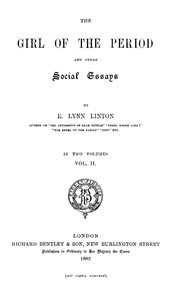
The Girl of the Period, and Other Social Essays, Vol. 2 (of 2) — Context and Discussion
(0 User reviews)
2246
Project Gutenberg
2012
Not confirmed
Women; Girls
Readers of public-domain and historical texts
Project Gutenberg digital edition
en
Edition facts
Words
88,188
Reading time
384 min
Text sections
8
The catalog record for The Girl of the Period, and Other Social Essays, Vol. 2 (of 2) — Context and Discussion provides practical reading context through 88,188 words, 6 hr 24 min estimated reading time, and 8 detected text sections.
The text analysis averages about 34.7 words per sentence, while the detected sections provide another way to judge how the source is divided.
Project Gutenberg metadata also associates the work with “Women,” connecting these edition facts with the source record’s subject description.
Source:
Project Gutenberg record #41736
This second volume of E. Lynn Linton's collected Saturday Review essays dissects late-Victorian social types—gushing men, modern man-haters, shrieking sisterhood—through sharp, aphoristic prose. The excerpts reveal a consistent rhetorical strategy: contrasting idealized masculine restraint with what Linton sees as contemporary failures in both sexes.
Editorial Edition Score
4.8/5
★★★★★
★★★★★
Calculated from edition completeness, EPUB availability, text structure and catalogue metadata. Not a user rating.
How this score is calculated
- Description quality20 pts
- Title & short description10 pts
- Source metadata20 pts
- Text length15 pts
- Chapters / structure15 pts
- EPUB file integrity20 pts
Total of 100 points, scaled to a 2.5-5.0 range. Editions with an empty description or a missing EPUB file are not scored.
Edition quality
Read the Text
hurch was cursed. Feeling and emotion and imagination do all the work of the world according to him; and when he is asked to reason and to demonstrate, he answers, with the lofty air of one secure of the better way, that he Loves, and that Love sees further and more clearly than reason.
As the strong-minded woman is a mistake among women, so is the gushing man among men. Fluid, unstable, without curb to govern or rein to guide, he brings into the masculine world all the mental frailties of the feminine, and adds to them the force of his own organization as a man. Whatever he may be he is a disaster; and at all times is associated with failure. He is the revolutionary leader who gets up abortive risings--the schemer whose plans run into sand--the poet whose books are read only by schoolgirls, or lie on the publisher's shelves uncut, as his gushingness bubbles over into twaddle or exhales itself in the smoke of obscurity--the fanatic whose faith is more madness than philosophy--the man of society who is the butt of his male companions and the terror of his lady acquaintances--the father of a family which he does his best, unintentionally, to ruin by neglect, which he calls nature, or by eccentricity of training, which he calls faith--and the husband of a woman who either worships him in blind belief, or who laughs at him in secret, as heart or head preponderates in her character. In any case he is a man who never finds the fitting time or place; and who dies as he has lived, with everything about him incomplete.
A vast amount of poetry has always been thrown round that special time of a woman's life when,
Standing with reluctant feet Where the brook and river meet,
she is no longer a child and yet not quite a woman--that transition time between the closed bud and the full-blown flower which we in England express by the term, among others, of Sweet Seventeen. Without meaning to be sentimental, or to envelope things in a golden haze wrought by the imagination only and nowhere to be found in fact, we cannot deny the peculiar charm which belongs to a girl of this age, if she is nice, and neither pert nor silly. Besides, it is not only what she is that interests us, but what she will be; for this is the time when the character is settling into its permanent form, so that the great thought of every one connected with her is, How will she turn out? Into what kind of woman will the girl develop? and, What kind of life will she make for herself?
Certainly Sweet Seventeen may be a most unlovely creature, and in fact she often is; a creature hard and forward, having lost the innocence and obedience of childhood and having gained nothing yet of the tact and grace of womanhood; a creature whose hopes and thoughts are all centred on the time when she shall be brought out and have her fling of flirting and fine dresses with the rest. Or she may be only a gauche and giggling schoolgirl, with a mind as narrow as her life, given up to the small intrigues and scandals of the dormitory and the playground--a girl who scamps her lessons and cheats her masters; whose highest efforts of intellect are shown in the cleverness with which she can break the rules of the establishment without being found out; who thinks talking at forbidden times, peeping through forbidden windows, giving silly nicknames to her companions and teachers, and telling silly secrets with less truth than ingenuity in them, the greatest fun imaginable, and all the greater because of the spice of rebellion and perversity with which her folly is dashed. Or she may be a mere tomboy, regretting her sex and despising its restraints; cultivating schoolboy slang and aping schoolboy habits; ridiculing her sisters and disliked by her companions, while thinking girlhood a bore and womanhood a mistake in exact proportion to its feminality. Or she may be a budding miss, shy and awkward, with no harm in her and as little good--a mere sketch of a girl, without a leading line as yet made out or the dominant colour so much as indicated.
The opening essay, “Gushing Men,” immediately establishes Linton’s method: she takes a familiar feminine stereotype and applies it to men, arguing that the “gushing man” is “the furthest possible removed from the ordinary manly ideal.” She invokes literary touchstones—Jane Eyre’s Rochester, Goethe and Bettina—to define what women supposedly want, then measures actual men against that standard. The tone is brisk, opinionated, and laced with irony.
Throughout the volume, Linton returns to a core anxiety: that women are abandoning traditional feminine virtues while men fail to embody the strength and restraint she admires. The excerpts from “Modern Man-Haters” and “The Shrieking Sisterhood” extend this critique, portraying women who “ascribe to her own sex every good quality under heaven” and treat husbands as “enemy ex officio.” Linton’s voice is consistent—censorious, witty, and grounded in social observation rather than narrative.
The Rhetoric of Contrast
Linton’s essays rely on a recurring structural device: she sets up an ideal—often a masculine ideal of “calm, grave, restrained” strength—and then contrasts it with a contemporary failing. In “Gushing Men,” the ideal is drawn from women’s own imaginations: “Greathearts with an eye cast Mercywards” or “Goethes with one weak corner left for Bettina.” The failure is the gushing man, who lacks “ballast.” In “Modern Man-Haters,” the contrast is between the “pretty, frail, delicate woman” who accuses men of “the meaner and more cowardly class of faults” and the implied ideal of mutual respect. This pattern of antithesis gives each essay a clear argumentative spine, even when the evidence is purely anecdotal.
A Vocabulary of Disapproval
Linton’s diction is precise and often withering. She describes the gushing man as “all heart and no brains, all impulse and no ballast.” The modern man-hater “ascribes to her own sex every good quality under heaven” and “robs men of their inborn characteristics that she may deck her own sex with their spoils.” The “shrieking sisterhood” is a label that recurs, and Linton uses “nasty subject” to dismiss causes she disapproves of. She favors concrete, almost physical metaphors: “ballast,” “spoils,” “heavy end of the stick.” This language reinforces her authority as a social commentator who sees through pretension.
The Implied Reader and the Target
Linton writes as if addressing a like-minded audience that shares her assumptions about natural gender roles. She uses “we” and “us” to include the reader: “The picture of a gushing creature … is familiar to most of us.” The targets are clearly defined: the gushing man, the man-hating woman, the “shrieking sisterhood.” But she also critiques women who “would rather have brutality with love than no love at all,” suggesting a broader dissatisfaction with contemporary manners. The essays are not neutral descriptions but polemics, and the reader is positioned to nod along—or to resist.
What the Excerpts Leave Unsaid
The excerpts cover only the opening of “Gushing Men” and a portion of “Modern Man-Haters.” We do not see how Linton develops her arguments across a full essay, nor do we have examples from the many other pieces listed in the contents—such as “Sweet Seventeen,” “The Habit of Fear,” or “Hotel Life in England.” The volume’s subtitle, “Reprinted, by permission, from the Saturday Review,” indicates these were periodical pieces, likely intended to provoke immediate reaction. Without the complete essays, we cannot assess whether Linton offers solutions or merely diagnoses. The excerpts suggest a consistent, conservative viewpoint, but the range of topics hints at a broader social survey.
Readers approaching this volume should treat each essay as a self-contained argument, not a chapter in a developing narrative. Linton’s voice is consistent, but her targets vary widely—from gushing men to shrieking sisterhood to hotel life. Pay attention to her use of contrast and her precise, often cutting vocabulary. The excerpts give a clear sense of her method, but the full range of her social criticism can only be grasped by reading the complete essays. This is a book to be sampled and argued with, not swallowed whole.
Some evenings, when I tire of noise, I recall how Linton’s sharp-eyed exasperation—her grid of proprieties—mirrors the quiet fury of Ruskin’s economics, both weary of a world pretending sentiment can be purchased. Their kinship isn’t agreement but shared sorrow. I keep Unto This Last, and Other Essays on Political Economy — A Reader’s Guide near her second volume, like two stern old friends who only speak through me.
There are no reviews for this eBook.
There are no comments for this eBook.
Reader reflection
How did this book work for you?
Your answers remain private and are stored only in this browser.
Your progress
0
/
10
2
How much did you enjoy the reading experience?
3
Would you recommend this book to another reader?
4
Did the language feel accessible?
5
Is this a title worth rereading?
6
Was the book easy to understand?
7
How useful were the ideas in this book?
8
What did you think about the pace?
9
Which lesson or insight stayed with you?
10