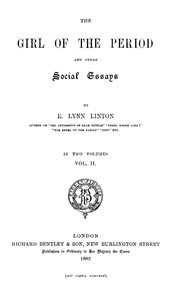
The Girl of the Period, and Other Social Essays, Vol. 2 (of 2) — Context and Discussion

(9 User reviews)   2211
Linton, E. Lynn (Elizabeth Lynn), 1822-1898 Project Gutenberg 2012 Not confirmed
Women; Girls Readers of public-domain and historical texts
Project Gutenberg digital edition en

Edition facts

Words 88,188
Reading time 384 min
Text sections 8

The catalog record for The Girl of the Period, and Other Social Essays, Vol. 2 (of 2) — Context and Discussion provides practical reading context through 88,188 words, 6 hr 24 min estimated reading time, and 8 detected text sections.

The text analysis averages about 34.7 words per sentence, while the detected sections provide another way to judge how the source is divided.

Project Gutenberg metadata also associates the work with “Women,” connecting these edition facts with the source record’s subject description.

This second volume of E. Lynn Linton's collected Saturday Review essays dissects late-Victorian social types—gushing men, modern man-haters, shrieking sisterhood—through sharp, aphoristic prose. The excerpts reveal a consistent rhetorical strategy: contrasting idealized masculine restraint with what Linton sees as contemporary failures in both sexes.
Share
Editorial Edition Score 4.8/5

Calculated from edition completeness, EPUB availability, text structure and catalogue metadata. Not a user rating.

How this score is calculated
  • Description quality20 pts
  • Title & short description10 pts
  • Source metadata20 pts
  • Text length15 pts
  • Chapters / structure15 pts
  • EPUB file integrity20 pts

Total of 100 points, scaled to a 2.5-5.0 range. Editions with an empty description or a missing EPUB file are not scored.

Edition quality

Read the Text

hurch was cursed. Feeling and emotion and imagination do all the work of the world according to him; and when he is asked to reason and to demonstrate, he answers, with the lofty air of one secure of the better way, that he Loves, and that Love sees further and more clearly than reason.

As the strong-minded woman is a mistake among women, so is the gushing man among men. Fluid, unstable, without curb to govern or rein to guide, he brings into the masculine world all the mental frailties of the feminine, and adds to them the force of his own organization as a man. Whatever he may be he is a disaster; and at all times is associated with failure. He is the revolutionary leader who gets up abortive risings--the schemer whose plans run into sand--the poet whose books are read only by schoolgirls, or lie on the publisher's shelves uncut, as his gushingness bubbles over into twaddle or exhales itself in the smoke of obscurity--the fanatic whose faith is more madness than philosophy--the man of society who is the butt of his male companions and the terror of his lady acquaintances--the father of a family which he does his best, unintentionally, to ruin by neglect, which he calls nature, or by eccentricity of training, which he calls faith--and the husband of a woman who either worships him in blind belief, or who laughs at him in secret, as heart or head preponderates in her character. In any case he is a man who never finds the fitting time or place; and who dies as he has lived, with everything about him incomplete.

A vast amount of poetry has always been thrown round that special time of a woman's life when,

Standing with reluctant feet Where the brook and river meet,

she is no longer a child and yet not quite a woman--that transition time between the closed bud and the full-blown flower which we in England express by the term, among others, of Sweet Seventeen. Without meaning to be sentimental, or to envelope things in a golden haze wrought by the imagination only and nowhere to be found in fact, we cannot deny the peculiar charm which belongs to a girl of this age, if she is nice, and neither pert nor silly. Besides, it is not only what she is that interests us, but what she will be; for this is the time when the character is settling into its permanent form, so that the great thought of every one connected with her is, How will she turn out? Into what kind of woman will the girl develop? and, What kind of life will she make for herself?

Certainly Sweet Seventeen may be a most unlovely creature, and in fact she often is; a creature hard and forward, having lost the innocence and obedience of childhood and having gained nothing yet of the tact and grace of womanhood; a creature whose hopes and thoughts are all centred on the time when she shall be brought out and have her fling of flirting and fine dresses with the rest. Or she may be only a gauche and giggling schoolgirl, with a mind as narrow as her life, given up to the small intrigues and scandals of the dormitory and the playground--a girl who scamps her lessons and cheats her masters; whose highest efforts of intellect are shown in the cleverness with which she can break the rules of the establishment without being found out; who thinks talking at forbidden times, peeping through forbidden windows, giving silly nicknames to her companions and teachers, and telling silly secrets with less truth than ingenuity in them, the greatest fun imaginable, and all the greater because of the spice of rebellion and perversity with which her folly is dashed. Or she may be a mere tomboy, regretting her sex and despising its restraints; cultivating schoolboy slang and aping schoolboy habits; ridiculing her sisters and disliked by her companions, while thinking girlhood a bore and womanhood a mistake in exact proportion to its feminality. Or she may be a budding miss, shy and awkward, with no harm in her and as little good--a mere sketch of a girl, without a leading line as yet made out or the dominant colour so much as indicated.

Sometimes she is awkward in another way, being studious and preoccupied--when she passes for odd and original, and is partly feared, partly disliked, and wholly misunderstood by her own young world; and sometimes she has a cynical contempt for men and beauty and pleasure and dress, when she will make herself ridiculous by her revolt against all the canons of good taste and conventionality. But after her _début_ in tattered garments of severe colours and ungainly cut, she will probably end her days as a frantic Fashionable, the salvation of whose soul depends on the faultless propriety of her wardrobe. The eccentricities of Sweet Seventeen not unfrequently revenge themselves by an exactly opposite extravagance of maturity. But though there are enough and to spare of girls according to all these patterns, the Sweet Seventeen of one's affections is none of them. And yet she is not always the same, but has her different presentations, her varying facets, which give her variety of charm and beauty.

The best and loveliest thing about Sweet Seventeen is her sense of duty--for the most part a new sense. She no longer needs to be told what to do; she has not to be kept to her tasks by the fear of authority nor the submissive grace of obedience; but of her own free will, because understanding that it is her duty and that duty is a holier thing than self-will, she conscientiously does what she does not like to do, and cheerfully gives up what she desires without being driven or exhorted. She has generally before her mind some favourite heroine in a girl's novel, who goes through much painful discipline and comes out all the brighter for it in the end; and she makes noble resolves of living as worthily as her model. She comforts her soul too, with passages from Longfellow and Tennyson and the 'Christian Year,' and learns long extracts from 'Evangeline' and the 'Idyls;' poetry having an almost magical influence over her, nearly as powerful as the Sunday sermons to which she listens so devoutly and tries so patiently to understand. For the first time she wakes to a dim sense of her own individuality, and confesses to herself that she has a life of her own, apart from and extraneous to her mere family membership. She is not only the sister or the daughter living with and for her parents or her brothers and sisters, but she is also herself, with a future of her own not to be shared with them, not to be touched by them. And she begins to have vague dreams of this future and its hero--dreams that are as much of fairyland as if they were of the young prince coming over the sea in a golden boat to find the princess in a tower of brass waiting for him.

Quite impersonal, and with a hero only in the clouds, nevertheless these dreams are suggested by the special circumstances of her life, by her favourite books or the style of society in which she has been placed. The young prince is either a beautiful and high-souled clergyman--not unlike the young vicar or the new curate, but infinitely more beautiful--an apostle in the standing collar and single-breasted coat of the nineteenth century; or he is an artist in a velvet blouse and with flowing hair, living in a world of beauty such as no Philistine can imagine; or he is a gallant sailor, with blue eyes and a loose necktie, looking up to heaven in a gale, and thinking of his mother and sisters at home and of the one still more beloved, when he certainly ought to be thinking of tarry ropes and coarse sailcloth; or he is a magnificent young officer heading his men at a charge, and looking supremely well got up and handsome. This is the kind of _futur_ she dreams of when she dreams at all, which is not often. The reality of her mature life is perhaps a stolid square-set squire, or a prosaic city merchant without the thinnest thread of romance in his composition; while her own life, which was to be such a lovely poem of graceful usefulness and heroic beauty, sinks into the prosaic routine of housekeeping and society, the sigh after the vanished ideal growing fainter and fainter as the weight of fact grows heavier.

Married men are all sacred to Sweet Seventeen when she is a good girl; so are engaged men. For the matter of that, she believes that nothing could induce her to marry either a widower or one who had been already engaged, as nothing could induce her to marry any man under five foot eleven, or with a snub nose or sandy whiskers. Sweet Seventeen has in general the most profound aversion for boys. To be sure she may have her favourites--very few and very seldom; but she mostly thinks them stupid or conceited, and impartially resents either their awkward attentions to herself or their assumptions of superiority. An abnormally clever boy--the Poet-Laureate or George Stephenson of his generation--is her detestation, because he is odd and unlike every one else; while the one that she dislikes least among them is the school hero, who is first in the sports and takes all the prizes, and who goes through life loved by every one and never famous.

For her several brothers she has a range of entirely different feelings. Her younger schoolboy brothers she regards as the torments of her existence, whose unkempt hair, dirty boots and rude manners are her special crosses, to be borne with patience, tempered by an active endeavour after reform. But the more advanced, and those who are older than herself, are her loves for whom she has an enthusiastic admiration, and whose future she believes in as something specially brilliant and successful. If only slightly older or younger than herself, she impresses them powerfully with the sentiment of her superiority, and patronizes them--kindly enough; but she makes them feel the ineffable supremacy of her sex, and how that she by virtue of her womanhood is a glorified creature beside them--an Ariel to their Caliban.

Now too, she begins to speak to her mother on more equal terms; to criticize her dress, and to make her understand that she considers her old-fashioned and inclined to be dowdy. She ties her bonnet-strings for her; arranges her cap; smartens up her old dress and compels her to buy a new one; and, while considering her immeasurably ancient, likes her to look nice, and thinks her in her own way beautiful. Sometimes she opposes and quarrels with her, if the mother has less tact than arbitrariness. But this is not her natural state; for one of the characteristics of Sweet Seventeen is her love for her mother and her need of better counsel and guidance; so that if she comes into opposition with her it is only through extreme pain, and the bitter teaching of tyranny and injustice. This is just the age indeed, when the mother's influence is everything to a girl; and when a silly, an unjust, or an unprincipled woman is the very ruin of her life. But with a low or evil-natured mother we seldom see a Sweet Seventeen worth the trouble of writing about: which shows at least one thing--the importance of the womanly influence at such a time, and how so much that we blame in our modern girls lies to the account of their mothers.

Great tact is required with Sweet Seventeen in such society as is allowed her; care to bring her out a little without obtruding her on the world, without making her forward and consequential, and without attracting too much attention to her. She is no longer a child to be shut away in the nursery, but she is not yet entitled to the place and consideration of a member of society. And yet it would be cruel to debar her wholly from all that is going on in the house. To be sure there is the governess, as well as mamma, to look after her manners and to give her rope enough and not too much; but by the time a girl is seventeen a governess has ceased to be the autocrat _ex officio_, and she obeys her or not according to their respective strengths. Still, the governess or mamma is for the most part at her elbow; and Sweet Seventeen, if well brought up, is left very little to her own guidance, and sees the world only through half-opened doors.

Girls of this age are often wonderfully sad, and full of a kind of wondering despair at the sin and misery they are beginning to learn. They take up extreme views in religion and talk largely on the nothingness of pleasure and the emptiness of the world; and many fair young creatures whom their elders, laden with sorrowful experience, think full of hope and joy, are ready to give up all the pleasure of life, and to lay down life itself, for very disgust of that of which they know nothing. They delight in sorrowful lamentations and sentimental regrets put into rhyme; and one of the funniest things in the world is to see a girl dancing with the merriest in the evening, and to hear her talking broken-hearted pessimism in the morning. It is merely an example of the old proverb about the meeting of extremes; vacuity leading to the same results as experience.

But however she takes this unknown life, it is always in an unreal and romantic aspect. Some of more robust mind delight in the bolder stories of Greece and Rome, and wish they had played a part in the sensational heroism of those grand old times; while others go to Venice, and make pictures for themselves out of the gliding gondolas and the mysterious Council of Ten, the lovely ladies with grim old fathers and high-handed brothers acting as gaolers, and the handsome cavaliers serenading them in the moonlight. That is their idea of love. They have no perception of anything warmer. It is all romance and poetry, and tender glances from afar, and long and patient wooing under difficulties and a little danger, with scarce a word spoken, and nothing more expressive than a flower furtively given, or a fleeting pressure of the finger tips. They know nothing else and expect nothing else. Their cherry is without stone, their bird without bone, their orange without rind, as in the old song; and they imagine a love as unreal as all the rest.

When thrown into actualities, though--say when left motherless, and the eldest girl of perhaps a large family with a father to comfort and a young brood to see after--Sweet Seventeen is often very beautiful in her degree, and rises grandly to her position. Sometimes the burden of her responsibilities is too much for her tender shoulders, and she is overweighted, and fails. Sometimes too she is tyrannical and selfish in such a position, and uses her power ill; and sometimes she is careless and good-humoured, when they all scramble up together, through confusion, dirt and disorder, till the close time is over, and they scatter themselves abroad. Sometimes she is a martyr, and makes herself and every one else uncomfortable by the perpetual demonstration of her martyrdom, and how she considers herself sacrificed and put upon. Indeed she is not unfrequently a martyr from other causes than heavy duties, being fond of adopting unworkable views which cannot run in the family groove anyhow. If she falls upon this rock she is in her glory; youth being marvellously proud of voluntary crucifixion, and thinking itself especially ill-used because it must be made conformable and is prevented from making itself ridiculous.

But Sweet Seventeen is intolerant of all moral differences. What she holds to be right is the absolute, the one sole and only just law; and she thinks it tampering with sin to allow that any one else has an equal right with herself to a contrary opinion. But on the whole she is a pleasant, loveable interesting creature; and one's greatest regret about her is that she is so often in the hands of unsuitable guides, and that her powers and noble impulses get so stunted and shadowed by the commonplace training which is her general lot, and the low aims of life which are the only ones held out to her.

The mind, like the body, contracts tricks and habits which in time become automatic and involuntary--habits of association, tricks of repetition, of which the excess is monomania, but which, without attaining to quite that extreme, become more or less masters of the brain and directors of the thoughts. And, of all these tricks of the mind, the habit of fear is the most insidious and persistent. It is seldom that any one who has once given in to it is able to clear himself of it again. However unreasonable it may be, the trick clings, and it would take an exceptionally strong intellect to be convinced of its folly and learn the courage of common-sense. But this is just the intellect which does not allow itself to contract the habit in the beginning; a coward being for the most part a washy, weak kind of being, with very little backbone anyhow. We do not mean by this fear that which is physical and personal only, though this is generally the sole idea which people have of the word; but moral and mental cowardice as well. Personal fear indeed, is common enough, and as pitiable as it is common; and we are ashamed to say that it is not confined to women, though naturally it is more predominant with them than with men.

As for women, the tyranny of fear lies very heavy on them, taking the flavour out of many a life which else would be perfectly happy; being often the only bitter drop in a cup full of sweetness. But how bitter that drop is!--bitter enough to destroy all the sweetness of the rest. Some women live in the perpetual presence of dread, both mental and personal. It surrounds them like an atmosphere; it clothes them like a garment; day by day, and from night to morning, it dogs their steps and sits like a nightmare on their hearts; it is their very root work of sensation, and they could as soon live without food as live without fear.

Ludicrous as many of their terrors are, we still cannot help pitying these poor self-made martyrs of imaginary danger. Take that most familiar of all forms of fear among women, the fear of burglars, and let us imagine for a moment the horror of the life which is haunted by a nightly dread--by a terror that comes with as unfailing regularity as the darkness--and measure, if we can, the amount of anguish that must be endured before death comes to take off the torture. There are many women to whom night is simply this time of torture, never varying, never relieved. They dare not lock their doors, because then they would be at the mercy of the man who sooner or later is to come in at the window; and if they hear the boards creak or the furniture crack they are in agonies because of the man who they are sure is in the house, and who will come in at the door. They cannot sleep if they have not looked all about the room--under the bed, behind the curtains, into the closet, where perhaps a dress hanging a little fantastically gives them a nervous start that lasts for the night.

The opening essay, “Gushing Men,” immediately establishes Linton’s method: she takes a familiar feminine stereotype and applies it to men, arguing that the “gushing man” is “the furthest possible removed from the ordinary manly ideal.” She invokes literary touchstones—Jane Eyre’s Rochester, Goethe and Bettina—to define what women supposedly want, then measures actual men against that standard. The tone is brisk, opinionated, and laced with irony.

Throughout the volume, Linton returns to a core anxiety: that women are abandoning traditional feminine virtues while men fail to embody the strength and restraint she admires. The excerpts from “Modern Man-Haters” and “The Shrieking Sisterhood” extend this critique, portraying women who “ascribe to her own sex every good quality under heaven” and treat husbands as “enemy ex officio.” Linton’s voice is consistent—censorious, witty, and grounded in social observation rather than narrative.

The Rhetoric of Contrast

Linton’s essays rely on a recurring structural device: she sets up an ideal—often a masculine ideal of “calm, grave, restrained” strength—and then contrasts it with a contemporary failing. In “Gushing Men,” the ideal is drawn from women’s own imaginations: “Greathearts with an eye cast Mercywards” or “Goethes with one weak corner left for Bettina.” The failure is the gushing man, who lacks “ballast.” In “Modern Man-Haters,” the contrast is between the “pretty, frail, delicate woman” who accuses men of “the meaner and more cowardly class of faults” and the implied ideal of mutual respect. This pattern of antithesis gives each essay a clear argumentative spine, even when the evidence is purely anecdotal.

A Vocabulary of Disapproval

Linton’s diction is precise and often withering. She describes the gushing man as “all heart and no brains, all impulse and no ballast.” The modern man-hater “ascribes to her own sex every good quality under heaven” and “robs men of their inborn characteristics that she may deck her own sex with their spoils.” The “shrieking sisterhood” is a label that recurs, and Linton uses “nasty subject” to dismiss causes she disapproves of. She favors concrete, almost physical metaphors: “ballast,” “spoils,” “heavy end of the stick.” This language reinforces her authority as a social commentator who sees through pretension.

The Implied Reader and the Target

Linton writes as if addressing a like-minded audience that shares her assumptions about natural gender roles. She uses “we” and “us” to include the reader: “The picture of a gushing creature … is familiar to most of us.” The targets are clearly defined: the gushing man, the man-hating woman, the “shrieking sisterhood.” But she also critiques women who “would rather have brutality with love than no love at all,” suggesting a broader dissatisfaction with contemporary manners. The essays are not neutral descriptions but polemics, and the reader is positioned to nod along—or to resist.

What the Excerpts Leave Unsaid

The excerpts cover only the opening of “Gushing Men” and a portion of “Modern Man-Haters.” We do not see how Linton develops her arguments across a full essay, nor do we have examples from the many other pieces listed in the contents—such as “Sweet Seventeen,” “The Habit of Fear,” or “Hotel Life in England.” The volume’s subtitle, “Reprinted, by permission, from the Saturday Review,” indicates these were periodical pieces, likely intended to provoke immediate reaction. Without the complete essays, we cannot assess whether Linton offers solutions or merely diagnoses. The excerpts suggest a consistent, conservative viewpoint, but the range of topics hints at a broader social survey.

Readers approaching this volume should treat each essay as a self-contained argument, not a chapter in a developing narrative. Linton’s voice is consistent, but her targets vary widely—from gushing men to shrieking sisterhood to hotel life. Pay attention to her use of contrast and her precise, often cutting vocabulary. The excerpts give a clear sense of her method, but the full range of her social criticism can only be grasped by reading the complete essays. This is a book to be sampled and argued with, not swallowed whole.

Some evenings, when I tire of noise, I recall how Linton’s sharp-eyed exasperation—her grid of proprieties—mirrors the quiet fury of Ruskin’s economics, both weary of a world pretending sentiment can be purchased. Their kinship isn’t agreement but shared sorrow. I keep Unto This Last, and Other Essays on Political Economy — A Reader’s Guide near her second volume, like two stern old friends who only speak through me.

Mila Thompson
1 week ago

Michael Adams
1 week ago

Amelia Rodriguez
4 weeks ago

Madison Lopez
1 week ago

Lucas White
2 weeks ago

5
5 out of 5 (9 User reviews )

Add a Review

Your Rating *
  • ...
    Shannon Baker - 1 month ago
    The Girl of the Period and Other Social Essays, Vol. 2, is a tedious read. The essays are repetitive and overly verbose, making the same points over and over. The author's views are often narrow and moralizing, and the relevance to modern readers is limited. The writing feels antiquated, and the lack of contextual notes makes it hard to fully appreciate the nuances. Overall, it’s a forgettable collection that fails to engage.

  • ...
    Kelly Villegas - 1 week ago
    This second volume of essays offers a compelling look at Victorian social norms, particularly regarding women. The author's arguments are well-reasoned and often ahead of their time. However, some essays feel repetitive, covering similar ground, and the language can be dated in places. It's an insightful read for history enthusiasts, but general readers might find it a bit dense. Worth reading for the historical perspective.

  • ...
    Jose Frye - 6 days ago
    The Girl of the Period and Other Social Essays, Vol. 2, is a fascinating and thought-provoking collection that provides a sharp critique of Victorian society. The author's essays are witty, bold, and surprisingly relevant today, challenging gender norms and social hypocrisy with incisive observations. The writing is engaging and accessible, making complex social issues easy to understand. This volume is a valuable piece of social history and a must-read for anyone interested in feminist literature or Victorian culture. Highly recommended.


Reader reflection

How did this book work for you?

Your answers remain private and are stored only in this browser.

Your progress 0 / 10
1

Have you finished this book?

2

How much did you enjoy the reading experience?

3

Would you recommend this book to another reader?

4

Did the language feel accessible?

Related eBooks