
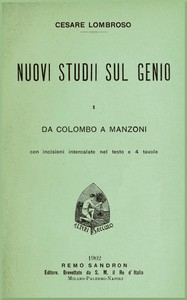
Nuovi studii sul genio vol. I (da Colombo a Manzoni) by Cesare Lombroso
Let's be clear: this isn't a novel. There's no plot in the traditional sense. Instead, think of it as a detective's case file, where the detective is a 19th-century scientist and the suspects are some of history's greatest minds.
The Story
Cesare Lombroso, a famous criminologist, had a theory that genius was a form of 'degeneracy' linked to epilepsy and madness. He thought it was a biological trait you could see in a person's body. In this book, he puts his theory to the test. He combs through the biographies, portraits, and even the autopsy reports of famous Italians. He measures skull shapes from busts, analyzes handwriting for oddities, and catalogs every reported illness and eccentric behavior. For Lombroso, a strange-looking head or a history of migraines wasn't just a footnote—it was proof of his grand idea. Each chapter is like a profile, building his evidence piece by piece.
Why You Should Read It
I found this book utterly captivating, but not for the reasons Lombroso intended. You don't read it to learn about genius. You read it to watch a very smart, very determined man build an entire castle on sand. His methods are shocking by today's standards—full of bias, wild leaps in logic, and cherry-picked facts. It's a masterclass in how confirmation bias works. Yet, you can feel his genuine passion. He truly believed he was uncovering a great scientific truth. That tension—between his obvious intellect and his deeply flawed conclusions—is what makes it so compelling. It's a humbling reminder that even our best ideas can look foolish in hindsight.
Final Verdict
This book is not for everyone. It's a dense, academic text from another century. But if you're a history or psychology nerd who loves a good intellectual puzzle, it's a gem. It's perfect for readers interested in the history of science, the roots of criminology, or how society has tried to define 'abnormality.' Approach it not as a source of truth, but as a fascinating historical artifact. Read it to understand a moment in time when people thought they could measure greatness with a ruler, and to appreciate just how far we've come (and how careful we need to be) in our own thinking.
Patricia Perez
6 months agoUsed this for my thesis, incredibly useful.
Melissa Miller
1 year agoI was skeptical at first, but the author's voice is distinct and makes complex topics easy to digest. Highly recommended.
Mary Ramirez
6 months agoEnjoyed every page.
Charles Smith
1 year agoSurprisingly enough, the content flows smoothly from one chapter to the next. Exceeded all my expectations.

Nancy Smith
1 month agoEnjoyed every page.