
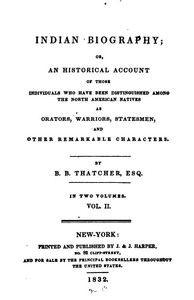
Indian Biography; Vol. 2 (of 2) by B. B. Thatcher
Let's be clear from the start: this is not a novel. 'Indian Biography, Vol. 2' is a collection of life stories, written in the 1830s, focusing on prominent Native American leaders from the 17th to early 19th centuries. B.B. Thatcher acts as a compiler and narrator, pulling from earlier histories, official documents, and firsthand accounts to build these portraits.
The Story
The book doesn't have a single plot. Instead, it's a series of deep dives into individual lives. You'll follow the devastating war led by Metacom (King Philip) in New England, a conflict that nearly pushed the colonists back into the sea. You'll witness the genius of Pontiac, who united numerous tribes in a massive, coordinated uprising against the British after the French and Indian War. Later, you meet Tecumseh and his brother Tenskwatawa (The Prophet), who tried to forge a pan-tribal confederacy to resist American expansion in the early 1800s. Thatcher traces their rise, their diplomatic and military strategies, their moments of triumph, and their ultimate defeats. The narrative thread connecting them all is the relentless pressure of westward expansion and the struggle to maintain sovereignty and way of life.
Why You Should Read It
What struck me most was the immediacy of Thatcher's perspective. He was writing while many of these events were still within living memory, and while the U.S. government was actively removing tribes from the Southeast via the Trail of Tears. His tone isn't that of a detached, modern historian. You can feel his admiration for his subjects' courage and his frustration with the bad faith and broken treaties of the American government. He presents these leaders as eloquent, politically savvy, and tragically outmatched. Reading this 19th-century account forces you to confront how these conflicts were understood by people closer to them in time. It adds a raw, human layer to historical figures who are often just names in a textbook.
Final Verdict
This is a perfect read for history lovers who want to go beyond the standard narrative. It's for anyone who has wondered about the 'other side' of stories like the Pilgrims' survival or the settlement of the Ohio Valley. Be prepared for 19th-century prose—it's elegant but denser than modern writing. It's not a light read, but it is a profoundly rewarding one. Think of it as sitting down with an intelligent, passionate, and surprisingly fair-minded writer from 1830, and letting him introduce you to some of the most formidable and fascinating figures in American history, on their own terms.

Melissa Harris
1 year agoPerfect.