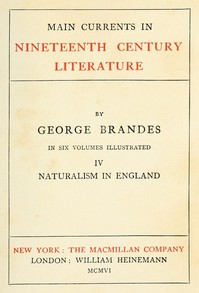
Main Currents in Nineteenth Century Literature - 4. Naturalism in England — Background and Themes
Edition facts
The catalog record for Main Currents in Nineteenth Century Literature - 4. Naturalism in England — Background and Themes provides practical reading context through 132,747 words, 9 hr 38 min estimated reading time, and 14 detected text sections.
The text analysis averages about 26.6 words per sentence, while the detected sections provide another way to judge how the source is divided.
Project Gutenberg metadata also associates the work with “Literature, Modern -- 19th century -- History and criticism,” connecting these edition facts with the source record’s subject description.
Calculated from edition completeness, EPUB availability, text structure and catalogue metadata. Not a user rating.
How this score is calculated
- Description quality20 pts
- Title & short description10 pts
- Source metadata20 pts
- Text length15 pts
- Chapters / structure15 pts
- EPUB file integrity20 pts
Total of 100 points, scaled to a 2.5-5.0 range. Editions with an empty description or a missing EPUB file are not scored.
Read the Text
Napoleon was threatening Europe with a world-wide Empire. To escape annihilation, all the threatened nationalities either instinctively or deliberately re-invigorated themselves from the sources of their national life. The national spirit is awakened and spreads and grows in Germany during the War of Liberation; in Russia it bursts into flames along with the ancient capital of the country; in England it inspires enthusiasm for Wellington and Nelson, and vindicates in bloody battles, from the Nile to Waterloo, the ancient English claim to the sovereignty of the sea; in Denmark the cannonade of the battle of Copenhagen awakens a new national spirit and produces a new literature. It is this patriotic spirit which leads all the different nations to the eager study of their own history and their own customs, their own legends and folk-lore. The devotion to everything national incites to the study and the literary representation of the "people"--that is to say, the lower classes of society, with whom the literature of the eighteenth century had not concerned itself. The reaction against French as a universal language brings even dialect into high repute.
In _Germany_, as we have already seen, patriotism led to enthusiasm for the country's past, for the Middle Ages--their faith, their superstitions, and their social order. In _Italy_ we have, in Manzoni's religious verse, an apparent return to Catholicism. The faith which had petrified into dogma, and meant renunciation of the flesh, is upheld as synonymous with poetry and morality; it is transformed from a religion into an art _motif_. Manzoni's religious enthusiasm is the same enthusiasm as that which accompanied the Pope back to Rome and inspired Alexander with the idea of the Holy Alliance. Even _France_, the country which had produced Napoleon, was driven by the spirit of the age into a path leading in much the same direction as that taken by Germany; the new French literary movement was directed against the Academy, against the so-called classical, _i.e._, universal, cosmopolitan literature; the age of Louis XIV. was neglected, and the poets of the sixteenth century, Du Bellay, Ronsard, nay, even the poor grotesque poets whom Boileau had scoffed at and rejected, came into vogue again. (Victor Hugo's attack on the literary opinions of the period previous to his own; Sainte-Beuve's earliest literary criticism; Théophile Gautier's _Les Grotesques_.) In _Denmark_ at the beginning of the century it was mainly in the wake of the German current that men's minds moved. They assumed an antagonistic attitude to French culture. But in the second and equally important stage of the literary movement, the antagonism becomes an antagonism to everything foreign, and more especially to Germany, which had for so long played the part of the oppressor in Denmark.[1]
In _England_ we find the same essential features which distinguish the movement in all the other countries. The influence of France, which in the eighteenth century had been paramount in the upper classes of society, was shaken off. Pope, the last poet of the classical school, did not long remain a master in the eyes of the younger generation. They began to pluck at the little man's elaborate wig and trample over the trim beds of his garden. And now it became apparent what a powerful intellectual reserve force the British nation possessed in those countries which lay remote from the centre of political life, fresh, unexhausted by civilisation. Ireland, which in the eighteenth century had produced such a thinker as Swift and such a writer as Goldsmith, owned a treasury of lovely melodies which, as soon as a great lyric poet lent them words, were poured forth by all the singing throats of Europe. The Welsh collected and published their old songs and poems. And in Scotland, to which country the mean, depressing conditions prevailing among the English industrial classes had not as yet spread, but where a people, proud of its past and its land, preserved its national songs, its superstitions, and its political peculiarities, there appeared in the second half of the eighteenth century, as a protest against cold reason and artificiality in poetry, Macpherson's _Ossian_. The influence of _Ossian_ was alike great upon Alfieri and Foscolo in Italy, upon Herder and Goethe in Germany, and upon Chateaubriand in France. On it follow in England Percy's collection of old English, and in Scotland Walter Scott's collection of Scotch, ballads.
But in the interval between these two publications our attention is demanded by one of those literary currents flowing from one country to another and back again, which it is our chief aim to trace, and which in this case is remarkably plain. Not long after Percy's _Reliques_ appeared, a luckless young German lawyer in Government employ, Bürger by name, was appointed to a small post in Göttingen, where he lived in straitened circumstances and in unhappy and demoralising marital relations with two sisters. Into this man's house Percy's book finds its way. It makes a powerful impression on him, and fires him with the desire to write something which had long been proscribed by the rules of poetical art, but which he himself calls (to Baggesen, see _The Labyrinth_) poetry proper, namely, a ballad. He begins the famous _Lenore_ and works at it slowly, week after week, with such a conviction of the importance of the step he is taking that his letters to his friends are full of nothing else. The ballad appears, and is soon read in every country in Europe. In the year 1795 an Edinburgh young lady introduces it to the notice of another lawyer in Crown employ; and this young man, Walter Scott by name, who was also to be an author, and a very much greater one, makes his literary _début_ with a translation of _Lenore_ and another ballad of Bürger's, _The Wild Huntsman_. His translations meeting with a favourable reception, Scott began to regard himself as a poet. And it was upon the basis of these translations and that of _Götz von Berlichingen_, which he published in 1799, that the national Scottish Romanticism of his poetry was founded.
There is, then, originally in this literature a distinct trace of the general European reaction against the eighteenth century. The strong national feeling which superseded the feeling of cosmopolitanism is to be found in England in Wordsworth in the form of patriotic poetical description, in Southey in the form of eulogy (at times partly, at times purely, official) of the Royal Family and the national exploits, in the Scottish-born Campbell in the form of passionately British songs of liberty and war; whilst Scott and Moore are positive literary personifications of Scotland and Ireland. The universal return to the popular has its chief representative and spokesman in Wordsworth, whose special theme is the life of the lower and lowest classes. The predilection for the Middle Ages is strongest in Scott, who combines the antiquarian's delight in memories and survivals of the past with the Tory politician's desire to represent the traditional in the most attractive light. The Romanticism of superstition finds its poet in Coleridge, whose studied childishness and simplicity are near of kin to Tieck's; and it is Coleridge, too, who, thoroughly imbued with the doctrines of the German philosophy of the day, enters a general scientific protest against those of the age of enlightenment. His philosophy is quite un-English; it is, in contradiction to the experimental nature of English science, purely transcendental; it is conservative, pious, and historical, because the philosophy preceding it had been radical, infidel, and metaphysical; it is a "Schellingism," which at first endeavours to preserve as many of the philosophic conclusions of the preceding century as possible, but which, ever more obstinate and ever more narrow-minded, hastens towards the opposite extreme from that which had proved fatal to the preceding period. The confusedly fantastic side of Romanticism is represented by Southey with his Oriental narrative poems; and as for the passionate, despairing heroes of Chateaubriand and Romanticism generally, we find them, more passionate and more manly, in the works of Byron; whilst Shelley's spiritualism and dissolution of all solid form into ethereal music recalls the ardour and vagueness of Novalis.
[1] This "oppression" was what today would be called "cultural imperialism". It should be remembered that the Danish kings were also German dukes (of Schleswig and Holstein) and very properly patronised German artists. In Denmark proper there was after 1800 a reaction against the German influence. Also Brandes is bitter because of the German annexation of the Danish part of Schleswig in 1864, but that happened half a century later and Denmark was not exactly an innocent victim.--Transcriber's note.
NATIONAL CHARACTERISTICS
But these general and most marked characteristics of the period are modified in a very perceptible manner by certain peculiarly English characteristics, which, observable nowhere else, are to be found in all the English authors of the day, however little resemblance there may be between them in other respects.
These English characteristics can all be traced back to one original distinctive quality, namely vigorous _Naturalism_. As we have observed, the first advance in the new literary movement is the inspiration of the authors of every country by a national spirit. Now in England this meant becoming a Naturalist, just as in Germany it meant becoming a Romanticist, and in Denmark a devotee of the Old-Scandinavian. The English poets, one and all, are observers, lovers, worshippers of nature. Wordsworth, who loves to parade his propensities as ideas, inscribes the word _nature_ on his banner, and paints pictures, grand in spite of their minute detail, of the hills, the lakes, the rivers, and the rustic population of the North of England. Scott's descriptions of nature, based upon close observation, are so accurate that a botanist might acquire a correct idea of the vegetation of the district from them. Keats, with all his devotion to the antique and to Greek mythology, is a sensualist, who, gifted with the keenest, widest, most delicate perceptions, sees, hears, feels, tastes, and inhales all the varieties of glorious colour, of song, of silky texture, of fruit flavour, of flower fragrance, which nature offers. Moore is the personification of spiritualised sensuality; the pampered, pampering poet, he seems to live surrounded by all that is rarest and most beautiful in nature; he dazzles our minds with sunshine, deafens them with the song of the nightingale, drowns them in sweetness; we live with him in endless dreams of wings, flowers, rainbows, smiles, blushes, tears, kisses--always kisses. The strongest tendency even of works like Byron's _Don Juan_ and Shelley's _Cenci_ is in reality Naturalism. In other words, Naturalism is so powerful in England that it permeates Coleridge's Romantic supernaturalism, Wordsworth's Anglican orthodoxy, Shelley's atheistic spiritualism, Byron's revolutionary liberalism, and Scott's interest in the past. It influences the personal beliefs and the literary tendencies of every author.
This realism, so full of sap and vigour, is a result of various strongly-marked and almost universal English characteristics. There is, in the first place, the English love of the country and of the sea. Almost all the English poets of this period are either countrymen or seamen. The English Muse of poetry has from time immemorial frequented the country seat and the farm. Wordsworth's genuinely English poetry is in exact keeping with the well-known paintings and engravings representing English country life, which produce an impression of health and tranquillity, and, when such subjects as family worship or the country clergyman's fatherly ministrations are portrayed, also of piety. Burns, the ploughman poet, Scotland's greatest poetic genius, early dedicated Scottish poetry to the country; and there is truth in Emerson's caustic remark that Scott, in his narrative poems, simply wrote a rhymed guide-book to Scotland. That the same idea had occurred to the poet's own contemporaries is evident from the satirical manner in which Moore writes of Scott's "doing" the one country-seat after the other.[1]
And what an important part country seats play in the lives of two such antipodal literary characters as Byron and Scott! Newstead Abbey is as inseparably connected with Byron's name as Abbotsford is with Sir Walter Scott's. The old abbey, with its medieval and fantastic architecture, is to Byron the indispensable accompaniment of his peerage and the pledge of his English citizenship. He does not dispose of it until he has turned his back on his native land for ever. Scott's proprietorship is not so ancient and venerable; but he buys Abbotsford when the desire to own land, which has always been strong in him, becomes irresistible, and, during the happy period of his life passed there, lives as if he had grown up with no other prospect before him than that of exercising the regal hospitality of an old Scottish landed proprietor and living his hardy out-of-door life. His greatest delight is in such perilous amusements as wading through a raging stream--with a bridge not fifty yards off, riding a horse unmanageable by any one else, spearing salmon by torch-light, soaked with rain or shivering in the cold night air. And is not every reader of Byron's life here reminded of that poet's love of wild rides and daring swimming exploits?
Nevertheless there is in the attitude of the two authors to their estates a difference, characteristic of their different natures. Byron's love for Newstead Abbey had its origin in his aristocratic proclivities, Scott's for Abbotsford in his historic instincts. Just as Sir Walter's estate had Ettrick Forest for its background, Newstead had Sherwood Forest, with its memories of Robin Hood and his merry men. But these memories exercised no perceptible influence on Byron's poetry, though we have an admirable description of the Abbey itself in the Thirteenth Canto of _Don Juan_. The whole of Scott's poetry, on the contrary, is pervaded, as by a refrain, by the memories of Ettrick Forest; and it is Scott, instead of Byron, who (in _Ivanhoe_) brings the poetry of Sherwood Forest to life again.
Another English qualification for Naturalism is the love of the poets for the nobler animals, and their intimacy with the animal world in general. They have that affection for all domestic animals which is a result of their English love of home. When they travel they carry home and their domestic animals with them. Almost all the authors of our period are devoted to manly exercises, and in particular to riding. And in observing this we must not fall into the common error of mistaking a thoroughly national characteristic for a personal and rare one. It is not without its significance that the English race traces its descent from two mystic heroes bearing the names of horses (Hengist and Horsa). The love of horses, dogs, and all kinds of wild animals, which is so often mentioned as a peculiar characteristic of Byron, the misanthropical exile, is quite as marked a characteristic of Scott, living at home in the happiest domestic circumstances. Matthew's well-known letter describing the life at Newstead Abbey shows us Byron, the youth, surrounded by a whole menagerie, including a bear and a wolf; in Medwin's account of the poet's life in Italy we read that he took with him when he left Ravenna in 1821, "seven servants, five carriages, nine horses, a monkey, a retriever, a bull-dog, two cats, three Guinea fowls, and other birds." One is apt to think this an exhibition of purely personal singularity, until one reads, in Lockhart's Life, Scott's own description of the removal to Abbotsford. "The neighbours have been much delighted with the procession of my furniture, in which old swords, bows, targets, and lances made a very conspicuous show. A family of turkeys was accommodated within the helmet of some _preux_ chevalier of ancient Border fame; and the very cows, for aught I know, were bearing banners and muskets. I assure your ladyship that this caravan, attended by a dozen of ragged rosy peasant children, carrying fishing-rods and spears, and leading poneys, greyhounds, and spaniels, would, as it crossed the Tweed, have furnished no bad subject for the pencil." The only difference is that the old curiosity shop of the collector is added to the menagerie. Byron's love for his dog, Boatswain, and the solemn inscription engraved on the stone marking the favourite's grave, are apt to be instanced as signs of the poet's rooted melancholy. But it helps us to a more correct appreciation of such feelings to remember that the cheerful-minded Scott had his favourite dog, Camp, solemnly buried in the garden at Abbotsford, the whole family standing weeping round the grave.
But even more characteristically English than the attachment to horses and dogs and land, and the witness in literature to the same, is the love of the sea. The Englishman is an amphibious animal. A considerable part of the description of nature in the literature of this period is marine painting. It was an ancient tradition, gloriously maintained at this particular time, that England was the mistress of the sea; and English writers have always been the best delineators and interpreters of the sea. There is a breath of its freshness and freedom in all the best poetry of the country. To the Englishman the sea has always been the great symbol of liberty, as the Alps have been to the freedom-loving Swiss. Wordsworth exclaims with truth in one of his _Sonnets Dedicated to Liberty_:--
"Two Voices are there; one is of the Sea, One of the Mountains; each a mighty voice: In both from age to age thou didst rejoice, They were thy chosen music, Liberty!"
We understand, therefore, how it was that the long-dormant Viking spirit re-awoke in the best poets of the country during this remarkable period of English literature. In Coleridge's _Ancient Mariner_ we have all the terror and horror of the sea; Campbell's _Mariners of England_ is an entrancingly melodious and manly glorification of the heroism and might of the English seamen; Byron's Vikinglike expeditions are mirrored in the exploits of Childe Harold and Don Juan; Shelley's passion for the sea and sailing lives and breathes in the billowy rhythm of his verse and in all the poems which extol wind and wave--above all others that masterpiece, the _Ode to the West Wind_.
Transferred to the domain of society, Naturalism becomes, as it did in Rousseau's case, revolutionary; and beneath that attachment to the soil, and that delight in encountering and mastering the fitful humours of the sea, which are the deep-seated causes of Naturalism, there is in the Englishman the still deeper-seated national feeling, which, under the peculiar historical conditions of this period, naturally led the cleverest men of the day in the direction of Radicalism. No nation is so thoroughly penetrated by the feeling of personal independence as England. This is best seen in the Englishman abroad; it is with a flourish of trumpets that he proclaims himself to be an Englishman. It is the transmission of this independence and self-sufficiency to English literature which has at decisive moments made its art a "character-art"; and at the period under consideration it is this peculiar quality which, asserting itself, actually produces the new movement in the literature of Europe. It took an Englishman to do what Byron did, stem alone the stream which flowed from the fountain of the Holy Alliance--in the first place, because only an English author would have had the audacity to do it, in the second, because at that time only English literary men had the strong political tendency and the keen political intelligence which have always distinguished the first, possibly the only, parliamentary nation. And an Englishman, too, was needed to fling the gauntlet boldly and defiantly in the face of his own people. Only in the haughtiest of nations were there to be found great men haughty enough to defy the nation.
Brandes opens by framing the period as a coherent composition shaped by history, despite its many antagonistic authors and schools. He identifies a central current that sweeps away classic forms, producing a naturalism that leads to radicalism and rebellion against religious and political reaction. The analysis moves between poets, contrasting their approaches to nature, love, and liberty.
The excerpts reveal Brandes's method: he juxtaposes Wordsworth's deliberate choice of insignificant or ugly themes to endow them with moral beauty against Moore's recoil from sordid details, his propensity to cast a glittering veil over the ugly. This structural contrast—between the natural and the artificial—recurs throughout the volume.
Contrasting Poetic Strategies
Brandes builds his argument through sharp juxtapositions. He sets Wordsworth, who chooses insignificant or unattractive themes to endow them with moral or spiritual beauty, against Moore, who detests sordid details and evades every moral with a smile. This opposition is not merely stylistic but structural: Wordsworth requires a cultivated taste, while Moore appeals to a nation. Brandes notes that Moore's faults—his inability to draw a whole object, his listing of beauties instead of outlines—stem from his being a musician and colourist, not a draughtsman. Yet in Moore's best poems, like The Last Rose of Summer, the over-abundance of imagery disappears, replaced by simple, imperishable language. The movement from artificial to natural within Moore's own work mirrors the larger arc Brandes traces.
Recurring Images of Veiling and Revelation
Brandes repeatedly uses imagery of veiling and unveiling to describe poetic style. Moore casts a soft, glittering veil over the ugly; his embroidery is so gorgeous it hardly permits nature's cloth to appear. Wordsworth, by contrast, strips away convention to reveal moral beauty in the mundane. This image recurs in Brandes's description of the period itself: a strong current sweeping away classic forms. The veil metaphor extends to Moore's love-poetry, where passion loses itself in simile, and to the broader tension between naturalism and romanticism. Brandes's own prose mirrors this movement, alternating between dense, embroidered passages and stark, simple statements—as when he declares that in Moore's best poems the tinsel is blown away by true Irish melancholy.
Movement Between Scenes and Poets
The volume's structure is itself a movement between scenes: from Wordsworth's rural life to Moore's erotic fancy, from the Lake School's conception of liberty to Byron's passionate personality. Brandes orchestrates these transitions by linking poets through contrast. He moves from Wordsworth and Coleridge, poets for a cultivated public, to Moore, the poet for a nation. The shift is not abrupt but mediated by a shared concern with nature and liberty. Within the Moore section, Brandes pivots from criticism of artificiality to praise of simplicity, using the example of Rich and rare were the gems she wore as a turning point. This choreographed progression gives the volume its coherence, as each poet is positioned within a larger argument about the evolution of naturalism.
The Role of National Character
Brandes repeatedly ties poetic style to national character. Moore is the poet for a nation, his Irish melancholy purging his style of tinsel. Wordsworth and Coleridge, by contrast, require a cultivated taste—a trait Brandes associates with English reserve. The political background, sketched in an early chapter, underpins these distinctions: the Lake School's Oriental romanticism and the poetry of Irish opposition and revolt are not merely literary movements but expressions of national spirit. Brandes's analysis of Moore's love-poetry as embodying erotic fancy rather than passion is framed as a national characteristic, and his praise of Moore's simple songs as having the significance of a national epic reinforces this link. The movement between poets thus becomes a movement between national temperaments, each contributing to the broader current of naturalism.
Brandes's volume rewards readers who attend to its structural contrasts and recurring imagery. Rather than a simple survey, it offers a dialectical argument in which each poet is defined against another. The excerpts hint at a larger pattern: the movement from artificial to natural, from national to universal, from reaction to radicalism. Readers may find it useful to track how Brandes uses specific poems—like Moore's The Last Rose of Summer—as turning points in his narrative, and to observe how his own prose shifts between embroidered and simple registers to mirror his subject.
James Martin
2 weeks agoHow did this book work for you?
Your answers remain private and are stored only in this browser.
Amelia Walker
2 weeks ago