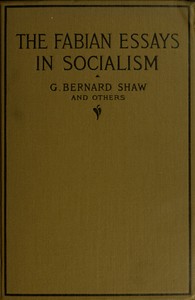
Fabian Essays in Socialism — Reading Companion
Edition facts
For Fabian Essays in Socialism — Reading Companion, the stored edition analysis reports 100,822 words, 7 hr 19 min estimated reading time, and 20 detected text sections.
The text analysis averages about 28.4 words per sentence, while the detected sections provide another way to judge how the source is divided.
Project Gutenberg metadata also associates the work with “Socialism,” connecting these edition facts with the source record’s subject description.
Calculated from edition completeness, EPUB availability, text structure and catalogue metadata. Not a user rating.
How this score is calculated
- Description quality20 pts
- Title & short description10 pts
- Source metadata20 pts
- Text length15 pts
- Chapters / structure15 pts
- EPUB file integrity20 pts
Total of 100 points, scaled to a 2.5-5.0 range. Editions with an empty description or a missing EPUB file are not scored.
Read the Text
had a common object in Democracy.
Besides this common object the two had a common conception of method in revolution. They were both catastrophists. Liberalism had conquered autocracy and bureaucracy by that method in England and France, and then left industry to make what it could of the new political conditions by the unregulated action of competition between individuals. Briefly, the Liberal plan was to cut off the King’s head, and leave the rest to Nature, which was supposed to gravitate towards economic harmonies when not restrained by tyrannical governments. The Socialists were very far ahead of the Liberals in their appreciation of the preponderant importance of industry, even going so far as to maintain, with Buckle and Marx, that all social institutions whatever were imposed by economic conditions, and that there was fundamentally only one tyranny: the tyranny of Capital. Yet even the Socialists had so far formed their political habits in the Liberal school that they were quite disposed to believe that if you cut off the head of King Capital, you might expect to see things come right more or less spontaneously.
No doubt this general statement shews the Revolutionaries of 1848-71 as simpler than they appear on their own records. Proudhon was full of proposals: one of them, the minimum wage, turns out to be of the very first importance now that Mr. and Mrs. Sidney Webb have put the case for it on an invincible basis of industrial fact and economic theory. Lassalle really knew something of the nature of law, the practice of Government, and the mind of the governing classes. Marx, though certainly a bit of a Liberal fatalist (did he not say that force is the midwife of progress without reminding us that force is equally the midwife of chaos, and chaos the midwife of martial law?), was at all events no believer in _Laisser-faire_. Socialism involves the introduction of design, contrivance, and co-ordination, by a nation consciously seeking its own collective welfare, into the present industrial scramble for private gain; and as it is clear that this cannot be a spontaneous result of a violent overthrow of the existing order, and as the Socialists of 1848-71 were not blind, it would be impossible to substantiate a claim for Fabian Essays as the first text-book of Socialism in which catastrophism is repudiated as a method of Socialism.
Therefore we must not say that the Revolutionists and Internationalists of 1848-71 believed in a dramatic overthrow of the capitalist system in a single convulsion, followed by the establishment of a new heaven, a new earth, and a new humanity. They were visionaries, no doubt: all political idealists are; but they were quite as practical as the Conservatives and Liberals who now believe that the triumph of their party will secure the happiness and peace of the country. All the same, it was almost impossible to induce them to speak or think of the Socialist state of the future in terms of the existing human material for it. They talked of Communes, and, more vaguely and less willingly, of central departments to co-ordinate the activities of the Communes; but if you ventured to point out that these apparently strange and romantic inventions were simply city corporations under the Local Government Board, they vehemently repudiated such a construction, and accused you of reading the conditions of the present system into Socialism. They had all the old Liberal mistrust of governments and bureaucracy and all the old tendency of bourgeois revolutionists to idolize the working class. They had no suspicion of the extent to which the very existence of society depends on the skilled work of administrators and experts, or how much wisdom and strength of character is required for their control by popular representatives. They actually believed that when their efforts throughout Europe had demonstrated the economics of Socialism to the proletariats of the great capitals, the cry “Proletarians of all lands: unite,” would be responded to; and that Capitalism would fall before an International Federation of the working classes of Europe, not in the sense in which some future historian will summarize two or three centuries (in which sense they may prove right enough), but as an immediate practical plan of action likely to be carried through in twenty years by Socialist societies holding completely and disdainfully aloof from ordinary politics. In short, they were romantic amateurs, and, as such, were enormously encouraged and flattered when Marx and Engels insisted on the “scientific” character of their movement in contrast to the “Utopian” Socialism of Owen, Fourier, St. Simon, and the men of the 1820-48 phase. When the events of 1871 in Paris tested them practically, their hopeless public incapacity forced their opponents to exterminate them in the most appalling massacre of modern times--all the more ghastly because it was a massacre of the innocents.
Public opinion in Europe was reconciled to the massacre by the usual process of slandering the victims. Now had Europe been politically educated no slanders would have been necessary; for even had it been humanly possible that all the Federals mown down with mitrailleuses in Paris were incendiaries and assassins, it would still have been questionable whether indiscriminate massacre is the right way to deal with incendiaries and assassins. But there can be no question as to what must be done with totally incompetent governors. The one thing that is politically certain nowadays is that if a body of men upset the existing government of a modern state without sufficient knowledge and capacity to continue the necessary and honest part of its work, and if, being unable to do that work themselves, they will not let anyone else do it either, their extermination becomes a matter of immediate necessity. It will avail them nothing that they aim higher than their fathers did; that their intentions are good, their action personally disinterested, and their opponents selfish and venal routineers who would themselves be equally at a loss if they had to create a new order instead of merely pulling the wires of an old one. Anyone who looks at the portraits of the members of the Paris Commune can see at a glance that they compared very favorably in all the external signs of amiability and refinement with any governing body then or now in power in Europe. But they could not manage the business they took upon themselves; and Thiers could. Marx’s demonstration that they were heroes and martyrs and that Thiers and his allies were rascals did not help in the least, though it was undeniably the ablest document in the conflict of moral clap-trap that obscured the real issues--so able indeed as a piece of literature, that more than thirty years after its publication it struck down the Marquis de Gallifet as if it had appeared in the _Temps_ or _Débats_ of the day before. It was amiable of the Federals to be so much less capable of exterminating Thiers than he was of exterminating them; but sentimental amiability is not by itself a qualification for administering great modern States.
Now the Fabian Society, born in 1884, and reaching the age of discretion in less than two years, had no mind to be exterminated. Martyrdom was described by one of us as “the only way in which a man can become famous without ability.” Further, we had no illusions as to the treatment we should receive if, like the Paris Federals, we terrified the property classes before they were disabled by a long series of minor engagements. In Paris in 1871, ordinary sane people hid themselves in their houses for weeks under the impression that the streets were not safe: they did not venture out until they ran a serious risk of being shot at sight by their own partisans in the orgy of murder and cruelty that followed the discovery that the Commune could fight only as a rat fights in a corner. Human nature has not changed since then. In 1906 a Fabian essayist stood one May morning in the Rue de Rivoli, and found himself almost the only soul in the west end of Paris who dared appear there. The cultured inhabitants of that select quarter were hiding in their houses as before, with their larders full of hams and their baths full of live fish to provision them for a siege. There was much less danger of a revolution that day than there is of Primrose Hill becoming an active volcano at six o’clock this evening; and the purpose of the Government and its party newspapers in manufacturing the scare to frighten the bourgeoisie into supporting them at the general election just then beginning was obvious, one would have thought, to the dimmest political perspicacity. In the evening that same essayist, in the Place de la Révolution, saw a crowd of sightseers assembled to witness the promised insurrection, and the troops and the police assembled to save society from it. It was very like Trafalgar Square in 1887, when the same violent farce was enacted in London. Occasionally the troops rode down some of the sightseers and the police arrested some of them. Enough persons lost their temper to make a few feeble attempts at riot, and to supply arrests for the morning papers. Next day Society, saved, came out of its hiding places; sold the fish from its baths and the hams from its larders at a sacrifice (the weather being very hot and the hams in questionable condition); and voted gratefully for the government that had frightened it out of its senses with an imaginary revolution and a ridiculous “complot.” England laughed at the Parisians (though plenty of English visitors had left Paris to avoid the threatened Reign of Terror); yet in the very next month our own propertied classes in Cairo, terrified by the Nationalist movement in Egypt, fell into a paroxysm of cowardice and cruelty, and committed the Denshawai atrocity, compared to which the massacre of Glencoe was a trifle. The credulity which allows itself to be persuaded by reiteration of the pious word Progress that we live in a gentler age than our fathers, and that the worst extremities of terror and vengeance are less to be apprehended from our newly enriched automobilist classes than they were from the aristocracies of the older orders, is not a Fabian characteristic. The Fabian knows that property does not hesitate to shoot, and that now, as always, the unsuccessful revolutionist may expect calumny, perjury, cruelty, judicial and military massacre without mercy. And the Fabian does not intend to get thus handled if he can help it. If there is to be any shooting, he intends to be at the State end of the gun. And he knows that it will take him a good many years to get there. Still, he thinks he sees his way--or rather the rest of his way; for he is already well on the road.
It was in 1885 that the Fabian Society, amid the jeers of the catastrophists, turned its back on the barricades and made up its mind to turn heroic defeat into prosaic success. We set ourselves two definite tasks: first, to provide a parliamentary program for a Prime Minister converted to Socialism as Peel was converted to Free Trade; and second, to make it as easy and matter-of-course for the ordinary respectable Englishman to be a Socialist as to be a Liberal or a Conservative.
These tasks we have accomplished, to the great disgust of our more romantic comrades. Nobody now conceives Socialism as a destructive insurrection ending, if successful, in millennial absurdities. Membership of the Fabian Society, though it involves an express avowal of Socialism, excites no more comment than membership of the Society of Friends, or even of the Church of England. Incidentally, Labor has been organized as a separate political interest in the House of Commons, with the result that in the very next Budget it was confessed for the first time that there are unearned as well as earned incomes in the country; an admission which, if not a surrender of the Capitalist citadel to Socialism, is at all events letting down the drawbridge; for Socialism, on its aggressive side, is, and always has been, an attack on idleness. The resolution to make an end of private property is gathering force every day: people are beginning to learn the difference between a man’s property in his walking stick, which is strictly limited by the public condition that he shall not use it to break his neighbor’s head or extort money with menaces, and those private rights of property which enable the idle to levy an enormous tribute, amounting at present to no less than £630,000,000 a year, on the earnings of the rest of the community. The old attempt to confuse the issue by asserting that the existence of the family, religion, marriage, etc., etc., are inextricably bound up with the toleration of senseless social theft no longer imposes on anyone: after a whole year of unexampled exploitation of this particular variety of obscene vituperation by the most widely read cheap newspapers in London, no Socialist is a penny the worse for it.
The only really effective weapon of the press against Socialism is silence. Even Bishops cannot get reported when they advocate Socialism and tear to pieces the old pretence that political economy, science, and religion are in favor of our existing industrial system. Socialist speakers now find audiences so readily that, even with comparatively high charges for admission, large halls can be filled to hear them without resorting to the usual channels of advertisement. Their speeches are crammed with facts and figures and irresistible appeals to the daily experience and money troubles of the unfortunate ratepayers and rent-payers who are too harassed by money worries to care about official party politics; but not a word of these is allowed to leak through to the public through the ordinary channels of newspaper reporting. However, the conspiracy of silence has its uses to us. We have converted the people who have actually heard us. The others, having no news of our operations, have left us unmolested until our movement has secured its grip of the public. Now that the alarm has at last been given, nobody, it seems, is left in the camp of our enemies except the ignorant, the politically imbecile, the corruptly interested, and the retinue of broken, drunken, reckless mercenaries who are always ready to undertake a campaign of slander against the opponents of any vested interest which has a bountiful secret service fund. This may seem a strong thing to say; but it is impossible not to be struck by the feebleness and baseness of the opposition to Socialism to-day as compared with the opposition of twenty years ago. In the days when Herbert Spencer’s brightest pupils, from Mrs. Sidney Webb to Grant Allen, turned from him to the Socialism in which he could see nothing but “the coming slavery,” we could respect him whilst confuting him. To-day we neither respect our opponents nor confute them. We simply, like Mrs. Stetson Gillman’s prejudice slayer, “walk through them as if they were not there.”
Still, we do not affect to underrate the huge public danger of a press which is necessarily in the hands of the very people whose idleness and extravagance keep the nation poor and miserable in spite of its immense resources. It costs quarter of a million to start a London daily paper with any chance of success; and every man who writes for it risks his livelihood every time he pens a word that threatens the incomes of the proprietors and their class. The quantity of snobbish and anti-social public opinion thus manufactured is formidable; and a new sort of crime--the incitement by newspapers of mobs to outrage and even murder--hitherto tried only on religious impostors, is beginning to be applied to politics. The result is likely to be another illustration of the impossibility of combining individual freedom with economic slavery. We have had to throw freedom of contract to the winds to save the working classes from extermination as a result of “free” contracts between penniless fathers of starving families and rich employers. Freedom of the press is hardly less illusory when the press belongs to the slave owners of the nation, and not a single journalist is really free. We think it well therefore at this moment to warn our readers not to measure the extent of our operations or our influence, much less the strength of our case, by what they read of us in the papers. The taste for spending one’s life in drudgery and never-ending pecuniary anxiety solely in order that certain idle and possibly vicious people may fleece you for their own amusement, is not so widespread as the papers would have us think. Even that timidest of Conservatives, the middle class man with less than £500 a year (sometimes less than £100) is beginning to ask himself why his son should go, half-educated, to a clerk’s desk at fifteen, to enable another man’s son to go to a university and complete an education of which, as a hereditary idler, he does not intend to make use. To tell him that such self-questioning is a grave symptom of Free Love and Atheism may terrify him; but it does not convince. And the evolution of Socialism from the Red spectre on the barricade, with community of wives (all petroleuses), and Compulsory Atheism, to the Fabian Society and the Christian Social Union, constitutional, respectable, even official, eminent, and titled, is every day allaying his dread of it and increasing his scepticism as to the inevitability of the ever more and more dreaded knock of the ground landlord’s agent and the rate collector.
The Fabian Essays, edited by Bernard Shaw, open with a detailed table of contents that maps out a systematic argument: economic principles, historical development, industrial change, and moral justification. The first essay, by Shaw himself, immediately tackles economic rent, value, and wages, using technical terms like 'final utility' and 'subsistence wage.' This is not a popular pamphlet but a rigorous, academic-style treatise aimed at convincing the educated reader.
The collection's structure reveals its method: each essay builds on the previous, moving from abstract theory to concrete historical and industrial evidence, then to ethical appeals. The reader should expect dense argumentation, frequent references to contemporary economists and historians, and a tone that is earnest but not dogmatic.
Opening with Economic Theory
Shaw's opening essay, 'Economic,' sets the stage with a focus on rent, value, and wages. He defines socialism narrowly as a property form, not a religion or family system. The language is precise: 'the replacement of private capital by collective capital.' Shaw engages with classical economists like Ricardo and Marx, but his argument is distinctly Fabian—evolutionary, not revolutionary. He concludes that socialism is economically sound, a 'meliorist' path. Readers unfamiliar with economic jargon may find the first pages challenging, but the essay rewards careful attention.
Historical and Industrial Arguments
Sidney Webb's 'Historic' essay traces the development of democracy and the disintegration of medievalism, linking socialism to the evolution of state activity. He cites the Industrial Revolution and French Revolution as turning points. William Clarke's 'Industrial' essay then examines the factory system, joint-stock companies, and trusts, arguing that individualist production has been superseded. Both essays rely on historical evidence—statistics, parliamentary reports, and contemporary sources—to show that socialism is not a utopian dream but a logical next step.
Moral Justification and Ethical Appeal
Sydney Olivier's 'Moral' essay attempts to justify socialist ideals by appealing to accepted moral canons and 'positive ethical science.' He addresses critics who see poverty as necessary for progress or as a moral discipline. Olivier argues that socialism would eliminate abject poverty and ensure 'sufficient food and covering' for a moderate day's work. His tone is defensive but reasoned, engaging with religious and evolutionary objections. This essay reveals the Fabian strategy: to win over not just economists but also moralists and clergy.
Structure and Reading Strategy
The essays are designed to be read sequentially, each assuming knowledge of the previous. The table of contents acts as a roadmap, with subheadings like 'The Period of Anarchy' and 'The New Synthesis.' Readers should note the frequent footnotes citing sources such as the Encyclopædia Britannica and parliamentary reports. The collection is not a single argument but a collaborative one, with each author contributing a distinct perspective. For a first reading, focus on the opening and closing paragraphs of each essay, which often summarize the key claims.
The Fabian Essays present socialism as a practical, gradual reform, not a sudden upheaval. Readers should approach the text as a series of interconnected lectures, each building a case from different angles. The essays are dense with references to contemporary debates and data, so patience is rewarded. Pay attention to the footnotes: they reveal the authors' sources and the intellectual context of late 19th-century Britain. This is a work of persuasion, not a neutral survey, and its power lies in its cumulative argument.
I've often thought that the Fabian essays, for all their talk of gradual reform, hold a quiet faith in conversation changing minds. Such earnest hope reminds me of that earlier pamphlet, Representation of the Impiety and Immorality of the English Stage (1704); Some Thoughts Concerning the Stage in a Letter to a Lady (1704) — Themes and Context, which likewise argued, with gentle persistence, that the words we permit ourselves shape the world we build. It feels like a quiet kinship across centuries.
James Lee
2 weeks agoMatthew Perez
1 month ago-
Russell Thomas Allen - 1 month ago
{'review_type': 'negative', 'content': 'Despite its historical importance, this book is now largely outdated. The essays are verbose and riddled with early 20th-century social assumptions that have little relevance today. The writing is often dry, and the socialist proposals are idealistic without addressing implementation challenges. I struggled to maintain interest and would recommend it only to historians.'} -
Janet Bailey - 1 month ago
{'review_type': 'neutral', 'content': "The Fabian Essays are historically significant and offer a coherent case for social democracy. Some essays are more compelling than others, and the style can be quite heavy, but the overall message is clear. It's a worthwhile read for those interested in political theory, though the dated examples may weaken its impact for some modern readers."} -
Melanie Anderson - 1 week ago
{'review_type': 'positive', 'content': 'This collection of essays by leading Fabian socialists is a cornerstone of socialist thought. From Sidney Webb to George Bernard Shaw, each essay provides a clear, reasoned argument for gradual social reform, combining practical economics with ethical vision. The book is a breath of fresh air in political literature, offering hope and practical solutions rather than utopian rhetoric. Essential reading for anyone interested in progressive politics.'}
How will you remember this book?
Save your reaction, strongest insight, and memorable passage.
Gabriel Lopez
1 week ago