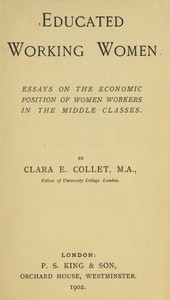
Educated working women: Essays on the economic position of women workers in the middle classes — A Reader’s Guide
Edition facts
Educated working women: Essays on the economic position of women workers in the middle classes — A Reader’s Guide can be approached with a clearer sense of reading commitment from its source measurements: 31,703 words, 2 hr 18 min estimated reading time, and 11 detected text sections.
The text analysis averages about 25.9 words per sentence, while the detected sections provide another way to judge how the source is divided.
Project Gutenberg metadata also associates the work with “Women -- Employment,” connecting these edition facts with the source record’s subject description.
Calculated from edition completeness, EPUB availability, text structure and catalogue metadata. Not a user rating.
How this score is calculated
- Description quality20 pts
- Title & short description10 pts
- Source metadata20 pts
- Text length15 pts
- Chapters / structure15 pts
- EPUB file integrity20 pts
Total of 100 points, scaled to a 2.5-5.0 range. Editions with an empty description or a missing EPUB file are not scored.
Read the Text
00 women teachers, and over 4,000,000 girls between the ages of five years and twenty; and yet already this little handful of graduates is told that it is in excess of the demand and that it must take lower salaries in consequence. In our public high schools not one in four teachers is a graduate; in private schools the proportion is much smaller. I do not propose to discuss this question, and will only make two remarks on it. The first, that after an expensive college course, which is only less expensive than that of a man because a woman is less extravagant in her personal expenditure, a Girton or Newnham student who has taken a good degree may hope for an initial salary of £105 to £120 non-resident, rising by very slow degrees to about £140 to £150 a year. Secondly, that every graduate should remember that when she accepts a lower rate still, she is making it easier to lower the salaries of the great majority below her. If all women graduates, and they are not many, agreed to a minimum, less than which they would not accept, the mass of teachers, already underpaid, could not be told as they are at present, that graduates could easily be obtained for the sum they ask. The teacher with a higher local certificate could hold out for her £90 a year, little enough in all conscience, because she would know that no graduate would take less than £100.
But the head mistress engages so few graduates, not merely because of the higher salary demanded, but because she is quite content, or rather because the British parent is quite content, that his daughter should be taught by less competent persons. If we look for the cause of this indifference, we shall find that he does not attach the slightest value to the education which she is receiving. For some unknown reason girls seem to think it absolutely necessary to learn Latin; he does not wish his daughter to be at any disadvantage with other girls; therefore he lets her learn Latin. If other girls are taught well, his daughter must be taught well; but if other girls are taught badly, he is quite content that his daughter should be so also. He perhaps learned Latin himself for some similar reason at school, and so far as he knows he derived no benefit from it, and he is quite certain he derived no enjoyment from it. The mass of parents do not wish their daughters to be teachers; and they pertinently ask, what good are classics and the higher mathematics and advanced natural science to girls unless they intend to teach? A few can answer honestly, “We enjoy the study. It is delight to us. Plato, Sophocles, Æschylus speak to us with a more living voice than any of our modern thinkers. Mathematics is not merely a discipline to us but an absorbing occupation, taking us completely out of ourselves for the time being. A natural science is to us not a mere mass of ascertained facts unrelated to each other, but a system of interdependent laws giving a new meaning to life; its very incompleteness is a charm, for it gives us the opportunity of being ourselves discoverers.” A few can say this honestly; several, under the influence of a teacher whom they adore with that schoolgirl devotion so common in our high schools, persuade themselves that they feel some of the enjoyment that a properly-constituted mind would feel. What they really enjoy is the teacher’s enjoyment, which is infectious. There is no subject so dry or so useless that a living, healthy, human teacher cannot persuade girls to think it interesting for the time being. But the majority of girls--and boys too for that matter--are Philistines and care for none of these things. They do their work conscientiously enough, because it is their work. They derive benefit from it as from a kind of mental gymnastics, and so far as their school days are concerned no harm is done, and they have benefited by the mental discipline.
When a girl or boy is about seventeen, the future career is considered. In the case of a son, the father to some extent takes into account the boy’s natural bent, and also the chances of obtaining a post for him. Thenceforth his education takes a definite direction. If intended for one of the professions, the course is easily mapped out. In other cases the boy may be sent to the University, not so much for an academic as for a social training; very frequently he leaves school and at once begins his training for business or mercantile pursuits. If his father is a merchant, or large employer of labour, he will perhaps be sent elsewhere to learn all parts of his business and then take some responsible post in his father’s firm. If this is impossible, relatives or friends or business connections may be able to offer him a post, and no stone is left unturned. There is no question either of his being content to have a low salary because he can live at home. Nor does he, if he has any sense, deliberately choose to enter an overstocked market, merely because the men who succeed in it are admitted to be men of high intelligence. If he has a high opinion of his own talents, or if he prefers shining by reflected light to earning an income, he does perhaps become a barrister or a doctor, without much fitness for the profession. But at least those who take up business prefer to enter a labour market where there are comparatively few men of ability yet to be found, and where the supply of them is not so great as the demand.
The girl of seventeen is never helped in the same way, in many cases because it has never occurred to men that girls could be so assisted. There are many other reasons, which I do not propose to dwell on here. I am not addressing myself to those who do not wish women to earn their living, but to those who, having accepted the fact that many girls must work for a living, would be glad to help them in any way that might be suggested; and I am also speaking to those women who prefer, no matter what their private resources may be, to be trained for some occupation which will call for the exercise of mental powers which they know they possess. I am also confining my remarks to working women educated for their work in life, and am not referring to the large numbers of women who take up work without any other training than the general education acquired at school. If the woman, who from seventeen to twenty-two has been trained for her profession, cannot obtain the salary which, as Mr. Pollard has shown, is necessary to keep her in good health and provide for her old age, there is no need to say that the untrained schoolgirl enters the labour market at a greater disadvantage. Now, on what principles is a girl’s career determined? In a large number of cases the parents take it for granted that she will be married in a few years, and they feel they can support her at home in comfort until then. Fortunately the girl herself does not always take this view; she thinks it quite possible that she never will be married, and she also sees that in that case she may in middle life be left with an income quite inadequate and necessitating a total change in her habits of living. If she has any public spirit, she will not undersell her poorer competitors, and will see no reason why she should not be paid the full worth of her services; she will be glad to know that her services are really worth her living. But all that she sees before her, unless she has exceptional talent, is teaching. It is the same with girls who _have_ to earn their living and whose parents can only afford to give them an expensive training in the hope that a remunerative income may afterwards be obtained. They also must be teachers; it is the only brain-work offered them, and badly paid as it is, it is better paid than any other work done by women. The result is that we see girls following the stream and entering the teaching profession; after a few years, growing weary and sick of it, tired of training intellects, and doubtful about the practical value of the training, or altogether careless of it; discontented with a life for which they are naturally unsuited, and seeing no other career before them. We see others, who have a strong practical bent, giving themselves up to purely intellectual studies, because they are the only ones possible to them; and, on the other hand, clever girls, who have no scholastic ambitions, are left to fritter away their talents or exercise them with no aid but rule-of-thumb principles to guide them. The prizes, the exhibitions, the glory are all given to encourage scholarship. Brain-power is worshipped, and as people with brains are not encouraged to exercise them in a practical direction, the possession of brain-power is not ascribed to those who do not display capacity or liking for classics or mathematics or the abstract sciences. And the whole tendency is to compete with men where men are strongest. And here, socially, morally, and economically, we are making a great mistake. We are narrowing women to one kind of education, which would cut off the majority of them from sympathy with the men in their own class; they imbibe a false idea that culture means the possession of useless knowledge; and because men in the commercial world have a knowledge which enables them to perform services for which others are willing to pay, they are regarded as necessarily uncultured and mercenary. The leisured and professional classes take the precedence in the girl-graduate’s eyes as being better educated and having less sordid aims. But, fortunately for England, the majority of men are neither leisured nor professional, and the organisation of industry and the extension of commerce give scope for the exercise of the highest powers. Socially, therefore, the educated woman at present is isolated from her class and suffers in consequence. Morally she suffers, for she is not developing her natural powers. A woman’s emotional nature is different from a man’s, her inherited experience is different, her tastes are different, and--greatest heresy of all nowadays--her intellect is different. It is a common thing to say that there is no sex in intellect. If the upholders of this theory mean that from two given premisses the same conclusion must be drawn by men and women whenever they think rightly, of course no one can deny it. But this purely deductive work can be done by machinery. The real work of intelligence is the induction which supplies the premisses, the selection of premisses suitable to the purpose in view and the application of the conclusion. The working of intelligence is prompted, strengthened, and directed by interest and emotion; and here it is that men and women differ, and always will differ, a woman inheriting as she does, with a woman’s nervous organization, a woman’s emotional nature. It is on this difference between men and women, amidst much which is common to both, that I build my hopes of women’s success in the future. I do not urge women to compete with men because they can do what men can, but because I believe they can do what men cannot; and I believe that those branches in which men have attained the highest pitch of excellence are those in which women are least likely to find pleasure or excel. Creditable as have been their performances in the Mathematical Tripos, I am glad to see that their success in the Natural Science Tripos is much greater. Instead of glorying in having once in a score of years a Senior Classic, I take pride in the fact that in the four years since the Mediæval and Modern Language Tripos was instituted, women have always been in the front rank, and I notice with fear and trembling that, although during the first three years there was always a woman in the first class, and no men, last year, although there was no deterioration in the women’s work, they did not have the first class all to themselves. I look forward to the day, but I hope it will be long before it comes, when the men’s colleges shall rejoice because they have a man in the first class without a woman to share the honours. There are many things which men are doing alone, which could be done infinitely better if educated women helped them; and nowhere is this more obvious to me, although probably not to them, than in business. While there is much that can be done well by the human being, indifferently, whether man or woman, there is much that can only be done well by the male human being, much that can only be done well by the female human being, and much that can only be done well by the two in conjunction. And if men in business only considered their daughters’ future in the same light as that of their sons, they would find many branches of business in which they could be most useful, and earn a good income. Girls inherit, to some extent, their intellectual capacities from their fathers, just as boys do from their mothers. And many a bright, clever, lazy girl would suddenly develop a most unexpected taste for study, if she had before her the prospect of doing practical, and to her most interesting work, as one of her father’s managers, or as foreign correspondence clerk, or as chemist or artistic designer in a large manufactory; or as assistant steward on her father’s property, or as a farmer on her own freehold, if (rents having gone down) he is unable to leave her an income. For all these a course of hard mental training is necessary or at least desirable; and the girl would be receiving culture on the one hand, and would have a chance of developing her natural gifts on the other. Many a girl, accustomed to a country life, would much prefer the occupations and life of a farmer to that of a teacher, provided she is allowed to have the college life and the free intercourse with other girls which is the main attraction of Girton and Newnham. The work would be far more interesting to her if she came to it with the enthusiasm of a scientist with theories to be tested. What is drudgery to an uneducated person may often be pleasurable to an educated one.
No one can study the organisation of industry at the present time without noticing that there is great room for improvement. Good organisers are extremely rare; and even in the internal management of a factory, perhaps the least important part of the work of a great manufacturer, much could be done which is rarely done at present. The admittance of educated women to a share in factory management should really be regarded in the light of co-operation with men, not competition with them. A man and a woman looking at a work-room are struck by different features, and each can be suggestive to the other. This is especially the case wherever women are employed.
The question of capacity is a more difficult one for me to answer, but an easier one for the individual girl, if she is not afraid of ridicule. And it is at this point that I would reiterate Mrs. Browning’s advice. To any really clever girl who asked me for advice as to her future work I should say, “What do you think you could do best if it were possible for you to do it? Whatever that is, do your very best to get training in it, to show by capacity at one stage that you could master the next if you had the chance. If you do this, you will find that the men who laughed at women for thinking of doing such work will frequently be the very ones to make an exception in your favour and to help you over the next difficulty. If you wish to be a farmer, and to study every department of your work and be thoroughly grounded in agricultural science, make the best of your opportunities where you are, attend classes if possible in the technological department of a good college; and if the agricultural colleges are closed to women, when you have done everything you can without them, get one of them to make an exception in your favour. Whatever it may be that you wish to do, prepare yourself for it, and, instead of bemoaning the ill-treatment of women in general, persuade those in authority of your fitness in particular. And when you have gained your end help every girl you can who shows similar capacities.”
One effect on the economic position of educated working women of such an extension of employment would be to enable them to measure their value. Teachers are paid out of fixed income, and their salaries are almost entirely determined by standard of living. If employed in business they would be employed for profit, and if they increased profits their value would rise, and could be measured; they would be paid according to their worth and not according to their standard of living. Education would be better adapted to practical needs, and teachers would be held in higher honour accordingly. Large numbers of clever girls would be spurred to exertion, whose intellectual powers have hitherto lain in abeyance, because no education was offered them corresponding to their needs. There are other arts, which women already practise, which it would be well for them to study on a scientific basis. Not only the future wife, mother, and housekeeper needs a knowledge of physiology, the laws of health, and domestic economy, but to a still greater extent the future Poor Law guardian, Board School manager, factory and workshop inspector, and sanitary officer; and both household manager and public officer should study the relation between domestic and national economics. Nor can any man do a greater injury to women in this respect than by placing a woman in a responsible post for which she has not been proved competent. The incapacity of a man is referred to the man himself; that of a woman is credited to the sex. But although a man may foolishly vote for a woman to be placed on the School Board or Board of Guardians merely because she is a woman, without knowing anything about her, I am not afraid that he will ever give her a well-paid post in his own business unless she is fit for it. Women who give their services for nothing are rarely told the truth; it will be a good thing for them when they receive, instead of flattery and thanks, criticism and payment.
Clara E. Collet opens her 1902 collection with a pointed epigraph from Elizabeth Barrett Browning's Aurora Leigh: “By speaking we prove only we can speak, / Which he, the man here, never doubted. / What He doubts is, whether we can DO the thing.” This sets the tone for six essays that rely not on rhetoric but on empirical evidence—budgets, tables, and surveys—to document the economic position of educated women in the middle classes. Collet, a Fellow of University College London, addresses a narrow but significant demographic: women whose education and social standing placed them above manual labor but whose need to earn a living placed them in a precarious, often invisible, economic category.
Budgets as Evidence
The most striking feature of Collet's method is her use of detailed personal budgets. She presents accounts from a high school mistress, clerks, and a journalist, breaking down expenditures on dress, food, rent, and even “small expenses” like cabs and stationery. For example, a clerk (No. 5) spent £16 on dress in a year, while a journalist (No. 6) spent £42. Collet notes that the clerk's dress expenditure was £10 less than when she lived at home as a “lady of leisure,” yet produced a better effect—a concrete measure of the economic pressure on working women. These budgets are not anecdotes but data points, and Collet treats them with the rigor of an economist, noting discrepancies (e.g., washing costs understated because items were sent to a country laundry) and gaps (income tax not stated). The reader is invited to see how these women allocated scarce resources, revealing priorities and constraints that abstract discussions of “women's work” often miss.
The Marriage Question Recast
Collet's essay “Prospects of Marriage for Women” (1892) reframes a common anxiety of the era. Rather than lamenting the “surplus” of unmarried women, she examines the economic logic behind marriage decisions. She argues that for educated middle-class women, marriage was not a universal goal but one weighed against the possibility of independent earnings. The budgets show that some women could support themselves, albeit modestly, and that marriage might entail a loss of autonomy. Collet does not romanticize either state; she presents the trade-offs in pounds and pence. The essay is notable for its cool, statistical tone—a deliberate counter to the sentimental or panicked discourse on “redundant women.” She does not predict trends but documents conditions “true in 1891,” acknowledging that their applicability may narrow or widen over time.
The Limits of the Evidence
Collet is scrupulous about the boundaries of her study. In the preface, she states that her point of view is “circumscribed by the conditions set forth in the first two chapters,” and that many questions about working women remain “almost untouched.” The excerpts show her focus on a small section of the community—the middle classes—and she does not claim to speak for working-class women or for all educated women. The budgets come from a handful of volunteers, and Collet notes when data is incomplete (e.g., the journalist's holiday spending was unusually low that year). This honesty about the limits of her sample is a strength: it reminds the reader that the essays are a snapshot, not a comprehensive survey. The catalog subjects “Women—Employment” and “Women—Education” are thus both addressed and qualified by the text itself, which insists on the specificity of its subjects.
Readers should approach Educated Working Women as a primary source for the economic history of women, not as a manifesto. Collet's value lies in her method: she lets numbers and individual accounts speak, and she resists sweeping conclusions. The budgets, in particular, reward close reading—each line item is a clue to a life. To get the most from this book, compare the tables across essays and note what is omitted as well as what is recorded. The result is a rare, unvarnished view of how educated women managed money, work, and expectations at the turn of the twentieth century.
I found myself returning to Clara Collet's careful budgets—those columns of shillings and pence—and thinking how quietly revolutionary her arithmetic was. It reminded me, strangely, of another patient excavation of neglected foundations. The way she tallied a woman's wages feels akin to how scholars once traced a phrase back through forgotten commentaries. There is a particular tenderness in recovering what was always there, waiting to be counted. A History of Literary Criticism in the Renaissance With special reference to the influence of Italy in the formation and development of modern classicism — Key Ideas to Explore holds a similar pulse—so much older, yet somehow adjacent to that same stubborn, private reckoning with what we inherit.
John Thomas
1 week agoNoah Lee
4 weeks agoMatthew Nguyen
1 week agoMatthew King
2 weeks ago-
Jim Anthony - 1 month ago
While the book raises important issues, its approach is overly conservative and narrow. The author focuses almost exclusively on professional middle-class women, ignoring broader working-class struggles. The proposed solutions, like better education, are insufficient and do not challenge the patriarchal structure. The writing is dry and repetitive. For a more radical and inclusive perspective, look elsewhere. This book adds little to modern feminist discourse. -
Sean Barnes - 4 weeks ago
This work offers a thoughtful examination of the limited economic prospects for educated women of the time. The author's arguments are clear and well-reasoned, though some solutions feel dated. It's a solid piece of social commentary that will interest readers of feminist history and economics. The main drawback is that it's firmly rooted in its era, so some assumptions may seem quaint to modern readers. Still, it's an important read. -
Jeffrey Griffin - 3 weeks ago
A remarkably forward-thinking analysis of the economic hurdles faced by educated women in the middle classes. The author presents compelling arguments for equal opportunity and financial independence, supported by careful observation of societal constraints. This book is not only a valuable historical document but also a relevant commentary on ongoing workplace inequalities. It's an inspiring read for anyone interested in women's rights and economic justice.
What did you think of this book?
Answer a few questions and save a private reflection on this device.
Madison Jones
2 weeks ago