
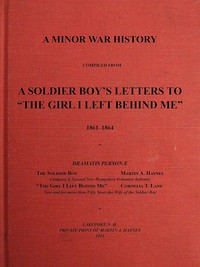
A Minor War History Compiled from a Soldier Boy's Letters to "the Girl I Left Behind Me": 1861-1864 — Key Ideas to Explore

(3 User reviews)   844
Haynes, Martin A. (Martin Alonzo), 1842-1919 Project Gutenberg 2020 Not confirmed
United States -- History -- Civil War, 1861-1865 -- Personal narratives; United States. Army. New Hampshire Infantry Regiment, 2nd (1861-1865) Readers of public-domain and historical texts
Project Gutenberg digital edition en

Edition facts

Words 75,748
Reading time 330 min
Text sections 157

The catalog record for A Minor War History Compiled from a Soldier Boy's Letters to "the Girl I Left Behind Me": 1861-1864 — Key Ideas to Explore provides practical reading context through 75,748 words, 5 hr 30 min estimated reading time, and 157 detected text sections.

The text analysis averages about 17.9 words per sentence, while the detected sections provide another way to judge how the source is divided.

Project Gutenberg metadata also associates the work with “United States -- History -- Civil War, 1861-1865 -- Personal narratives,” connecting these edition facts with the source record’s subject description.

A collection of Martin A. Haynes's letters to his future wife, Cornelia T. Lane, written during his service in the 2nd New Hampshire Infantry (1861–1864). The letters offer a private soldier's view of camp life, logistics, and small incidents, deliberately avoiding grand strategy. Published in 1916 in a private edition of sixty copies.
Share
Editorial Edition Score 4.9/5

Calculated from edition completeness, EPUB availability, text structure and catalogue metadata. Not a user rating.

How this score is calculated
  • Description quality20 pts
  • Title & short description10 pts
  • Source metadata20 pts
  • Text length15 pts
  • Chapters / structure15 pts
  • EPUB file integrity20 pts

Total of 100 points, scaled to a 2.5-5.0 range. Editions with an empty description or a missing EPUB file are not scored.

Edition quality

Read the Text

years from home is a long stretch, but you can be pretty sure the war will not last many months. At any rate, my fortunes are cast with the Abbott Guard, and its fortunes I am bound to follow, wherever they lead.

General Abbott told us, this afternoon, that we should all have a chance to go home and put our affairs in order.

CAMP CONSTITUTION, PORTSMOUTH, _May 19, 1861_.

The regiment is now uniformed—the queerest-looking uniform in the world. You have probable seen some like them in the streets of Manchester, on the First Regiment boys. The suit is gray throughout, with a light trimming of red cord. The coat is a “swallow-tail,” with brass buttons bearing the New Hampshire coat-of-arms; a French army cap to top off with.

We have the Manchester Cornet Band here with us now—they came yesterday. They played in front of the barracks last evening—lots of the good old tunes that you and I have enjoyed together, many a time.

CAMP CONSTITUTION, PORTSMOUTH, _June 2, 1861_.

Do not know how much longer we will be here, but not more than a few days—perhaps not over a week. Yesterday the First Maine Regiment passed through here. I wish this regiment had been in their place.

CAMP CONSTITUTION, PORTSMOUTH, _June 7, 1861_.

Expected I would have a chance to write a long letter today. I was on guard last night, and in the natural course should have had the day to myself. But our company was mustered this forenoon—sworn in for three years’ service—and the regiment has been marching and parading all the afternoon. I was never more tired in all my life. We shall be off in a day or two. Next Tuesday is the time set, but we may not get away until a day or two later. We are very busy getting ready to leave.

A number of the boys have taken a notion to get married before leaving for the front, among the number being Eugene Hazewell, E. Norman (nicknamed “Enormous”) Gunnison, and Johnny Ogden, the round-faced Englishman I pointed out to you down by the cemetery, one day.

We have lots of fun with the fellows who come creeping into the barracks late at night or early in the morning. All sorts of traps are set, and some one of them generally gets the bird. Sometimes it is the old trick of tinware over the door, which is bound to rouse the whole camp, no matter how carefully the door is opened; or a gun box set on end in the aisle; or a rope stretched across it.

Just to bring myself to a realization of how long the three years ahead ought to seem, I have been measuring back to events that transpired three years ago. Three years seems a long time looking into the future, and yet many things that took place three years ago do not seem so very far away. In the depot at Manchester I met Ike Sawyer, who has just got back from sea. I asked him how long he had been gone this time, and he said, “Over three years.” I was surprised that it was so long, and hope the coming three will sort of shorten up in the same way.

Our company is now stocking up on mascots. The latest additions are a splendid Newfoundland dog and a pretty maltese cat.

Nich. Biglin is going up tomorrow to bid good bye to a large and enthusiastic circle of female admirers. Just now he and Dan Mix are engaged in an animated dispute as to whether a man will get tight on gin sweetened with sugar sooner than if sweetened with molasses, and “Heenan” proposes that they go out and experiment.

CAMP CONSTITUTION, PORTSMOUTH, _June 12, 1861_.

Still in Portsmouth, in spite of all prophecies, augurs and omens. The excuse now is that the baggage wagons and some other camp equipage are not ready. The time now set is next Monday, but I am not counting on going before Wednesday, as a precaution against being disappointed. All our baggage wagons, harnesses, horses, and other field stuff are in Concord, and it is more than probable that we shall go there to get it, and thence to New York through Manchester. I hope so, as it will give me a chance to see you once more just for a moment.

I was somewhat surprised to hear that Frank had gone to Washington. I wish he was going with this regiment; but I shall have as good care as I could wish for if I am sick, as my uncle, Dr. John, is going out with us in the hospital department. My aunt wrote me that if the doctor went she should put on the breeches and go too.

And, by the way, I am not sure that you would recognize me now that I have followed the prevailing fashion and had my flowing locks shaved off close to my scalp.

Yesterday morning, before breakfast, a party of us boys went down to the beach and had a glorious frolic, swimming, digging clams, and catching crabs.

In the regimental organization we are designated as Company I. It is explained to us that this gives us a post of honor, as the color company, in the center of the regiment; but I am a little skeptical.

The boys have been singing sentimental songs, but just now have switched off onto cheers over the taking of Big Bethel, in Virginia, by Gen. Butler. “_Hooray!_” The way they are tearing it off is a caution. All are at fever heat to be off and helping in the war.

HEADQUARTERS SECOND REGT. N. H. V., PORTSMOUTH, _June 16, 1861_.

We know, at last, just when we are going away—“_sure_.” Next Thursday, at 7 o’clock in the morning, we are off. As we go direct to Boston, and not through Manchester, it is good bye until I come home from the war.

Si. Swain is under guard today. He refused to do duty and invited Rod. Manning, one of the sergeants, to go to H——ot place.

My ribs are sore from laughing over the regatta we had today out on the mill pond. Some of the boys gathered together from somewhere a number of hogsheads, halved by being sawed in two, and went voyaging in them. They were not a very manageable craft. They rolled around every-which-way, capsized, collided, and went through all sorts of ridiculous stunts.

We have had issued to us blue flannel blouses, thin, loose, and far more comfortable than our uniform dress coats.

Some of the boys have been fishing down at the fort today. They brought home a lobster they caught, and while a kettle of water is heating to boil him in, are teasing the poor fellow with sticks. “Heenan” is taking an active part in the persecution. He holds up long enough to say to me, “Tell her I want to keep the first two months’ pay to buy my liquor with; but after that I will remit enough so that, with her own efforts, the family will be insured from want.”

HEADQUARTERS SECOND REGT. N. H. VOLS., PORTSMOUTH, _June 19, 1861_.

Off we go at 7 o’clock tomorrow morning, and everything is bustle and excitement. Have seen lots of Manchester folks here within a day or two. Mary Rice was on the parade ground yesterday. Dr. Nelson, Henry A. Gage, A. C. Wallace, policeman Bennett, Parker Hunt and his mother, and many more of my friends and acquaintances. We have been drilling today with knapsacks and equipments on, and my shoulders are as lame as if I had been beaten with a club. Twenty rounds of cartridges have been issued to us. You will direct letters to Company I, 2d Regt. N. H. Vols., Washington, D. C. We may not be at Washington, but there is no mail south of there, and it will be distributed from that point.

There was quite an excitement here last night, resulting from a fire on the frigate “Santee.” It was set near the magazine, in which was forty tons of powder.

WASHINGTON, D. C., _June 25, 1861_.

Here we are at last, in Washington, safe and sound, but stewed with the heat. We left Portsmouth on schedule time, Thursday morning. At Boston, we met with a grand reception. The boys will never forget the superb collation that was served us there—not merely the toothsome meats and substantials, but all the little niceties, such as strawberries and cream, &c. From Boston we went to Fall River, where we took the steamer “Bay State” for New York. I roosted on the hurricane deck and never had a better night’s sleep in my life. At New York the Sons of New Hampshire gave us a flag and a feast, after which we were ferried to Amboy, 16 miles, and took cars for Baltimore. I got in a good night’s sleep between Harrisburg and Baltimore, and Sunday noon we arrived in Washington.

Our camp reminds me of the old-fashioned tin oven my grandmother used to set before the fireplace to bake biscuits in. On the sunny slope of a ridge, with not a tree for shade and shelter. Hot! And the flies! I know now how to pity those poor old Egyptians. We have plenty of unusual happenings now. I am not sure but that some of the boys are seeing spooks. Sunday night several of the sentinels reported exchanging shots with prowlers about the camp. I was on guard that night, where there were plenty of bushes, but the best I could do I couldn’t find anything to get excited over. Dan Mix, one of the teamsters, says he was fired at four times while coming into camp with his team last night. And it is currently reported that the Zouaves, camped next to us, captured a spy a day or two ago, and he will be hanged today or tomorrow. I can understand how some secessionists around here might be tempted to take a pot shot at a Yankee sentinel out of pure cussedness; but I haven’t got it through my head yet what a spy could find to spy out that isn’t perfectly open to anybody who cares to look about in broad daylight, unmolested.

Just before I left Portsmouth I had a letter from my mother that touched a sensitive nerve. My dear old Grandmother Knowlton came down from New London to see me, but I had just gone back to Portsmouth. As the first and favorite grandchild I always filled a big space in her little world. She mourned over her disappointment, and grieved that she should never see me again. My mother could not even conceal her own blue streak. She and father were in Boston when we went through, and I had a chance just to shake hands and say good bye to them.

I have seen Dave Perkins here two or three times. [David L., of Manchester, then connected with one of the Departments.] He asked me if I wanted to send any word to that little girl away up in New Hampshire, for he was going back in a few weeks. I gave him lots of messages, and have no doubt he will forget every one of them before he sees you.

Our grub, since we got here, has not been quite up to the Astor House standard, but the army stores will be here today, which will improve the bill of fare. So far it has consisted of hard bread bearing the stamp “1810”—whatever that may signify—ham or salt pork and coffee.

CAMP SULLIVAN, WASHINGTON, _July 2, 1861_.

Saturday was quite an eventful day with me. I went over to the city on a sight-seeing trip with Hen. Morse, one of my tentmates [killed, three weeks later, at Bull Run.] Went first to the Capitol, and viewed the paintings and statuary. Thence to the Smithsonian Institute and spent several hours in its wonderful museum, where I could have interested myself for days. From there to the Washington monument. Among the stone blocks there, contributed from various sources and to be built into the walls, was one inscribed: “_From the Home of Stark. From the Ladies of Manchester, N. H._” We wound up our sight-seeing in the parks around the President’s house; and when we got back to camp I was tired enough to pile onto my blankets and go to sleep.

Not much sleep, though. I had hardly lost myself when somebody shook me and said the Captain wanted me up at his tent. I went up, in no very amiable mood. Found Commissary Goodrich there, who said he wanted me to be his clerk. I chewed the matter over and decided I’d take the assignment. It relieves me from guard duty and drill, and gives me very nice quarters with the Commissary. I jumped into my work the next day—Sunday. Issued three days’ rations to the regiment, and had a pretty busy time keeping track of the provisions. Monday and Tuesday I had my hands full straightening up accounts and opening a set of books; and not until today have I had any chance to write letters and attend to private affairs.

Last night we had a rain—and _such_ a rain! The board floor in my tent kept me high and dry above the flood, but the fellows down in camp came pretty near being carried out to sea.

I am not starving now. I don’t think anybody does in the commissary department. Yesterday I had all the cherries I could eat, and some day, when I have a little leisure, I think I’ll go blackberrying.

CAMP SULLIVAN, WASHINGTON, _July 7, 1861_.

Yesterday I received orders to deliver four days’ rations of beef, bread and coffee, and the cooks were ordered to cook the meat, ready for a march. We are now expecting marching orders at any moment. I have an idea that they will come about night, so as to avoid marching in the heat of the day. I am going, you bet. Captain Goodrich told me this camp is not to be broken up at present. The commissary stores are to be left here, the tents to remain standing, with the surplus baggage, all under guard of the cripples and invalids. When it came to details, I found the plan was for the Captain to go with the expedition, while I remained behind to look after things in camp. That didn’t suit me; so I asked him to hunt up another clerk, and notified the Captain that I wanted my gun again and to go with the company.

Where we are going we do not know, but inasmuch as twelve regiments are going with us, and we are to take no knapsacks, but four days’ rations and a large supply of ammunition, it is fair to presume we will be looking for trouble. I hope we are going down to Manassas to drive the secessionists out of that stronghold. Very likely some of the boys have not many days to live, but they are jolly eager to be off, and will give a good account of themselves.

I went to a ride into the country yesterday to find a boarding place for Captain Goodrich’s wife.

CAMP SULLIVAN, WASHINGTON, D. C., _Sunday, July 14, 1861_.

We are still here in Camp Sullivan, our marching orders having been countermanded at the last moment; but are sure to be off before many days. We have been expecting to march today, but probably will not.

A day or two ago there was a dreadful accident in our brigade. The Rhode Island battery were drilling upon the parade ground in front of our camp, when the ammunition in one of the limbers exploded and the three men seated on the box were hurled high in the air, two being killed instantly—literally blown all to pieces. I was on the spot almost instantly, and with the single exception of the Pemberton Mills horror, which I viewed as a newspaper reporter, it was the most sickening sight I ever saw.

We certainly do have gay times here in camp. The days are frightfully hot, but the evenings are cool and nice, and somehow or other the camp scenes then remind me—and I can’t tell just how—of an old-fashioned country fair. I suppose it’s the canvas, the lighted tents like open booths, the men swarming hither and thither, the bustle and frolic and singing—and we have some very fine singers in our company.

_P. S._—_Monday Morning._—We have received orders to march tomorrow at two o’clock, with three days’ rations and without camp equipage. The orders are imperative and we are sure of going. We shall probably see some of the business we came for before long. I will write at the first opportunity and let you know what happens.

WASHINGTON, D. C., _July 24, 1861_.

I intended to write to you yesterday, but after what I have been through in the past week I simply couldn’t get up steam. Last Tuesday—a week ago yesterday—this regiment crossed the Potomac at Long Bridge, with the other regiments and batteries of Burnsides’ brigade, and advanced into Virginia. Saturday night we were encamped about a mile from Centreville. At two o’clock Sunday morning we were up and on the march, and at ten o’clock we came upon the secessionists at Bull Run and engaged them. The battle lasted several hours, when we were obliged to withdraw. It was a very disorderly retreat. We expected to be followed sharply, of course, and there was no halt worth talking about until we straggled into Washington, every man for himself. Coming and going we got in about sixty miles of travel, to say nothing of several hours on the battlefield. I was about all in when, midday Monday, I reached the Virginia end of Long Bridge. We were then inside the fortifications, and there were kettles of hot coffee and boxes of hard bread set out for everybody to help themselves. It did seem as if I never could drag myself over to our camp. But I finally negotiated with a huckster who was over there with his team, and having purchased his remaining stock of pies and distributed them among the crowd of refugees, he gave me a ride across the bridge and up into the city well toward Camp Sullivan.

The battle was the hardest fought so far, and the losses on both sides were heavy. At the roll call this morning 175 were missing from the Second Regiment, but this number will doubtless be cut down as stragglers come in. Of my eight tentmates, six went. Two [Harvey Holt and Henry Morse] were killed outright, and one [George F. Lawrence] was severely wounded in the head. I got my little upset at the very tail-end of the fight. The regiment had crossed over to the opposite hill, and about a hundred of us had taken cover in a cut in the road. We had a house on our front, some secessionist cannon up near it, and enough of the enemy to give us a real lively time. There was a rail fence along the edge of the cut, and I rested my musket on one of the rails, and carefully sighted on a fellow who seemed to be showing off. Then something happened. A cannon ball struck the rail, one of the fragments hit me in the head and neck, and I rolled down the bank. I heard one of the boys cry out “Mart is killed!” and for about half a minute I didn’t know but what I was. But when we had to break for the rear, a few minutes later, I had no trouble in keeping up with the procession.

The preamble to this volume explains its unusual origin: Martin A. Haynes, a private in Company I of the Second New Hampshire Volunteer Infantry, saved the letters he wrote to “the girl I left behind me” during the Civil War. Decades later, he copied them—removing “strictly personal matters”—and burned the originals. The result is a deliberately minor history, as he calls it, one that does not pretend to be a connected narrative or a study of campaigns. Instead, these letters preserve what the men in the ranks talked about, from sleigh rides and drunken choppers to the arrival of commissions and the loss of knapsacks. The book was printed in only sixty copies, mostly for family members, and Haynes wryly predicts it will demote him from his grandchildren’s heroic image to third place, behind Grant and Sherman.

A Private’s Perspective on Camp Life

The letters consistently avoid battlefield heroics. In one excerpt, Haynes describes a farcical sleigh ride by the general’s staff officers—complete with a wagon body mounted on runners, two tip-overs, and a final smash. He notes that the sleighing “would not have been called sleighing at all up in New Hampshire,” a remark that reveals both his New England frame of reference and his eye for the absurd. Elsewhere, he recounts a frustrating day spent gathering wood: a chopper who had been drunk all day claimed no wood was cut, forcing a two-mile round trip, only to be sent out again when the truth emerged. The passage ends with army mules and drivers struggling through “stumps, roots and bog holes.” These episodes, while seemingly trivial, form the texture of his war—a war of logistics, miscommunication, and small triumphs.

The Rhythm of Waiting and Rumors

Haynes’s letters are punctuated by the constant expectation of movement. In one, he notes that “stories of going home have been let loose every two or three weeks as regular as clockwork,” capturing the repetitive cycle of hope and disappointment. The editor’s note between letters confirms that such rumors did materialize: the regiment left the Army of the Potomac in February 1863, arrived in New Hampshire in March, and returned to Washington in May. During that furlough, Haynes married Cornelia T. Lane—the girl he left behind. The letters thus trace not only military service but a personal timeline, with the wedding occurring mid-war. The reader encounters these events as the soldier did: through anticipation, brief realization, and then a return to the front.

Loss and Farewell in the Margins

Though Haynes excised the most personal passages, loss surfaces in asides. In a letter dated May 27, 1863, he mentions that George Slade’s wife was at Concord, “almost heart-broken.” A bracketed editorial note—added decades later—reads simply: “It was their last farewell—George never came back.” This editorial intrusion, rare in the text, underscores the retrospective knowledge that the original letters could not contain. Haynes also notes that he was glad his own wife did not come to the depot, a quiet acknowledgment of the pain of parting. The letters do not dwell on death, but such moments remind the reader that the minor history is shadowed by major losses.

The Book’s Unusual Construction

Haynes’s compilation is not a seamless narrative. The letters are numbered (the excerpt includes Letter LXXXIX), and the editor’s notes bridge gaps in time. The preamble admits that the letters were burned after copying, making this volume the sole record of their content. The book was printed privately in 1916, fifty-five years after the war began, and the author’s preface jokes about his grandchildren’s likely disappointment. The physical edition—sixty copies, each numbered and presented to a recipient—emphasizes its status as a family artifact. Readers today encounter a text that is both a primary source and a curated memoir, shaped by Haynes’s decisions about what to include and what to destroy.

Because the letters were written without knowledge of the war’s outcome, they offer an immediate, unshaped record of a soldier’s daily concerns. Readers should approach the book not as a history of battles but as a collection of moments—some comic, some mundane, a few shadowed by foreshadowed grief. The gaps between letters, and the editorial notes that fill them, are as revealing as the correspondence itself. This is a minor history, as Haynes insisted, but one that rewards attention to its small details.

There’s something tender in how Martin’s letters pause on small camp details rather than the war’s grand sweep, as if the ordinary were all he could bear to send home. I’ve been rereading The Arte of English Poesie — Reading Companion lately, and it reminds me of that same patient noticing—how a quiet turn of phrase can hold more than any grand pronouncement. Both feel like whispers across time.

James Mitchell
1 week ago

Leo Johnson
4 weeks ago

Scarlett Lopez
1 week ago

5
5 out of 5 (3 User reviews )

Add a Review

Your Rating *
There are no comments for this eBook.

Reader reflection

How did this book work for you?

Your answers remain private and are stored only in this browser.

Your progress 0 / 10
1

How far have you progressed with this book?

2

How did the book work for you overall?

3

Would you encourage someone else to read it?

4

Did the language feel accessible?

Related eBooks