
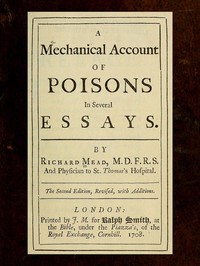
A Mechanical Account of Poisons in Several Essays — A Closer Reading
Edition facts
Before opening A Mechanical Account of Poisons in Several Essays — A Closer Reading, the edition data offers a quick orientation: 40,072 words, 2 hr 55 min estimated reading time, and 15 detected text sections.
The text analysis averages about 39.2 words per sentence, while the detected sections provide another way to judge how the source is divided.
Project Gutenberg metadata also associates the work with “Poisons -- Early works to 1800,” connecting these edition facts with the source record’s subject description.
Calculated from edition completeness, EPUB availability, text structure and catalogue metadata. Not a user rating.
How this score is calculated
- Description quality20 pts
- Title & short description10 pts
- Source metadata20 pts
- Text length15 pts
- Chapters / structure15 pts
- EPUB file integrity20 pts
Total of 100 points, scaled to a 2.5-5.0 range. Editions with an empty description or a missing EPUB file are not scored.
Read the Text
e looked upon as the beginning of a fresh Period of Life, and (as the throwing off the _Senectus_ of these Creatures seems to be) the Renewing of Age (9).
Whether one or the other of these Reasons be allow’d of, or both thought good, certain it is that such fond and superstitious Fancies concerning the Viper, together with the mistaken Opinion that few of its Parts were exempt from Poison, did not suffer the Ancients to make any Curious Enquiries into its Nature by Anatomy and Experiments, and this is the Cause of the many Errors they have delivered down to us in these Points, which by gradual Advances have since been rectified, and the inward Make, Properties, and Generation of this Animal, largely treated of; more especially M. _Redi_ (10), _Charas_ (11), and Dr. _Tyson_ in his Dissection of the _Rattle-Snake_ (12), which is a larger Species of a Viper, have taken Pains on this Subject, to whose Discoveries, what is yet wanting, we shall add at the End of this Essay.
The Symptoms which follow upon the Bite of a Viper, when it fastens either one or both its greater Teeth in any Part of the Body, are an acute Pain in the Place Wounded, with a Swelling at first Red, but afterwards Livid, which by degrees spreads farther to the Neighbouring Parts with great Faintness, and a Quick, tho’ Low, and sometimes Interrupted Pulse, great Sickness at the Stomach, with Bilious, Convulsive Vomitings, Cold Sweats, and sometimes Pains about the Navel; and if the Cure be not speedy, Death it self, unless the Strength of Nature prove sufficient to overcome these Disorders; and tho’ it does, the Swelling still continues inflamed for some time; nay, in some Cases more considerably upon the abating of the other Symptoms, than at the beginning; and often from the small Wound runs a sanious Liquor, and little Pustules are raised about it; the colour of the whole Skin is changed Yellow, as if the Patient had the _Jaundice_.
These Mischiefs, altho’ different Climates, Season of the Year more or less Hot, the greater or lesser Rage of the Viper, the Beast it self of a larger or smaller Size, and consequently able to communicate more or less Venom, and the like Circumstances, may variously heighten or abate ’em, yet do usually discover themselves much after the same manner in all; unless the Bite happen not to be accompanied with the Effusion of that _Liquor_, which is the main Instrument and Cause of this violent and shocking Disturbance.
But before I proceed to enquire into the Nature and Manner of Acting of this _Juice_, it may be worth the while to take Notice, that this is not made on purpose to be deadly and destructive to _Mankind_; but that the true Design of it is (tho’ Authors have not regarded it) to perform an Office and Service of so great Moment, to the Preservation of the Individual, that without it this Creature could not subsist.
For Vipers live chiefly upon Lizzards, Frogs, Toads, Mice, Moles, and the like Animals, which they do not chew, but swallow down whole, and they lie in the Stomach; or if that be not big enough to receive them, partly in that, and partly in the Œsophagus, which is membranous and capable of great Distension, till by the Salival Juices of those Parts, together with the Help of the Fibres of the Stomach, and the Contraction of the Muscles of the Abdomen, they are gradually dissolved into a Fluid Substance, fit for the Nourishment of their Bodies, which is the Work of many Days; this is _one_ Reason why these Creatures can live so long without taking any fresh Food, which I have known them to do Three or Four Months; as _another_ is, that their Blood is a grosser and more viscid Fluid than that of most other Animals; so that there is but a very little expence of it by Transpiration, and consequently less need of Recruit; this not only _Microscopes_ discover, but Reason teaches; because there is but very little Muscular Force in the Stomach to comminute the Food, and make a Chyle of fine Parts, and therefore the Blood must accordingly be of a Tough and Clammy Consistence. Besides, the Heart of a Viper has properly but one Ventricle, and the Circulation of the Blood is performed after the same Manner as it is in a Frog and Tortoise, in which not above one Third of it passes thro’ the Lungs; upon which Account its Comminution in them by the Air is proportionably lesser than in other Animals. Now such a manner of Feeding as _this_ does necessarily require, that the Prey should upon the first Catching be immediately kill’d, otherwise it were by no means fit to be let into the Stomach; for we are not to think that the Force of this Part would be alone sufficient to destroy it, the Subtilty of a living Creature (besides the Consideration of the Weakness of the Fibres) being in a great Measure able to elude _that_, as indeed we do every Day find live Animals in the Ventricles of others; and therefore to do _this_ is the proper Use both of the Teeth and their Poison; for which being designed and adapted, it is no wonder if the Viper, this same Way by which it destroys its Prey, proves sometimes mischievous to any other Creatures besides, when it happens to be enraged, or by any Provocation stirr’d up to bite.
The Description of the Poisonous _Fangs_, their Make, Articulation and Motion, as also of the Glands that separate the Yellowish Liquor, and the Bags that contain it; I shall give, together with some Anatomical Observations, at the End of this Discourse.
This Venomous Juice it self is of so inconsiderable a quantity, that it is no more than one good _Drop_ that does the Execution; and for this reason Authors have contented themselves with Trials of the Bite upon several Animals, never Essaying to examine the Texture and Make of the Liquor it self; for which purpose I have oftentimes by holding a Viper advantageously, and inraging it till it struck out its Teeth, made it to bite upon somewhat solid, so as to void its Poison; which carefully putting upon a Glass Plate, I have with a Microscope, as nicely as I could, viewed its Parts and Composition.
Upon the first Sight I could discover nothing but a Parcel of small Salts nimbly floating in the Liquor, but in a very short time the Appearance was changed, and these saline Particles were now shot out as it were into _Crystals_ of an incredible Tenuity and Sharpness, with something like Knots here and there, from which they seemed to proceed, so that the whole Texture did in a manner represent a _Spider’s Webb_, tho’ infinitely Finer, and more Minute; and yet withal so rigid were these pellucid _Spicula_, or _Darts_, that they remained unaltered upon my Glass for several Months (13).
I have made several Trials with this _Juice_ in order to find out under what Tribe of Salts these Crystals are to be ranged; and not without some difficulty, by reason of the Minute Quantity of the Liquor, and the Hazard of Experiments of this Nature, have plainly seen that it does, as an _Acid_, turn the blue Tincture of _Heliotropium_ to a Red Colour.
I did not succeed so well in mixing it with Syrup of Violets, and yet it did really seem to induce in this a _Reddish Hue_; but I am very certain it did not at all change it to a _Greenish_ Colour, as it would have done if any ways _Alcalious_.
This may suffice in their own way of arguing, to convince those Gentlemen, who without the Assistance of any Experiments, meerly to serve an _Hypothesis_ which they have too fondly taken up, have with great Assurance told the World, that the Viperine Venom is an _Alcali_, and consequently to be cured by _Acid_ Remedies. But it is by far more easie to Spin out a false Notion into precarious Reasonings, than to make faithful Experiments, and fairly improve ’em by just and necessary Consequences.
To proceed, this Discovery agrees very well with a Relation communicated by an Ingenious Person to Dr. _Tyson_, which does so much illustrate this Matter, that I shall transcribe it in his own Words, out of the before cited _Philosophical Transactions_; he says then, That being in the _Indies_, there came to him an _Indian_ with several Sorts of _Serpents_, offering to shew him some Experiments about the Force of their Poison; having therefore first pulled out a large One, the _Indian_ told him this would do no Harm; and making a Ligature on his Arm as in letting Blood, he exposed it naked to the Serpent, being first irritated to make him bite it; the Blood that came out of the Wound made by his Teeth, he gathered with his Finger, and laid it on his Thigh, till he had got near a Spoonful, after this he takes out another called _Cobra de Capelo_, which was lesser, and inlarges much upon the Greatness of his Poison; to shew an Instance of it, grasping it out about the Neck, he expresses some of the Liquor in the Bags of the Gums, about the Quantity of half a Grain, and this he puts to the coagulated Bleed on his Thigh, which immediately put it into a great _Fermentation_, and working like _Barme_, changed it into a _Yellowish_ Liquor.
This I say does well enough accord with what we have been advancing concerning the Nature of this _Juice_, for Mr. _Boyle_ has long since proved by Experiments, that there is nothing of Acid in human Blood; and Dr. _Pitcarn_ (14) has demonstrated, that the _Acid Substances_ of Vegetables taken into the Stomach, are by the Action of this Part, the Lungs and Heart, when they come into the Blood-Vessels, turn’d to _Alcalious_; so that the Arterial Fluid must necessarily be considered as an _Alcali_; and therefore according to the known Principles of Chymistry, its mixture with such a Liquor as we have discovered the Viperine _Sanies_ to be, will always exhibit some such appearance as this now related.
But not to engage any farther in these sort of Controversies, we may perhaps from the foregoing Observations receive some Light in order to understand the Nature and Reason of all those Symptoms which attend the Bite of this Creature. For the pungent Salts of this Venom, when with Force thrown into the Wound, will not only as so many _Stimuli_, irritate and fret the sensile Membranes, whereupon there necessarily follows a greater Afflux than ordinary of the Animal Juices that way, (as is manifest from the _Bellinian_ Doctrine, _De Stimulis_) so that the wounded Part must be Swelled, Inflamed, Livid, _&c._ but also these _Spicula_ being mixt with the Blood, will so disjoin and disunite the Parts of it, that its Mixture must be quite alter’d; and from the various _Cohæsion_ of its _Globules_ will arise such different Degrees of _Fluidity_ and _Impulse_ towards the Parts, _&c._ from what this Liquor had before, that its very Nature will be changed, or in the common way of speaking, it will be truly and really _Fermented_.
To understand aright how all this is done, it is necessary to hint somewhat concerning the Nature of _Fluids_ in General, and those Alterations in them which we call _Fermentations_; for I shall retain this known Word, tho’ in the proper Sense in which ’tis commonly used, there can be no _Fermenting_ of the Liquors in the Animal Body.
And here I must refer to the Treatise of _Bellini de Fermentis_, who has with great Clearness shewn, that there is in all _Fluids_ not only a simple _Contact_ of their Parts, but also a _nisus in Contactum_, or _Cohæsion_, and this of a certain _Degree_ or _Force_, and besides, of a particular _Direction_; which is indeed, tho’ express’d in other words, the very same thing with the _Attraction_ of the Particles one to another; This Mr. _Newton_ has demonstrated to be the great Principle of Action in the Universe, has taught us the Laws of it in the greater Quantities and Collections of _Matter_; and he who rightly Studies his Philosophy will understand that the same obtains in the most Minute and Finest Corpuscles, which do unite into Bodies of different _Solidity_ and _Make_, according to the Degree with which they do mutually _attract_ each other, and to the _Superficies_, by which, when drawn, they do _touch_ and _adhere_. To this if we add a _Pression_ of the several Parts of the Fluid every way, and consider withal, that this _Uniform_ Attraction of the Parts to one another must be variously changed by the different Attraction of Heterogeneous Bodies mixt with them, we have the great Principles of all Fluids, upon which their several _Phænomena_ do depend.
And hence it follows, that whatsoever _Power_ is sufficient to make a Change in this Attraction, or Cohæsion of the Parts, makes an Alteration of the Nature of the Fluid; that is, as the Chymists express it, puts it into a _Fermentation_. And if any one shall think it necessary to enquire into the particular Manner of producing such an Effect, we may perhaps in so abstruse a Matter not improbably Conjecture _thus_, That our Blood consisting chiefly of Two Parts, a simple _Lymph_, and an infinite Number of small _Globules_, containing a very subtle and elastic Fluid, these acute Salts, when mingled with it, do prick those Globules, or _Vesiculæ_, and so let out their imprisoned active Substance, which expanding it self every way, must necessarily be the Instrument of this speedy Alteration and Change (15). From such an _Hypothesis_ as this (and, it may be, not very easily from any other) we may account for many of the surprizing Phænomena in the Fermentations of Liquors; and as precarious as it seems, its Simplicity, and Plainness, and Agreement with the forementioned Doctrine, will, I believe, recommend it before any other to those who are not unacquainted with _Geometrical_ Reasonings. But I wave these Considerations at present, and shall only add One Remark or Two with Relation to the purpose in Hand, and so proceed.
In the first place then, we may from this _Theory_, learn, how it comes to pass that so small a Portion of Juice should infect so great a quantity of Liquor; for in order to do this, it is not necessary that the Venom should be at the very first mixt with all its Parts; but it is sufficient that it prick some of the _Bladders_, and the elastic Matter of these being let out, will be a nimble _Vehicle_ to the acute Salts, and not only by its activity disperse them thro’ the Fluid, but restore to them their decreasing _Force_, and thus continue their Effects, till a great part of the Liquor undergoes at least, in some Degree, the like Alteration.
And this will the more easily happen in the present Case, because the _Force_ with which this Poison is thrown into the Blood, as appears from the Mechanism of the discharging Organs, is very great, and consequently its Effects will be proportionably violent, or the Mischief more large and diffused.
The want of this may be one Reason why the Experiment of first making a Wound in the Flesh with any sharp Instrument, and then dropping in the _Sanies_, may not always succeed so well in killing Animals, as one would from the preceeding Doctrine be ready to expect. Tho’ if some amends be made for this Defect, by taking a greater quantity of the Juice, and carefully instilling it, It proves equally Fatal this way, as when immediately discharg’d from the Viper it self. Thus it might happen that those Trials of this kind, which were happily made by S^r _Redi_, might not however convince M^r _Charas_, in as much as there is oftentimes a great deal of difference in the Event of Experiments, when made with Purpose, and a Design that they should succeed, and when Timorously and Cautiously managed, lest they should unluckily overthrow a darling _Hypothesis_.
The other Observation I shall draw from the foregoing Theory, is this, That it appears from hence what a vast _variety_ there may be in the Fermentations even of one and the same Fluid; for these being no other than _Changes_ made in the _Cohæsion_ of the compounding Particles, are capable of as many Alterations as _Motion_ in its _Degrees_ and _Directions_ can admit of, which are really Infinite.
This I mention with regard to some of the following _Essays_, in which, if we ascribe many Symptoms seemingly very different, to a Ferment rais’d in the Blood, it may be consider’d, that the Nature of this Cause is such, as according to the several Properties of the _Primum Agens_, or _Fermenting Power_, to bear by far more Varieties than any one can be aware of.
To return to the Viper; the Effects of such an Agitation of the Blood, as we have been describing, must not only be whatever are the Consequences of a disturbed _Circulation_, and irregular and interrupted _Secretion_ of the Spirits, as low Pulse, Faintings, Sickness, Palpitation of the Heart, Convulsive Vomitings, Tremblings of the Body, _&c._ but also the _Texture_ of this Fluid being thus broken, those Parts of it which are of the slowest Motion, and greatest Viscidity, will be easily separated from the others; such they are, which when united together do compound the _Bile_, and therefore these will tinge the Capillary Vessels, and fine _Ducts_ in the Skin, with a Yellowish Colour; that is, will induce an _Icterus_, or Jaundice.
For it is not only (if at all _Primarily_) from an Obstruction of the _Biliary Canals_ that this Symptom does proceed, but also from any Cause whatsoever, which either destroys the Saline Part of the Bile, by the means of which its Oil is kept mixt with the Water of the Blood, or else increases the Oily and Sulphureous Part to that Degree, that tho’ it be duly impregnated with Salt, yet the Watery Part of the Blood, which can only take up a certain Proportion of it, being already _Saturated_, can receive no more; or lastly, does, by _disuniting_ the compounding Particles of the Blood, alter that _Intestine_ Motion and Agitation which is necessary to carry along thro’ the Vessels, together with the more volatile Parts, those which are more Clammy and Glutinous. For in all these Cases ’tis plain that the Bilious Corpuscles must be _præcipitated_ upon those Parts of the Body where there is least Motion, that is, upon the extreme Superficies.
And tho’ this Theory may perhaps appear extravagant, because new and uncommon, yet it will not, I believe, seem ill grounded or irrational to those who understand the Doctrine of the _Mixture_ of Heterogene Fluids, and their _Separation_; and who withal know, that the Vessels are rarely obstructed, unless it be from the fault of the Liquid they carry, and consequently that a Defect in the Bile it self must be (excepting some extraordinary Cases) antecedent to the Obstruction of the Biliary Ducts.
In short, the different Cure of this Disease confirms these Notions; for an _Icterus_ from the first Cause assign’d, which is generally owing to a sedentary Life, want of Exercise, _&c._ and attended with an extreme Costiveness and white _Fæces_, is cured by Volatile, Acrimonious, and Bitter Salts. From the Second produced oftentimes by drinking strong Liquors, Spirits, _&c._ and accompanied with a _Diarrhœa_, partly by Diluting and Temperating, partly by Stomachic and Strenghning Medicines. As the last Species of it (for the sake of which we have mention’d the other) is removed by such _Antidotes_ as overcome and destroy the Venomous Ferment, corrupting the Blood, and breaking its _Compages_. But to have hinted these things may abundantly suffice for the present.
We must however take Notice, That _tho’_ the _main_ Alterations made by this Poison be in the Fluid of the Arteries, _yet_ that _That_ of the Nerves may hereby be considerably _changed_ too; for _This_ consisting, as well as the Blood of differing Parts, and being dispersed in small _Tubes_ all over the Body, is not only very capable of _various_ Degrees of _Force_, _Impulse_, _&c._ but _Undulating_ continually towards the Brain, and being the chief Instrument of Motion and Action, may perhaps sometimes more immediately convey the Mischief to the sensile Membranes, and thus be the Cause of those violent Pains, Convulsions, Sickness, _&c_ with which Those who are Bitten are presently seiz’d.
Richard Mead opens his 1708 treatise by acknowledging the difficulty of giving an exact account of poisons, yet he aims to reveal the mechanical principles behind their effects, moving beyond the bare qualities of heat or cold. He describes his work as a collection of short hints and rude strokes of reasoning, drawn from experiments on vipers and examinations of arsenic and mercury sublimate, conducted during leisure hours. The preface positions the essays as a specimen of a doctrine of poisons, not a finished system, and notes that the manuscript was set aside due to increasing business before being revived after a conversation with Dr. Areskine.
Mechanism Over Occult Qualities
Mead explicitly rejects attributing poison effects to occult or unknown principles, insisting instead on discovering the footsteps of mechanism in the surprising phenomena. He argues that the animal machine's exquisite fineness and marvellous composition require art and labour to unravel the springs of motion behind symptoms. This mechanical approach is evident in his analysis of viper venom, where he examines the texture of malignant substances and the minute bodies that induce sudden alterations. The preface frames the essays as a corrective to earlier authors who relied on heat or cold as explanations, promising a more intelligible discourse grounded in natural history and reasoning.
Experiments and Historical Sources
Mead's method combines firsthand experiments with extensive citation of ancient and contemporary authorities. He mentions testing viper venom, arsenic, and mercury sublimate, and turning over what authors had said on the subjects. The footnotes reveal a wide range of sources: Baglivi, Borelli, Bartholin, and Prosper Alpinus, among others. For instance, he references the Bellinian theory of melancholy and maniacal distempers, and cites Baccius on the use of temperate baths for distractions, including dæmoniaci, phanatici, and lycanthropi. This blend of experimental and scholarly evidence gives the essays a layered authority, though Mead admits his work is not methodical or finished.
Therapeutic Bathing and Mental Passions
In the discussion of hydrophobia, Mead advocates for bathing as a cure, noting that the ancients used it for melancholy and similar distempers. He explains that the passions of the mind alter the fluid of the nerves and arteries, and that terrifying or surprising the patient can have good effects, as in curing convulsions and agues. He cites Van Helmont's commendation of the practice for madness and chronic deliria, and Prosper Alpinus's observation that Egyptians use warm baths for melancholy. Mead regrets that such bathing is now almost laid aside, and he connects the theory to the Bellinian framework, arguing that both mind-originated and body-originated deliria require alteration of blood and spirits.
The Limits of Inference from Excerpts
The provided excerpts cover only the preface, a portion of the essay on hydrophobia, and footnotes, leaving the structure of the full work unclear. The table of contents is not included, so the number and order of essays remain unknown. Mead mentions three or four short discourses on vipers, arsenic, and mercury sublimate, but the excerpts do not reveal whether these are separate essays or integrated. The discussion of bathing and hydrophobia appears in what is likely the second essay, but the transition from viper venom to this topic is not shown. Readers should note that the text is a second edition from 1708, revised with additions, and that the author's claims about mechanism are based on 17th-century physiology, not modern toxicology.
Mead's essays reward readers interested in the history of medicine and the shift from humoral to mechanical explanations of the body. His willingness to present incomplete reasoning as a specimen invites scrutiny of how early modern physicians integrated experiment and authority. The work stands as a document of its time, revealing both the ambitions and the limitations of pre-Enlightenment science.
I keep returning to Mead's careful venom drawings, how he treated poison as a puzzle of motion. It made me think of that old collection, Essays of an Americanist I. Ethnologic and Archæologic. II. Mythology and Folk Lore. III. Graphic Systems and Literature. IV. Linguistic. — Story, Setting & Ideas, where symbols are traced like slow creeping things across pages. Both feel like quiet rooms of patient observation, not conclusions.
Theodore Brown
2 weeks agoCharlotte Taylor
1 week agoHarper Rodriguez
1 week ago-
Karen Evans - 3 weeks ago
{'review_type': 'positive', 'content': "This pioneering work on poisons offers a fascinating insight into 18th-century toxicology. Richard Mead's systematic approach, combining experimental evidence with clinical observations, is remarkably ahead of its time. The essays are clear, logical, and engaging, shedding light on the effects of various venoms and poisons. A must-read for anyone interested in the history of medicine or toxicology."} -
Sean Daniel Rhodes - 6 days ago
{'review_type': 'negative', 'content': "This book is largely obsolete scientifically, and its historical value is undermined by verbose, convoluted prose. Mead's mechanical theories are speculative and often incorrect, and the experiments described are crude by modern standards. Readers expecting a clear account of poisons will be disappointed; this is more a relic of past scientific thinking than a useful treatise."} -
Tyler Mendoza - 6 days ago
{'review_type': 'neutral', 'content': "Mead's 'Mechanical Account of Poisons' provides valuable historical context for the development of toxicology, with some intriguing experimental observations. However, the mechanistic philosophy feels dated and the writing is quite dry, lacking the narrative charm of some contemporaries. A worthwhile read for dedicated students of medical history, but not for casual readers."}
How will you remember this book?
Save your reaction, strongest insight, and memorable passage.
Grayson White
1 week ago