1

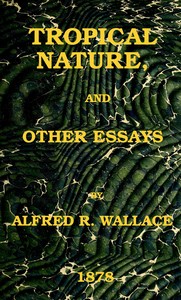
Tropical nature, and other essays — A Reader’s Guide
45
9
Project Gutenberg
2024
Natural history -- Tropics; Tropics; Ecology -- Tropics
Readers of public-domain and historical texts
Project Gutenberg digital edition
en
Edition facts
Words: 105,991
Reading time: 461 min
Text sections: 30
Source:
Project Gutenberg record #73563
Alfred Russel Wallace examines tropical natural phenomena through a scientific lens, distinguishing essential from accidental features. The essays blend precise observation with theoretical inquiry, exploring color production, climate effects, and the interplay of structure and environment.
Editorial Edition Score
4.9/5
★★★★★
★★★★★
Calculated from edition completeness, EPUB availability, text structure and catalogue metadata. Not a user rating.
Edition quality
Alfred Russel Wallace opens Tropical Nature, and Other Essays by distinguishing his approach from earlier travel writers: he aims to give a general view of phenomena that are essentially tropical, separating the local from the general and the accidental from the essential. The book's preface signals a systematic, analytical method rather than mere description. Wallace's voice is that of a naturalist who values explanation over wonder, though he does not dismiss the beauty of the tropics. The opening poem, contrasting the "unvarying splendours" of the tropics with England's "shifting scenes of beauty," establishes a comparative framework that recurs throughout the essays.
From Poem to Preface: Shifts in Register
The book begins with a sonnet pair that contrasts the tropics and England in conventional poetic diction: "Land of the Sun!" versus "Sweet changing Seasons!" This lyrical opening gives way to the preface's plain, expository prose. The shift is abrupt—from apostrophe to argument. Wallace writes that "the luxuriance and beauty of Tropical Nature is a well-worn theme," immediately deflating any romantic expectation. This change in register is not merely stylistic; it reflects Wallace's core project: to move from the subjective impressions of travellers to objective analysis. The reader should note how the author's voice modulates between these modes throughout the essays, sometimes returning to vivid description but always grounding it in causal reasoning.
The Mechanics of Colour: A Shift to Technical Prose
In the excerpt on how animal colours are produced, Wallace adopts a markedly different tone. He explains the physics of light, the structure of the retina, and the chemistry of pigments with textbook precision. Sentences become longer and more conditional: "It is a property of these various radiations, that they are unequally refracted..." The vocabulary shifts to terms like "refrangibilities," "molecular structure," and "metachromatism." This section demonstrates Wallace's ability to shift from natural history to physical science, integrating contemporary research (such as Mr. Ackroyd's work on colour-change by heat). The pace slows considerably; the reader is asked to follow careful reasoning rather than visual description. This technical passage contrasts sharply with the poem's emotional appeal, showing the range of Wallace's expository voice.
Pacing Through Parenthetical Detail
Wallace frequently inserts parenthetical asides and numbered references that alter the reading rhythm. In the colour section, he adds a footnote (18) citing a chemical journal, and within the text he offers examples like "mercuric oxide, which is orange yellow, but which changes to orange, red, and brown when heated." These details slow the narrative, demanding attention to specific cases. Yet they also serve a rhetorical purpose: they ground Wallace's general claims in observable phenomena. The reader may notice how these interruptions create a stop-start pace, especially when compared to the flowing lines of the opening poem. This technique reflects Wallace's commitment to evidence: he will not let a generalization pass without concrete support, even if it disrupts the flow.
Readers approaching Tropical Nature, and Other Essays should attend to the shifts in pace and register that mark Wallace's method. The book moves between poetic invocation, analytical exposition, and technical digression, each mode serving a distinct purpose. Rather than a uniform reading experience, the essays offer a series of intellectual engagements that reward patience. Wallace's voice is that of a naturalist who respects both the wonder and the complexity of his subject, and who trusts his reader to follow him through varied terrain.
Reader reflection
Your personal reading reflection
Build a private reading journal entry for this title.
Your progress
0
/
10
2
What was your overall reaction to the book?
3
How likely are you to recommend this book?
4
How much effort did this book require?
5
How did the reading compare with what you expected?
6
How strong was your personal connection to the text?
7
How useful were the ideas in this book?
8
Do you expect to return to this book?
9
In one sentence, what did you learn?
10