1

The Wise and Ingenious Companion, French and English; or, A Collection of the Wit of the Illustrious Persons, Both Ancient and Modern — Reading Notes
28
6
Project Gutenberg
2017
Wit and humor; Anecdotes
Readers of public-domain and historical texts
Project Gutenberg digital edition
en
Edition facts
Words: 66,477
Reading time: 290 min
Text sections: 21
Source:
Project Gutenberg record #54498
Abel Boyer's 1700 bilingual collection of witty sayings, repartees, and stories from ancient and modern figures, presented in parallel French and English texts, with a prefatory introduction defending the moral and intellectual value of humor.
Editorial Edition Score
4.8/5
★★★★★
★★★★★
Calculated from edition completeness, EPUB availability, text structure and catalogue metadata. Not a user rating.
Edition quality
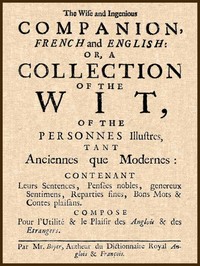
Abel Boyer's The Wise and Ingenious Companion, French and English (1700) presents itself as a dual-language treasury of wit, pairing French and English texts on facing pages. The title page promises wise sayings, noble sentiments, witty repartees, jests, and pleasant stories from illustrious persons both ancient and modern. Boyer, known for his Royal Dictionary, frames the collection as calculated for the improvement and pleasure of English and foreign readers alike.
The prefatory introduction argues that sentences, witty repartees, and jests have been esteemed by all civilized nations, citing Julius Caesar's collection of contemporary jests and Plutarch's recording of illustrious men's sayings. This defense of wit as both useful and delightful sets the tone for a work that blends instruction with entertainment.
Bilingual Structure and Reader Expectations
The most distinctive feature of this volume is its parallel presentation: each anecdote or saying appears first in English, then in French, or vice versa. The excerpt from a longer story—beginning with a mother telling her children a tale of love and slavery—shows the French text on the left and English on the right, with identical content in both languages. This layout suggests the book was designed for language learners as much as for connoisseurs of wit. Boyer's preface explicitly states the work is "calculated for the improvement and pleasure of the English and foreigners," indicating a pedagogical purpose. The bilingual format allows readers to compare phrasing and vocabulary across languages, making the collection a practical tool for studying French or English while enjoying the content.
The Prefatory Defense of Wit
Boyer opens with a learned introduction that traces the pedigree of wit-collecting from ancient Greece and Rome to modern authors. He mentions Julius Caesar's collection of jests, Plutarch's biographical anecdotes, and Diogenes Laertius's lives of philosophers, as well as moderns like Lord Bacon and Guichardin. This framing elevates the book beyond mere jest-book status, positioning it within a tradition of moral and intellectual improvement. The preface argues that witty sayings and repartees have been esteemed by all civilized nations, implying that the reader who engages with this collection is participating in a refined, cosmopolitan practice. Boyer's own authority as a lexicographer lends weight to this claim, as he presents himself as a curator of verbal excellence.
A Tale of Passion and Moral Ambiguity
The longest excerpt in the provided text is a first-person narrative of a woman's secret love for a slave named Glison. She describes her physical and emotional turmoil—"I could neither eat nor sleep"—and her eventual confession, which Glison accepts, saving her life. The story is framed by a mother addressing her children: "be merry whilst youth permits you; for the remembrance of past pleasures will be the only ones of your old age." This tale, with its frank depiction of desire and its morally ambiguous conclusion, stands in contrast to the book's advertised "wise sayings" and "noble sentiments." It suggests that the collection includes not only decorous wit but also more earthy, even transgressive, narratives, all presented without explicit moral judgment.
Readers approaching this work should attend to the interplay between its stated purpose—improvement through wit—and the actual content, which ranges from courtly repartee to intimate confession. The bilingual format rewards those who compare the two versions, as subtle differences in phrasing may reveal cultural assumptions about humor and decorum. Boyer's compilation offers a window into early modern attitudes toward language, learning, and the pleasures of a well-turned phrase.
Reader reflection
How will you remember this book?
Save your reaction, strongest insight, and memorable passage.
Your progress
0
/
10
2
How much did you enjoy the reading experience?
3
Would you pass this book on to a friend?
4
How easy was the book to follow?
5
Is this a title worth rereading?
6
How would you rate its originality?
7
Would you like to discuss this book with someone?
8
How would you describe its reading pace?
9
What changed or sharpened your thinking?
10