1

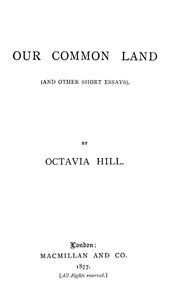
Our Common Land (and Other Short Essays) — Key Ideas to Explore
23
3
Project Gutenberg
2019
Land tenure -- Great Britain; Charity; Commons -- Great Britain
Readers of public-domain and historical texts
Project Gutenberg digital edition
en
Edition facts
Words: 38,371
Reading time: 167 min
Text sections: 4
Source:
Project Gutenberg record #59654
Octavia Hill's 1877 essays argue for preserving London's commons and transforming churchyards into public gardens. Her direct, observational prose blends social reform with practical steps, revealing a Victorian activist's voice through vivid crowd scenes and detailed proposals.
Octavia Hill opens 'Our Common Land' with a Bank holiday scene dense with sensory detail: 'a great dull unbroken choking cloud of dust' hangs over roads crowded with 'van, cart, chaise, gig.' The passage immediately establishes her method—grounding a reform argument in the lived, messy reality of London's poor enjoying rare leisure. She does not romanticize; she notes the 'wild songs and boisterous behaviour' and the 'sadly intoxication' bound up with holidays, yet balances this with the 'intense enjoyment' and 'unmixed good' she observes in family groups. This dual vision, attentive to both disorder and dignity, characterizes her authorial stance throughout the collection.
Observational Diction and the Crowd
Hill's prose relies on precise, unadorned observation rather than abstract moralizing. In the opening essay, she catalogs the vehicles—'van, cart, chaise, gig'—and the 'every size and sort of donkey, pony, or horse' pulling them. The repetition of 'every' and the accumulation of detail create a sense of overwhelming, chaotic movement. Yet she also singles out specific figures: 'the quiet figure of the mounted policeman' who 'keeps very tolerable order.' Her diction is exact: the crowd is 'undisciplined, but heartily happy.' She does not flinch from the 'really bad sights' at public-houses, but she also notes the 'happy family groups' with 'picnic dinners neatly tied up in handkerchiefs.' This balance of critical and sympathetic observation gives her argument a persuasive, grounded authority.
Dialogue with the Reader and Practical Address
Hill frequently shifts into direct address, using 'you' to draw the reader into her reform projects. In the essay on open spaces, she writes: 'I have ventured to draw the attention of some few London vicars to the question, and if you would each of you look in any crowded neighbourhood known to you, what might be done.' This is not a rhetorical flourish but a concrete call to action. She outlines the exact steps for converting a churchyard into a garden: secure the incumbent's leave, post notice on church doors, call a vestry meeting, obtain a faculty from the Dean of Arches. The specificity—'£1,200 was voted by the vestry' for St. George's-in-the-East, 'about £160' for Drury Lane—makes the proposal tangible. Her voice is that of an experienced organizer, not a distant theorist.
Recurring Details of Scale and Supervision
Throughout the excerpts, Hill returns to practical questions of scale and oversight. She distinguishes between large grounds that 'might be thrown absolutely open' and 'very small grounds' where admission might be by ticket. The supervisor she envisions is modest: 'an old man, any not too feeble old pensioner, especially if fortified with some kind of uniform.' The phrase 'fortified with some kind of uniform' reveals her pragmatic sense of how authority is signaled. She notes that 'the people will themselves help to keep order very soon,' suggesting a faith in communal self-regulation. These recurring details—ticket systems, uniformed attendants, the cost of bulbs—anchor her idealism in administrative reality. They also reflect her broader social philosophy: reform must be incremental, locally managed, and attentive to human nature.
The Churchyard as a Garden: A Case Study in Description
Hill's description of the transformed churchyard at St. George's-in-the-East is notable for its concrete, almost tactile language. She reports that the vestry 'actually ordered 24,000 bulbs this spring, in their enthusiasm to make the place bright and pretty.' The number '24,000' is characteristically precise, and the word 'actually' conveys a mild surprise at the vestry's eagerness. She earlier describes the ideal garden: 'they might sit quietly under trees; there the tiny children might play on gravel or grass, with a sense of Mother Earth beneath them.' The phrase 'Mother Earth' is rare in her otherwise practical lexicon, hinting at a deeper emotional appeal. Yet she immediately returns to utility: such gardens could be 'out-door sitting-rooms' where visitors might 'teach them games, read to them.' The description never loses sight of the reform goal.
Hill's essays reward attention to her sentence rhythms and the way she juxtaposes the 'choking cloud of dust' with the 'heartily happy' crowd. Readers interested in Victorian social reform will find here not only a historical document but a model of persuasive writing that earns its authority through precise observation and practical detail. The collection is best read slowly, noting how each essay builds a case from the ground up—from a single churchyard to a vision of common land preserved for all.
Reader reflection
How will you remember this book?
Save your reaction, strongest insight, and memorable passage.
Your progress
0
/
10
2
What was your overall reaction to the book?
3
Would you pass this book on to a friend?
4
Did the language feel accessible?
5
How clearly were the main ideas presented?
6
Did it raise ideas you would like to talk about?
7
Was the book what you thought it would be?
8
How valuable was this book for your own interests?
9
In one sentence, what did you learn?
10