1

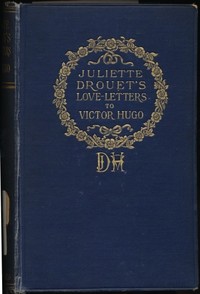
Juliette Drouet's Love-Letters to Victor Hugo Edited with a Biography of Juliette Drouet — Text and Context
39
8
Project Gutenberg
2013
Hugo, Victor, 1802-1885; Drouet, Juliette, 1806-1883
Readers of public-domain and historical texts
Project Gutenberg digital edition
en
Edition facts
Words: 94,386
Reading time: 411 min
Text sections: 9
Source:
Project Gutenberg record #44034
A collection of Juliette Drouet's letters to Victor Hugo, revealing her evolving voice from adoration to jealousy and despair, with an editor's biography framing the correspondence.
Editorial Edition Score
4.8/5
★★★★★
★★★★★
Calculated from edition completeness, EPUB availability, text structure and catalogue metadata. Not a user rating.
Edition quality
Juliette Drouet's letters to Victor Hugo, spanning from 1836 onward, offer a record of a relationship marked by intense emotional fluctuation. The excerpts show a voice that shifts rapidly between devotion and accusation, often within a single letter. Drouet's prose is direct and personal, frequently addressing Hugo as "my beloved" or "my glorious Victor," yet she does not hesitate to express doubt and jealousy. The letters are dated precisely, with times like "8.15 p.m.," suggesting a disciplined habit of writing. This editorial note examines the language, narrative voice, and changes in pace across the correspondence, drawing on the provided excerpts.
A Voice of Contradiction
Drouet's language oscillates between extremes. In the February 3, 1836 letter, she writes, "I accept my position without regret," yet immediately questions Hugo's love: "I cannot help noticing that your love is not what it was." This pattern of assertion followed by doubt recurs throughout. She demands honesty—"be brave enough to do so frankly"—while also pleading for reassurance. The voice is not passive; she insists on her worth: "I want no pension. I demand my place in your heart." The letters reveal a woman who is both submissive and defiant, using the intimate form of address to maintain closeness while challenging Hugo's behavior.
Jealousy as a Rhetorical Device
Jealousy dominates the February 17, 1836 letter, where Drouet declares, "I detest every woman upon whom your glances rest." She extends her jealousy to inanimate objects: "I am jealous of the very pavement upon which you tread." This hyperbolic language serves to emphasize the depth of her passion. She compares herself to a lioness, and her love to a force that can "rage, weep, crawl, or stand erect." The pacing here is rapid, with short clauses piling up to convey frenzy. In contrast, the August 15 letter adopts a more plaintive tone, complaining of being left alone and growing fat. The shift from fiery jealousy to mundane grievance shows the range of her emotional register.
Pacing and Temporal Markers
The letters are anchored by precise dates and times, creating a sense of immediacy. The February 3 letter is dated simply, while the February 17 letter adds "Wednesday, 8.15 p.m.," and the August 15 letter notes "Thursday, 8 p.m." This specificity suggests Drouet wrote at regular intervals, perhaps daily. The pacing within letters varies: the February 17 letter is breathless, with short, exclamatory sentences; the August 15 letter is more discursive, beginning with a complaint about being left alone and then drifting into reflections on her career. The editor's biography, though not excerpted, likely contextualizes these shifts, but the letters themselves show a writer attuned to the rhythms of her own emotions.
Readers approaching this collection should attend to the tension between Drouet's declared devotion and her persistent questioning of Hugo's fidelity. The letters are not merely love notes but documents of a woman negotiating her place in a relationship with a famous writer. The editor's biography may provide external context, but the letters stand as a testament to Drouet's own voice—passionate, jealous, and unafraid to demand honesty.
Reader reflection
How will you remember this book?
Save your reaction, strongest insight, and memorable passage.
Your progress
0
/
10
2
Was reading this book enjoyable?
3
Would you encourage someone else to read it?
4
What was the reading difficulty like?
5
Did the book give you something worth debating?
6
How did the reading compare with what you expected?
7
Which part made the strongest impression?
8
Did the story or argument move comfortably?
9
What changed or sharpened your thinking?
10