1

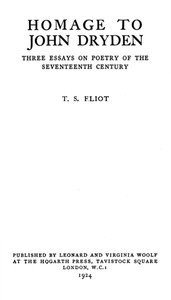
Homage to John Dryden: Three Essays on Poetry of the Seventeenth Century — Background and Themes
23
4
Project Gutenberg
2020
English poetry -- Early modern, 1500-1700 -- History and criticism; Great Britain -- Intellectual life -- 17th century
Readers of public-domain and historical texts
Project Gutenberg digital edition
en
Edition facts
Words: 14,088
Reading time: 62 min
Text sections: 2
Source:
Project Gutenberg record #63547
T.S. Eliot's 1924 collection of three essays on Dryden, the Metaphysical poets, and Marvell, originally published in the Times Literary Supplement, argues for the elegance of 17th- and 18th-century verse against Romantic norms, using precise textual observations.
Editorial Edition Score
4.5/5
★★★★★
★★★★★
Calculated from edition completeness, EPUB availability, text structure and catalogue metadata. Not a user rating.
Edition quality
Eliot opens his preface by confessing that these three essays, written years earlier for the Times Literary Supplement, need “still more justification in a book.” He had planned a series on seventeenth- and eighteenth-century poetry from Chapman to Johnson, but abandoned it due to “dissipation” and “infirmities of age.” The essays, he says, preserve “in cryptogram certain notions” too controversial to state directly. This defensive, almost apologetic tone sets the stage for a work that is both a homage and a polemic.
The Opening Gambit: Dryden and the Nineteenth-Century Reader
Eliot begins the first essay by confronting a problem: most living readers, he claims, are genuinely insensible to Dryden’s genius. He attributes this to a taste “formed entirely upon the English poetry of the nineteenth-century.” The twentieth century, he adds wryly, “is still the nineteenth.” Rather than praising Dryden directly, Eliot proposes to show that this insensibility “does not merely signify indifference to satire and wit” but a deeper lack of perception. He thus frames the essay as a corrective, not a celebration. The reader should note how Eliot uses the negative—what readers fail to see—as his primary argumentative strategy.
The Metaphysical Poets: A Revaluation Through Johnson
In the second essay, Eliot engages directly with Samuel Johnson’s criticism of the Metaphysical poets. He warns that we must not reject Johnson’s judgment “without having mastered it.” Johnson’s concept of wit, Eliot insists, was “something more serious than we usually mean to-day.” He also notes the narrow discipline of Johnson’s training. Eliot’s method here is to acknowledge the authority of the critic he partly opposes, then to qualify it. He suggests that a “fruitful work” would break up Johnson’s classification and exhibit the poets “in all their difference of kind and of degree.” The essay thus becomes a dialogue with the critical tradition.
Marvell and the Quality of a Civilization
The third essay turns to Andrew Marvell, whose tercentenary Eliot marks with “serious reflection.” He distinguishes this from “the resurrection of a deceased reputation,” noting that Marvell’s best poems are already well known. The critic’s task, Eliot says, is “to squeeze the drops of the essence of two or three poems.” He identifies the valuable quality in Marvell as “a quality of a civilization, of a traditional habit of life” rather than a personal one. This claim is striking: it ties poetic merit to cultural context, not individual genius. The reader should watch how Eliot uses Marvell to exemplify a broader argument about seventeenth-century verse.
Eliot’s Comparative Method: Diction and the Soul
Across the essays, Eliot repeatedly compares English poets to French ones. He calls Racine “the great master of the seventeenth century” and Baudelaire “the great master of the nineteenth,” noting they are “more like each other than they are like anyone else.” He then contrasts them with Milton and Dryden, who “triumph with a dazzling disregard of the soul.” This comparison is central to Eliot’s critical stance: he values psychological depth and diction together. He even urges poets to look “into the cerebral cortex, the nervous system, and the digestive tracts” rather than merely the heart. These passages reveal Eliot’s ambition to redefine the standards of poetic excellence.
These three essays, though brief, offer a concentrated argument about the trajectory of English poetry. Eliot’s method is to use specific poets as case studies for larger claims about tradition, sensibility, and critical judgment. Readers will benefit from attending to his comparative references—especially to French poets—and to his careful engagement with earlier critics like Johnson. The essays reward rereading, as Eliot’s own cryptic hints often become clearer on a second pass.
Reader reflection
Your personal reading reflection
Build a private reading journal entry for this title.
Your progress
0
/
10
2
Did this book hold your interest?
3
Would you encourage someone else to read it?
4
What was the reading difficulty like?
5
How clearly were the main ideas presented?
6
Would this book work well in a reading group?
7
How did the pace of the book feel?
8
How did the reading compare with what you expected?
9
What changed or sharpened your thinking?
10