1

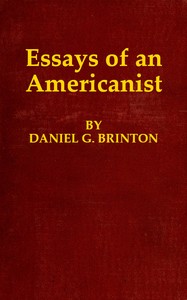
Essays of an Americanist I. Ethnologic and Archæologic. II. Mythology and Folk Lore. III. Graphic Systems and Literature. IV. Linguistic. — Story, Setting & Ideas
29
3
Project Gutenberg
2018
Indians; America -- Antiquities
Readers of public-domain and historical texts
Project Gutenberg digital edition
en
Edition facts
Words: 130,144
Reading time: 566 min
Text sections: 26
Source:
Project Gutenberg record #58464
Daniel G. Brinton's collection of essays defends the autochthony and high mental capacity of ancient American peoples through ethnology, mythology, graphic systems, and linguistics, using specific textual evidence from Aztec and Peruvian sources.
Editorial Edition Score
4.9/5
★★★★★
★★★★★
Calculated from edition completeness, EPUB availability, text structure and catalogue metadata. Not a user rating.
Edition quality
Brinton opens his preface by aligning his use of "essays" with Montaigne's sense of "attempts, endeavors," signaling a personal and argumentative stance. He directly states his divergence from most modern anthropologists on key points: the antiquity of man in America, the specific distinction of an American race, the generic similarity of its languages, and the phonetic character of some graphic methods. This forthright declaration frames the collection as a sustained defense of the autochthony and psychological complexity of indigenous cultures.
The excerpts reveal a scholar who moves between analytical prose and quoted primary texts, such as the Aztec war-songs. Brinton's method is to juxtapose his own interpretations with the raw material of native poetry, as when he explicates the metaphorical language of Tetlapan Quetzanitzin's song, clarifying that "flowers" refer to war-shields and "drunkenness" to battle fury. This interplay between commentary and evidence is a structural hallmark of the work.
The Preface as Manifesto
Brinton's preface is not a mere introduction but a declaration of intellectual independence. He lists the points where he stands "at variance with most modern anthropologists," including the antiquity of man in America and the specific distinction of an American race. This list functions as a table of contents for his arguments, each essay designed to vindicate these positions. The preface also diagnoses a prevailing error: the tendency to underrate "the psychology of savage life." Brinton attributes this to four causes: an unwillingness to go beyond physical investigations, judging ancient tribes by their degenerate modern representatives, inability to speak their languages, and preconceived theories about what a savage might know. This critique sets the stage for his method, which relies heavily on linguistic and textual evidence.
War-Songs as Windows to Psychology
Brinton devotes significant space to analyzing Aztec and Peruvian war-songs, treating them as evidence of sophisticated poetic feeling and abstract thought. He presents a song attributed to Tetlapan Quetzanitzin, an Aztec prince who was present at the capture of Montezuma. Brinton notes that the song is "highly metaphorical" and could be mistaken for a drinking song, but he explains that the "drunkenness" refers to battle intoxication, the "flowers" are war-shields, and the "fertile plains" are those watered with blood. He also provides a second song, which he calls a "war-song of the Chichimecs," featuring recurring images of smoke, flowers, and the "Giver of Life." These poems are presented without named authors, except for Tetlapan, whose historical circumstances Brinton briefly sketches. The effect is to ground abstract claims about indigenous psychology in specific, quoted texts.
Recurring Images and Symbolic Language
Across the excerpts, certain images recur: flowers, smoke, wine, and battle. In the Chichimec song, "the smoke of the war-fire winds around" and "the fatal flowers of death cover the fields." In Tetlapan's song, the poet urges his friends to "drink the white wine" of battle and seek "homes in some flowery land." Brinton interprets these as symbolic: flowers represent shields or the adornments of war, and wine represents the intoxicating fury of combat. He also notes that white wine was a sacred beverage among the Mexicans, used at solemn festivals. This attention to recurring motifs demonstrates Brinton's method of reading native texts as coherent symbolic systems, not primitive outbursts. He treats the poems as evidence of a "mental nature of excellent capacity" capable of abstract and metaphorical thought.
Structure: From Essay to Evidence
The book's structure is cumulative: each essay builds on the previous ones, and the same themes recur across sections. Brinton acknowledges this repetition in the preface, calling it a "defect" but one that allows each essay to stand alone. The excerpts show a pattern: Brinton states a thesis, then presents a primary text (such as a song or a linguistic example), and then explicates it. For instance, after quoting the Chichimec war-song, he immediately comments on its lack of named author, contrasting it with Tetlapan's song, which has a known composer. This movement between general claim and specific evidence is consistent. The reader is expected to follow Brinton's argument across multiple essays, each of which contributes to the overarching vindication of indigenous culture.
Readers approaching this collection should be prepared for a work that is both scholarly and polemical. Brinton does not merely describe indigenous cultures; he argues for their complexity against prevailing anthropological trends. The excerpts suggest that the most rewarding way to read the book is to follow the interplay between Brinton's analytical voice and the native texts he quotes. Pay attention to the recurring images—flowers, smoke, wine—and how Brinton uses them to build his case. The book rewards patience, as arguments accumulate across essays, each adding a piece to the larger picture of Americanist thought in the late nineteenth century.
Reader reflection
How did this book work for you?
Your answers remain private and are stored only in this browser.
Your progress
0
/
10
2
How much did you enjoy the reading experience?
3
Would you encourage someone else to read it?
4
How demanding did the text feel?
5
What was the strongest part of the book?
6
Would you start a conversation about this book?
7
How clearly were the main ideas presented?
8
How distinctive were its ideas or approach?
9
What did this book teach you most?
10