1

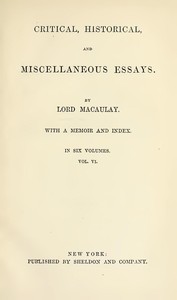
Critical, Historical, and Miscellaneous Essays; Vol. 6 With a Memoir and Index — Themes and Context
25
4
Project Gutenberg
2017
Great Britain -- History; English literature -- History and criticism
Readers of public-domain and historical texts
Project Gutenberg digital edition
en
Edition facts
Words: 171,329
Reading time: 745 min
Text sections: 32
Source:
Project Gutenberg record #55906
This volume collects Macaulay's essays on Chatham, Atterbury, Bunyan, Goldsmith, Johnson, and Pitt, with a memoir and index. The excerpts show his characteristic blend of biographical narrative, political analysis, and moral judgment, particularly in the detailed account of Pitt's final illness and funeral.
Editorial Edition Score
4.9/5
★★★★★
★★★★★
Calculated from edition completeness, EPUB availability, text structure and catalogue metadata. Not a user rating.
Edition quality
Macaulay's essay on William Pitt the Younger, included in this volume, opens with a striking admission of delay: the author had begun a sketch of Lord Chatham more than ten years earlier and now returns to it, noting that materials available in 1834 were 'scanty and unsatisfactory' compared to those at hand in 1844. This self-consciousness about sources recurs throughout the volume, which also contains essays on Francis Atterbury, John Bunyan, Oliver Goldsmith, Samuel Johnson, and a second Pitt essay. The excerpts reveal a writer who treats historical figures as subjects for moral portraiture, blending political narrative with personal anecdote.
A Deathbed Scene Without Sentiment
The account of Pitt's final days is notably unsentimental. Macaulay reports that stories of 'devout sentiments fervently uttered by the dying man' found 'no credit with anybody who knew him,' and he quotes Wilberforce's judgment that Pitt 'always said less than he thought on such topics.' The famous last words 'Oh my country!' are dismissed as 'a fable.' Instead, the dying man's actual utterances were 'broken exclamations about the alarming state of public affairs.' This refusal to embellish a deathbed scene is characteristic of Macaulay's approach: he values factual accuracy over hagiography, even when the subject is a towering political figure.
The Rhetoric of Political Opposition
Macaulay's essay on Pitt also contains a revealing passage about Fox's speech opposing a public funeral and monument for Pitt. He describes the speech as 'a model of good taste and good feeling,' noting that Fox performed 'the most invidious that ever an orator undertook' with 'humanity and delicacy.' This moment of cross-party respect is framed within a larger narrative of political rivalry. Earlier in the volume, Macaulay characterizes the Whig and Tory as representing 'a great principle, essential to the welfare of nations'—one the 'guardian of liberty,' the other of 'order.' Such abstract formulations sit alongside concrete details of parliamentary maneuvering.
The Material Culture of State Funerals
The description of Pitt's funeral is rich in physical detail: the corpse lay 'in state during two days in the Painted Chamber,' then was borne 'with great pomp to the northern transept of the Abbey.' The grave was placed 'near to the spot where his great father lay, near also to the spot where his great rival was soon to be.' Wilberforce, who 'carried the banner before the hearse,' reported that 'the eagle face of Chatham from above seemed to look down with consternation into the dark house.' Macaulay uses these concrete images to underscore the pathos of a minister who 'died of sorrows and anxieties of which none of the survivors could be altogether without a share.'
Readers approaching this volume should expect essays that are as much about character as about policy. Macaulay's method is to anchor broad historical arguments in specific, often vivid, human details—a dying man's last words, a rival's generous speech, the placement of a grave. The memoir and index that frame the collection suggest an editorial intention to present these pieces as a coherent body of work, though the excerpts alone cannot confirm how the volume's structure shapes the reader's experience.
Reader reflection
Your personal reading reflection
Build a private reading journal entry for this title.
Your progress
0
/
10
2
What was your overall reaction to the book?
3
Would you encourage someone else to read it?
4
What was the reading difficulty like?
5
Did the book deliver what you hoped for?
6
What did you think about the pace?
7
Would you read this book again?
8
Did you gain anything practical from the text?
9
What changed or sharpened your thinking?
10