1

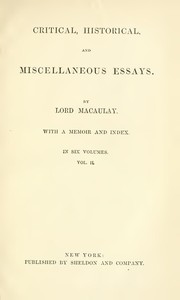
Critical, Historical, and Miscellaneous Essays; Vol. 2 With a Memoir and Index — Inside the Classic
31
5
Project Gutenberg
2017
Great Britain -- History; English literature -- History and criticism
Readers of public-domain and historical texts
Project Gutenberg digital edition
en
Edition facts
Words: 177,895
Reading time: 774 min
Text sections: 32
Source:
Project Gutenberg record #55902
Macaulay's second volume of essays showcases his combative prose and shifting pace: from the dense, syllogistic demolition of James Mill's Utilitarianism to the swift, ironic dismantling of arguments against Jewish emancipation, revealing a writer who adapts his rhythm to his rhetorical target.
Editorial Edition Score
4.9/5
★★★★★
★★★★★
Calculated from edition completeness, EPUB availability, text structure and catalogue metadata. Not a user rating.
Edition quality
Macaulay opens his essay on James Mill's Essay on Government with a characteristic blend of mock deference and sharp-edged irony. He notes that Mill's admirers consider the work 'perfect and unanswerable,' yet Macaulay immediately signals his dissent, setting up a sustained, methodical critique that proceeds through logical dissection. The pace is deliberate, almost forensic, as he examines Mill's premises and conclusions.
In contrast, the essay on Jewish disabilities adopts a quicker, more conversational rhythm. Macaulay shifts from dense philosophical argument to brisk, almost colloquial refutations, using rhetorical questions and pointed analogies. This change in tempo is not arbitrary; it reflects the different nature of the two debates—one abstract and theoretical, the other urgent and practical.
The Rhythm of Refutation
Macaulay's prose in the Mill essay moves with the measured pace of a courtroom cross-examination. He builds his case step by step, often restating his opponent's position before dismantling it. For instance, he quotes Mill's claim that the essay is 'irrefragably established' and then proceeds to show its logical flaws. The sentences are long, periodic, and packed with qualifying clauses, mirroring the complexity of the argument.
In the Jewish disabilities essay, the pace quickens. Macaulay uses shorter sentences and sharper contrasts: 'The constitution, it is said, is essentially Christian; and therefore to admit Jews to office is to destroy the constitution.' He then pounces on the absurdity with a swift analogy: 'essentially Protestant cookery, or essentially Christian horsemanship.' The rhythm here is more staccato, designed for immediate impact rather than sustained reasoning.
Voice and Audience
The voice in the Mill essay is that of a learned reviewer addressing fellow intellectuals. Macaulay assumes familiarity with Benthamite terminology and philosophical debates. He uses technical language—'Utilitarians,' 'Benthamites,' 'demonstration'—and expects his reader to follow intricate chains of reasoning. The tone is cool, even condescending, as he exposes what he sees as Mill's errors.
In the Jewish disabilities essay, Macaulay adopts a more public, persuasive voice. He addresses a broader audience, using plain language and common-sense appeals. He writes of 'the force of reason' and 'just principles,' and he frames the issue as a matter of basic fairness. The voice becomes that of an advocate, not just a critic, urging action rather than merely analyzing ideas.
Structural Contrasts
The Mill essay follows a traditional review structure: introduction of the work, summary of its arguments, then point-by-point refutation. Macaulay organizes his critique around key claims, such as Mill's definition of government and his views on representation. The structure is linear and cumulative, each paragraph building on the previous one.
The Jewish disabilities essay, by contrast, is more episodic. Macaulay moves from one argument to another, often using rhetorical questions to transition: 'Is it not a source of mortification...?' He also employs a more varied structure, mixing logical analysis with satirical jabs. The essay ends with a call to action, a feature absent from the Mill piece, which concludes with a final, devastating logical point.
Readers approaching this volume should attend to how Macaulay calibrates his style to his subject. The essays reward careful attention to sentence rhythm and rhetorical strategy, not just argumentative content. Noting shifts in pace and voice can illuminate Macaulay's method as a critic and advocate, revealing a writer who understood that how one says something is often as important as what one says.
Reader reflection
How will you remember this book?
Save your reaction, strongest insight, and memorable passage.
Your progress
0
/
10
2
How much did you enjoy the reading experience?
3
Is this a title you would suggest to others?
4
What was the reading difficulty like?
5
What was its emotional impact?
6
Did it raise ideas you would like to talk about?
7
Was the book easy to understand?
8
Is this a title worth rereading?
9
What is the main idea you are taking away?
10