1

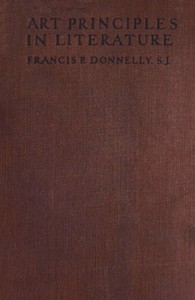
Art principles in literature — A Closer Reading
27
2
Project Gutenberg
2021
Literature; Aesthetics
Readers of public-domain and historical texts
Project Gutenberg digital edition
en
Edition facts
Words: 37,678
Reading time: 164 min
Text sections: 23
Source:
Project Gutenberg record #64443
Francis P. Donnelly's 1923 work argues for enduring aesthetic principles in literature, drawing on Aristotle and contrasting the roles of lecturer and teacher, with a focus on bringing the reader to the text rather than to secondary sources.
Editorial Edition Score
4.7/5
★★★★★
★★★★★
Calculated from edition completeness, EPUB availability, text structure and catalogue metadata. Not a user rating.
Edition quality
Francis P. Donnelly opens Art Principles in Literature by positioning his work as a continuation of an earlier discussion, but with a broader scope: not merely the art of interesting, but the application of artistic principles to writing and speaking. He immediately confronts the reader with a philosophical stance, rejecting skepticism, agnosticism, and pragmatism in favor of a belief in first principles that are as final as those of morals or pure science. Donnelly’s prose is direct and combative, as when he dismisses the notion that we must wait for future generations to validate artistic principles, quipping that such a view would leave us waiting until the last man joins Tutankhamen.
Aristotle’s Enduring Authority
Donnelly’s argument for the finality of artistic principles rests heavily on Aristotle. He asserts that Aristotle’s principles have “something of that finality” because they were derived from a body of literature that has met with the approval of the best taste across centuries. This is a striking claim: while Aristotle’s biology and physics are outdated, his ethics, logic, and aesthetics remain “in measurable distance of finality.” Donnelly acknowledges that additions have been made in religion and music, but insists that in literature, few additions have been made to the fields Aristotle surveyed. This selective appeal to authority is central to Donnelly’s method: he uses Aristotle not as a historical figure but as a benchmark for timelessness, and he does so without engaging with any post-Aristotelian literary theory.
The Lecturer Versus the Teacher
Donnelly draws a sharp distinction between the lecturer and the teacher of literature. The lecturer, he writes, “must stray more from the text than the teacher,” and is “necessarily more general and hence more impersonal.” The lecturer formulates theories based on dissection of the text, while the teacher’s “more humble lot” leads him to efface himself in the presence of the author. This dichotomy is not merely descriptive but prescriptive: Donnelly clearly values the teacher’s approach. He illustrates this with a lengthy quotation from Justin McCarthy describing his old schoolmaster, John Goulding, whose method was “literary rather than scholastic.” Goulding made students understand and enjoy what they read, using grammar as a means, not an end. Donnelly’s choice of this anecdote reveals his ideal: a teacher who brings the pupil to the text, not to footnotes or appendices.
The Text as Center, Not Starting Point
Donnelly’s central pedagogical principle is that the text should be the center of all study, not a launching pad for specialized digressions. He writes, “The text should be the center upon which every source of information should be focused, not the center from which to radiate to the cheerless circumference of specializations.” This is a strong rebuke to philological or historical approaches that treat literature as a document to be dissected rather than a work to be experienced. Donnelly does not reject philology or grammar outright—he insists on thoroughness, care, and accuracy—but he subordinates them to the goal of bringing “the mind of the author to the mind of the reader.” His language is emphatic: “Away from dictionary and grammar, away from footnote and appendix, back to the text, should be the teacher’s cry.”
The Vocabulary of First Principles
Donnelly’s own diction reveals his commitment to absolutes. He uses words like “finality,” “final truths,” and “first principles” repeatedly, and he frames his argument as a reaction against “ceaseless experimenting” in literature and education. His tone is that of an active mind forced back upon fundamentals, and he writes with a confidence that borders on the polemical. He does not merely describe his approach; he defends it against unnamed opponents. The excerpts show a writer who is deeply concerned with method—not just what to teach, but how to teach it. His prose is marked by parallel structures and rhetorical questions, as when he lists the three despairs (skepticism, agnosticism, pragmatism) that he rejects. This stylistic choice reinforces his message: literature demands clear principles, not tentative experiments.
Donnelly’s book is not a survey of literary works but a manifesto for a particular kind of reading and teaching. Readers who expect practical criticism of poems or novels will not find it here. Instead, they will encounter a sustained argument for returning to the text itself, guided by principles that Donnelly believes are as stable as those of ethics. The book is best approached as a period piece in educational philosophy, one that reveals the anxieties and certainties of early twentieth-century classical pedagogy.
Reader reflection
Your personal reading reflection
Build a private reading journal entry for this title.
Your progress
0
/
10
2
How much did you enjoy the reading experience?
3
How likely are you to recommend this book?
4
Did the language feel accessible?
5
How clear did the writing feel?
6
How would you rate its originality?
7
Could you apply anything you learned?
8
Did any part of the book feel personally relevant?
9
What changed or sharpened your thinking?
10