1

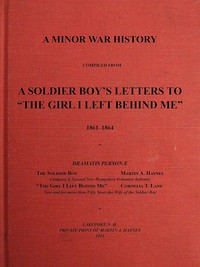
A Minor War History Compiled from a Soldier Boy's Letters to "the Girl I Left Behind Me": 1861-1864 — Key Ideas to Explore
26
2
Project Gutenberg
2020
United States -- History -- Civil War, 1861-1865 -- Personal narratives; United States. Army. New Hampshire Infantry Regiment, 2nd (1861-1865)
Readers of public-domain and historical texts
Project Gutenberg digital edition
en
Edition facts
Words: 75,748
Reading time: 330 min
Text sections: 157
Source:
Project Gutenberg record #63040
A collection of Martin A. Haynes's letters to his future wife, Cornelia T. Lane, written during his service in the 2nd New Hampshire Infantry (1861–1864). The letters offer a private soldier's view of camp life, logistics, and small incidents, deliberately avoiding grand strategy. Published in 1916 in a private edition of sixty copies.
Editorial Edition Score
4.9/5
★★★★★
★★★★★
Calculated from edition completeness, EPUB availability, text structure and catalogue metadata. Not a user rating.
Edition quality
The preamble to this volume explains its unusual origin: Martin A. Haynes, a private in Company I of the Second New Hampshire Volunteer Infantry, saved the letters he wrote to “the girl I left behind me” during the Civil War. Decades later, he copied them—removing “strictly personal matters”—and burned the originals. The result is a deliberately minor history, as he calls it, one that does not pretend to be a connected narrative or a study of campaigns. Instead, these letters preserve what the men in the ranks talked about, from sleigh rides and drunken choppers to the arrival of commissions and the loss of knapsacks. The book was printed in only sixty copies, mostly for family members, and Haynes wryly predicts it will demote him from his grandchildren’s heroic image to third place, behind Grant and Sherman.
A Private’s Perspective on Camp Life
The letters consistently avoid battlefield heroics. In one excerpt, Haynes describes a farcical sleigh ride by the general’s staff officers—complete with a wagon body mounted on runners, two tip-overs, and a final smash. He notes that the sleighing “would not have been called sleighing at all up in New Hampshire,” a remark that reveals both his New England frame of reference and his eye for the absurd. Elsewhere, he recounts a frustrating day spent gathering wood: a chopper who had been drunk all day claimed no wood was cut, forcing a two-mile round trip, only to be sent out again when the truth emerged. The passage ends with army mules and drivers struggling through “stumps, roots and bog holes.” These episodes, while seemingly trivial, form the texture of his war—a war of logistics, miscommunication, and small triumphs.
The Rhythm of Waiting and Rumors
Haynes’s letters are punctuated by the constant expectation of movement. In one, he notes that “stories of going home have been let loose every two or three weeks as regular as clockwork,” capturing the repetitive cycle of hope and disappointment. The editor’s note between letters confirms that such rumors did materialize: the regiment left the Army of the Potomac in February 1863, arrived in New Hampshire in March, and returned to Washington in May. During that furlough, Haynes married Cornelia T. Lane—the girl he left behind. The letters thus trace not only military service but a personal timeline, with the wedding occurring mid-war. The reader encounters these events as the soldier did: through anticipation, brief realization, and then a return to the front.
Loss and Farewell in the Margins
Though Haynes excised the most personal passages, loss surfaces in asides. In a letter dated May 27, 1863, he mentions that George Slade’s wife was at Concord, “almost heart-broken.” A bracketed editorial note—added decades later—reads simply: “It was their last farewell—George never came back.” This editorial intrusion, rare in the text, underscores the retrospective knowledge that the original letters could not contain. Haynes also notes that he was glad his own wife did not come to the depot, a quiet acknowledgment of the pain of parting. The letters do not dwell on death, but such moments remind the reader that the minor history is shadowed by major losses.
The Book’s Unusual Construction
Haynes’s compilation is not a seamless narrative. The letters are numbered (the excerpt includes Letter LXXXIX), and the editor’s notes bridge gaps in time. The preamble admits that the letters were burned after copying, making this volume the sole record of their content. The book was printed privately in 1916, fifty-five years after the war began, and the author’s preface jokes about his grandchildren’s likely disappointment. The physical edition—sixty copies, each numbered and presented to a recipient—emphasizes its status as a family artifact. Readers today encounter a text that is both a primary source and a curated memoir, shaped by Haynes’s decisions about what to include and what to destroy.
Because the letters were written without knowledge of the war’s outcome, they offer an immediate, unshaped record of a soldier’s daily concerns. Readers should approach the book not as a history of battles but as a collection of moments—some comic, some mundane, a few shadowed by foreshadowed grief. The gaps between letters, and the editorial notes that fill them, are as revealing as the correspondence itself. This is a minor history, as Haynes insisted, but one that rewards attention to its small details.
Reader reflection
How did this book work for you?
Your answers remain private and are stored only in this browser.
Your progress
0
/
10
2
How did the book work for you overall?
3
Would you encourage someone else to read it?
4
Did the language feel accessible?
5
How valuable was this book for your own interests?
6
Which part made the strongest impression?
7
Would a second reading be valuable?
8
How strong was your personal connection to the text?
9
Which lesson or insight stayed with you?
10