1

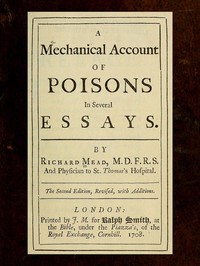
A Mechanical Account of Poisons in Several Essays — A Closer Reading
27
5
Project Gutenberg
2016
Poisons -- Early works to 1800; Venom -- Physiological effect -- Early works to 1800
Readers of public-domain and historical texts
Project Gutenberg digital edition
en
Edition facts
Words: 40,072
Reading time: 175 min
Text sections: 15
Source:
Project Gutenberg record #53202
Richard Mead's 1708 treatise examines poisons through a mechanical lens, analyzing venom, arsenic, and mercury sublimate via experiments and historical sources, with a focus on physiological effects and cures like bathing for hydrophobia.
Editorial Edition Score
4.8/5
★★★★★
★★★★★
Calculated from edition completeness, EPUB availability, text structure and catalogue metadata. Not a user rating.
Edition quality
Richard Mead opens his 1708 treatise by acknowledging the difficulty of giving an exact account of poisons, yet he aims to reveal the mechanical principles behind their effects, moving beyond the bare qualities of heat or cold. He describes his work as a collection of short hints and rude strokes of reasoning, drawn from experiments on vipers and examinations of arsenic and mercury sublimate, conducted during leisure hours. The preface positions the essays as a specimen of a doctrine of poisons, not a finished system, and notes that the manuscript was set aside due to increasing business before being revived after a conversation with Dr. Areskine.
Mechanism Over Occult Qualities
Mead explicitly rejects attributing poison effects to occult or unknown principles, insisting instead on discovering the footsteps of mechanism in the surprising phenomena. He argues that the animal machine's exquisite fineness and marvellous composition require art and labour to unravel the springs of motion behind symptoms. This mechanical approach is evident in his analysis of viper venom, where he examines the texture of malignant substances and the minute bodies that induce sudden alterations. The preface frames the essays as a corrective to earlier authors who relied on heat or cold as explanations, promising a more intelligible discourse grounded in natural history and reasoning.
Experiments and Historical Sources
Mead's method combines firsthand experiments with extensive citation of ancient and contemporary authorities. He mentions testing viper venom, arsenic, and mercury sublimate, and turning over what authors had said on the subjects. The footnotes reveal a wide range of sources: Baglivi, Borelli, Bartholin, and Prosper Alpinus, among others. For instance, he references the Bellinian theory of melancholy and maniacal distempers, and cites Baccius on the use of temperate baths for distractions, including dæmoniaci, phanatici, and lycanthropi. This blend of experimental and scholarly evidence gives the essays a layered authority, though Mead admits his work is not methodical or finished.
Therapeutic Bathing and Mental Passions
In the discussion of hydrophobia, Mead advocates for bathing as a cure, noting that the ancients used it for melancholy and similar distempers. He explains that the passions of the mind alter the fluid of the nerves and arteries, and that terrifying or surprising the patient can have good effects, as in curing convulsions and agues. He cites Van Helmont's commendation of the practice for madness and chronic deliria, and Prosper Alpinus's observation that Egyptians use warm baths for melancholy. Mead regrets that such bathing is now almost laid aside, and he connects the theory to the Bellinian framework, arguing that both mind-originated and body-originated deliria require alteration of blood and spirits.
The Limits of Inference from Excerpts
The provided excerpts cover only the preface, a portion of the essay on hydrophobia, and footnotes, leaving the structure of the full work unclear. The table of contents is not included, so the number and order of essays remain unknown. Mead mentions three or four short discourses on vipers, arsenic, and mercury sublimate, but the excerpts do not reveal whether these are separate essays or integrated. The discussion of bathing and hydrophobia appears in what is likely the second essay, but the transition from viper venom to this topic is not shown. Readers should note that the text is a second edition from 1708, revised with additions, and that the author's claims about mechanism are based on 17th-century physiology, not modern toxicology.
Mead's essays reward readers interested in the history of medicine and the shift from humoral to mechanical explanations of the body. His willingness to present incomplete reasoning as a specimen invites scrutiny of how early modern physicians integrated experiment and authority. The work stands as a document of its time, revealing both the ambitions and the limitations of pre-Enlightenment science.
Reader reflection
How will you remember this book?
Save your reaction, strongest insight, and memorable passage.
Your progress
0
/
10
2
Did this book hold your interest?
3
Would you encourage someone else to read it?
4
How demanding did the text feel?
5
Which part made the strongest impression?
6
How useful were the ideas in this book?
7
How closely did the book connect with your experience?
8
How would you describe its reading pace?
9
What did this book teach you most?
10